
Brazilian Blowout: The Hair Treatment Labeled 'Formaldehyde Free' That Contained 60 Times the Legal Limit of Formaldehyde
A salon treatment that literally embalmed your hair while the label said it didn't, resulting in a $4.5 million settlement and thousands of stylists breathing carcinogens
I want to make sure the central fact of this story lands with the weight it deserves, so I'm going to state it clearly and without decoration:
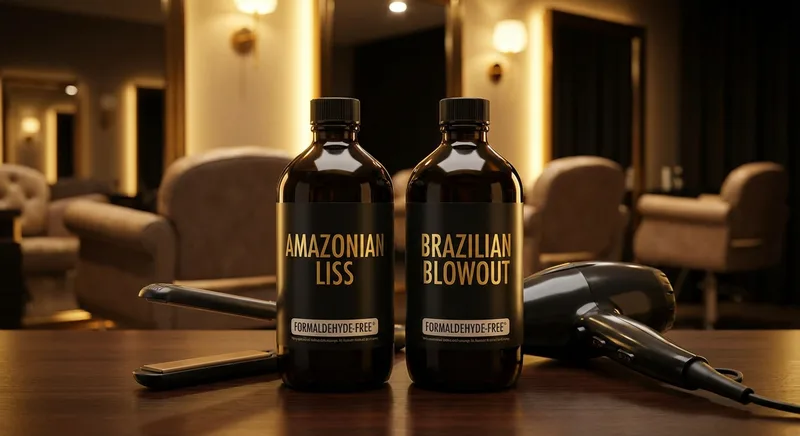
The Brazilian Blowout hair smoothing treatment was labeled "FORMALDEHYDE FREE" in capital letters. Independent laboratory testing found that it contained between 6% and 12% formaldehyde. The legal limit for cosmetic products is 0.2%.
The product that said it had no formaldehyde contained 30 to 60 times the legal limit of formaldehyde. This is not a rounding error. This is not a trace amount that a sensitive test detected. This is a product screaming "I'M FORMALDEHYDE FREE" while being more formaldehyde-rich than products that openly admit to containing formaldehyde.
Formaldehyde is a known carcinogen. The International Agency for Research on Cancer classifies it as a Group 1 carcinogen — the same classification as asbestos, tobacco smoke, and plutonium. It causes nasopharyngeal cancer. It causes leukemia. It irritates eyes, throat, and lungs. In high concentrations, it can cause chemical burns.
And it was in a hair treatment. Applied in enclosed salon spaces. Heated with flat irons, which released formaldehyde gas directly into the breathing zone of both the stylist and the client. The stylists — who performed multiple treatments per day, five days a week — were breathing industrial concentrations of a Group 1 carcinogen while the product label told them they weren't.
The label said formaldehyde free. The air said otherwise. The air was right.
The Vision: Smooth Hair Through Chemistry (Undisclosed Chemistry)
The Brazilian Blowout was a keratin hair-smoothing treatment that promised to eliminate frizz, reduce styling time, and produce sleek, straight, shiny hair for up to 12 weeks. The treatment was applied in salons: a liquid solution was worked through the hair, then sealed with a flat iron heated to approximately 450°F.
The heating step is where the chemistry gets criminal. Formaldehyde in solution exists in a bound form — methylene glycol — that releases formaldehyde gas when heated. The flat iron essentially vaporized the formaldehyde, filling the salon with carcinogenic fumes that stylists and clients inhaled directly.
OSHA measured formaldehyde levels in salons performing Brazilian Blowout treatments and found concentrations that exceeded workplace safety limits. Stylists reported burning eyes, nosebleeds, headaches, difficulty breathing, and chronic coughing. Some developed asthma. Some developed chemical sensitivities that prevented them from continuing to work in salons.
The manufacturer, GIB LLC, marketed the product as safe and "formaldehyde free" throughout this period. They argued that the product didn't contain formaldehyde per se — it contained methylene glycol, which they claimed was a different chemical. This is technically true in the way that ice and water are technically different states of matter. Methylene glycol IS formaldehyde in solution. When heated, it becomes formaldehyde gas. The distinction is chemical nomenclature, not safety.
The Glorious User Experience
Sara, Licensed Stylist from Los Angeles, CA — ★☆☆☆☆
"I did Brazilian Blowouts five to eight times a week for two years. My eyes burned every time. I wore a mask. The mask didn't help because the formaldehyde concentration was above what standard masks could filter. I developed a chronic cough that my doctor said was consistent with chemical irritant exposure. I was breathing carcinogens for two years while the product label — the label I trusted, the label I showed concerned clients — said 'formaldehyde free.' I was poisoning myself and my clients and the bottle told me I wasn't. One star."
Amanda from Chicago, IL — ★☆☆☆☆
"I got a Brazilian Blowout and my hair looked amazing. Absolutely incredible. Smooth. Shiny. Not a frizz in sight. Then I read the lab reports. Then I read the OSHA measurements. Then I realized my amazing hair was achieved by applying a carcinogen at 450°F six inches from my scalp while I breathed the fumes in an enclosed room. My hair was smooth because it was embalmed. I was getting morgue-quality styling at salon prices. One star."
“The product that said it had no formaldehyde contained 30 to 60 times the legal limit of formaldehyde”
Click to TweetDiane from Miami, FL — ★☆☆☆☆
"My stylist's eyes were red every time I came in for a touch-up. Every time. I asked her if she was okay. She said, 'It's just the product.' It was indeed just the product. The product that was labeled formaldehyde free. The product that contained 60 times the legal limit of formaldehyde. Her red eyes were her body reacting to a carcinogen that the label told her didn't exist. She has since stopped performing Brazilian Blowouts. She has not stopped coughing. One star."
Mark, Salon Owner from New York, NY — ★☆☆☆☆
"I pulled Brazilian Blowout from my salon the day the lab results went public. I had been offering this service for over a year. I had been exposing my stylists — my employees, people I am responsible for — to a known carcinogen for over a year because the manufacturer told me the product was formaldehyde free. I trusted the label. I shouldn't have needed to verify the label with independent lab testing. That's what labels are for. One star."
The Truth: $4.5 Million for Calling Formaldehyde 'Not Formaldehyde'
In 2012, GIB LLC settled a class-action lawsuit for $4.5 million over the mislabeling of Brazilian Blowout. The settlement covered consumers who purchased the treatment and were exposed to formaldehyde fumes despite being told the product was formaldehyde free.
The FDA issued a warning letter to GIB LLC in 2011, stating that Brazilian Blowout was misbranded because the label said "formaldehyde free" while the product contained formaldehyde. The FDA's own testing confirmed formaldehyde levels of approximately 8-12% — concentrations that were not just above the cosmetic limit but above levels found in some industrial applications.
Oregon OSHA, Canadian Health authorities, and multiple international regulatory agencies conducted their own testing and confirmed the findings. The product was pulled from shelves in several countries. In the U.S., it was reformulated but continued to be sold under the same brand name — a recurring theme in consumer products that should probably be more alarming than it is.
The "methylene glycol is not formaldehyde" argument that GIB used in their defense was rejected by every regulatory body that examined it. The FDA, OSHA, Health Canada, and the European Scientific Committee on Consumer Safety all stated that methylene glycol releases formaldehyde and should be treated accordingly.
The stylists — the front-line workers who breathed this chemical daily — received the least protection and bore the most exposure. A client sits for one treatment every three months. A stylist performs five to ten treatments per week. The cumulative exposure difference is staggering, and the stylists were the last to be informed that the product they were handling was mislabeled.
The Verdict
Brazilian Blowout is the beauty industry's most spectacular labeling lie — a product that contained 60 times the legal limit of a Group 1 carcinogen while advertising itself as free of that exact carcinogen. It exposed thousands of stylists to industrial levels of formaldehyde fumes in enclosed spaces. It used a chemical nomenclature technicality to argue that formaldehyde-in-solution wasn't formaldehyde, an argument that every regulatory body on Earth rejected.
Your hair looked great. Your lungs disagreed. The label lied. The air quality data told the truth. And somewhere between the flat iron and the formaldehyde, the beauty industry demonstrated that "free" is the most dangerous word on a product label when nobody is checking.
We rate it 1 out of 5 honest labels.
If you want smooth hair without inhaling carcinogens, see our alternatives below.
---
✅What to Buy Instead
Moroccanoil Treatment
Argan oil-based smoothing and shine without embalming fluid. The hair industry's proof that "smooth" doesn't require "carcinogenic."
Oribe Supershine Moisturizing Cream
High-end smoothing through hydration, not chemistry class. Your hair gets sleek. Your lungs get to keep functioning. Win-win.
Revlon One-Step Hair Dryer & Volumizer
Blow-dry and style at home for $30. No salon appointment. No formaldehyde fumes. No need to trust a label that might be lying to you.
Comments
Sign in or create an account to join the discussion.