
Cabbage Patch Snacktime Kids Doll: The Toy That Ate Children
A motorized chewing mechanism that couldn't tell the difference between plastic food and children's fingers, hair, and skin — recalled after one Christmas season
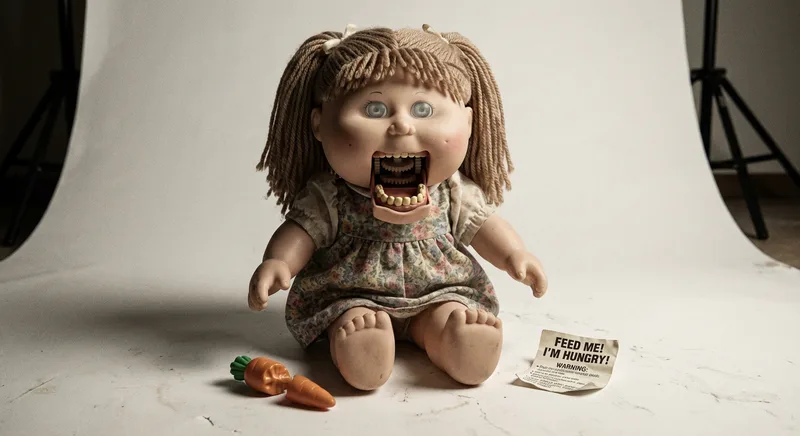
In 1996, Mattel released the Cabbage Patch Snacktime Kids — a doll with a motorized mouth that "chewed" and "ate" plastic food accessories. You inserted a french fry or a cookie-shaped piece of plastic into the doll's mouth, and the motorized mechanism pulled it in, simulating eating. Children would feed the doll. The doll would eat. Children and doll would bond over a shared love of plastic french fries.
The motorized mechanism had one feature and one flaw, and they were the same thing: the motor didn't stop. The chewing mechanism was a one-way roller that pulled anything placed in the doll's mouth inward. It pulled plastic food. It also pulled children's hair. And children's fingers. And anything else that came within range of the doll's insatiable, indiscriminate, motorized maw.
There was no off switch.
The doll's chewing mechanism was always active when a battery was inserted. There was no button to stop the motor. There was no reverse function. If a child's hair got caught in the doll's mouth — which happened because children hold dolls near their faces, because that is what children do with dolls — the motor would continue pulling hair into the mechanism, yanking it from the child's scalp with the steady, unstoppable force of a device that has no concept of pain, no awareness of screaming, and no off switch.
The CPSC received numerous reports of hair entanglement and finger injuries. Mattel voluntarily recalled the Snacktime Kids in January 1997 — after a single holiday season. The most anticipated toy of Christmas 1996 was being shipped back to Mattel by January 1997. The toy had the shortest retail lifespan of any major toy release in the 1990s, because the toy was eating children.
The Design Flaw: A Motor That Only Goes Forward
The Snacktime Kids mechanism was a rubber roller connected to a battery-powered motor. When activated by the insertion of food (or anything), the roller spun in one direction: inward. The roller gripped whatever was inserted and pulled it into the doll's backpack-mounted "stomach." Plastic food went in. The mechanism worked as intended.
When hair contacted the roller, the mechanism also worked as intended — which was the problem. The roller gripped the hair and pulled it inward with the same force and persistence it used on plastic food. The motor did not detect that it was pulling hair instead of food. It did not detect that a child was screaming. It did not detect anything, because it was a motor, and motors don't detect things. They spin.
The absence of an off switch was the fatal design choice. A parent whose child's hair was caught in the doll's mouth had to either wait for the hair to be pulled completely into the mechanism (painful and potentially injurious) or physically disassemble the doll's head to free the hair (difficult, stressful, and deeply alarming for the child whose hair was being eaten by a doll while their parent tried to decapitate it).
Some parents reported resorting to cutting the child's hair to free them from the doll. Others reported removing the doll's batteries by force. The experience of a child having their hair slowly pulled into a doll's mouth while their parent frantically tries to stop it is the kind of childhood memory that generates therapy appointments twenty years later.
The Christmas of 1996
The Snacktime Kids was one of the hottest toys of the 1996 holiday season. Parents fought to get them. Stores sold out. The demand was driven by the same impulse that drives all interactive doll sales: children want to nurture, feed, and care for their toys. A doll that eats is the logical next step after dolls that cry, drink, and wet.
“Children and doll would bond over a shared love of plastic french fries”
Click to TweetThe eating mechanism was the selling point. "Feed me!" the doll promised. Children fed it. The doll ate. Then the doll ate the wrong thing. And then parents who had spent weeks searching for the season's must-have toy were shipping it back to Mattel in a recall box, explaining to their crying children why the doll that ate french fries had to go away forever because it also ate hair.
The Snacktime Kids recall is one of the most memorable in toy history — not because of the scale (approximately 500,000 units) but because of the visceral horror of the failure mode. A doll. Eating a child's hair. While the child screams. And the motor doesn't stop. The image is unforgettable, which is why the Snacktime Kids appears on every "worst toys ever" list and has become a cautionary tale about what happens when product designers add motorized components to children's toys without adequate safety mechanisms.
The Fix That Should Have Been the Design
The fix was obvious: an off switch. Or a reverse button. Or a clutch mechanism that released when resistance exceeded a threshold. Or a pressure sensor that stopped the motor when the input force exceeded what plastic food would produce. Any of these features would have prevented the hair entanglement incidents. None were included.
Mattel's solution was the recall — not a redesign. The Snacktime Kids was never re-released. The motorized eating mechanism that made the doll special was also the mechanism that made it dangerous, and there was apparently no version of the design that could eat plastic food without also eating children.
Modern interactive dolls — like Baby Alive's feeding dolls — use non-motorized mechanisms or dramatically reduced motor force with safety cut-offs. The Snacktime Kids was a lesson the toy industry absorbed: if you put a motor in a toy near a child's face, the motor needs to know when to stop.
The Verdict
The Cabbage Patch Snacktime Kids is the toy that ate children. Not metaphorically. Not as a marketing slogan. The toy's motorized mouth grabbed children's hair and fingers and pulled them inward with an unstoppable motor that had no off switch, no reverse, and no awareness that it was consuming the child it was designed to entertain.
It lasted one Christmas. It generated one recall. It produced approximately 500,000 units of what can only be described as a battery-powered child-eating mechanism disguised as a Cabbage Patch Kid.
The toy was supposed to eat plastic french fries. It ate everything else too. The motor didn't know the difference. The children did.
We rate it 1 out of 5 uneaten children.
If your child wants a feeding doll that doesn't feed on children, see our alternatives below.
---
✅What to Buy Instead
Baby Alive Magical Mixer Baby
Modern feeding doll with a safe, non-motorized mechanism. Food goes in. Hair stays out. The lesson of 1996, applied.
Melissa & Doug Mine to Love
Classic soft baby doll with zero mechanical parts. Nurturing play through imagination, not motors. Cannot eat anything, including children.
American Girl Bitty Baby
Premium quality nurturing doll. Doesn't chew. Doesn't eat. Doesn't consume children. A higher standard of doll behavior.
Comments
Sign in or create an account to join the discussion.