
Colgate Kitchen Entrees: The Toothpaste Company That Made Frozen Dinners and Accidentally Destroyed Both Product Lines
Imagine opening your freezer and seeing 'Colgate Beef Lasagna.' Now imagine eating it. Now imagine tasting toothpaste. Now imagine never buying Colgate toothpaste again.
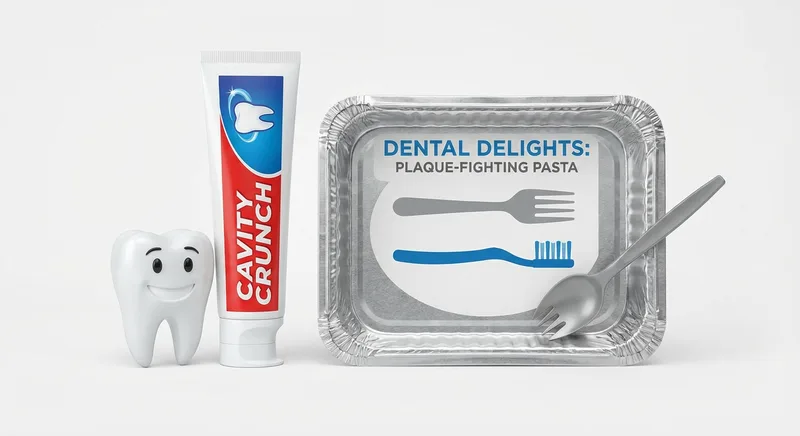
In the early 1980s, Colgate-Palmolive — the company you know exclusively as the maker of toothpaste, dish soap, and products that clean things — decided to enter the frozen dinner market. Colgate Kitchen Entrees were real. They were produced. They were placed in freezer sections. Next to Stouffer's. Next to Lean Cuisine. Next to products made by companies that do not make toothpaste.
This is, without exaggeration, the worst brand extension in the history of marketing. It is studied in every business school on Earth as the definitive example of what happens when a brand stretches into a category that its identity cannot support. It is in the Museum of Failure — a real museum in Sweden dedicated to failed products — where it sits alongside New Coke and the Juicero as a monument to corporate delusion.
The problem was not the food. Nobody remembers what the food tasted like, because nobody bought enough of it to find out. The problem was the name. The name was Colgate. On food. In a freezer. And the human brain, upon encountering the word "Colgate" on a frozen dinner, does not think "dinner." It thinks "toothpaste." And once you think "toothpaste," you cannot eat the dinner, because your brain has already decided the lasagna tastes like Colgate, and there is no reversing this decision, and you are now standing in a grocery store looking at Colgate Beef Lasagna and tasting mint.
This is the phenomenon known as "brand incongruence" — the psychological rejection that occurs when a brand appears in a category that contradicts its established identity. Colgate = clean teeth. Clean teeth ≠ beef lasagna. The brand's strength in oral care was its weakness in food. The more people trusted Colgate for toothpaste, the more they distrusted Colgate for dinner.
And then it got worse: Colgate Kitchen Entrees didn't just fail in the frozen food aisle. They DECREASED SALES OF COLGATE TOOTHPASTE. The brand extension was so incongruent that it damaged the core product. People who had previously purchased Colgate toothpaste without thought were now associating Colgate with frozen beef and feeling queasy about putting the brand in their mouths. The frozen dinners made the toothpaste less appetizing, which is an achievement of negative synergy that no MBA student could have predicted and no marketing textbook can adequately explain.
Colgate tried to sell you dinner and accidentally made you not want to brush your teeth. This is anti-marketing. This is marketing in reverse. This is a brand extension that retracted the brand.
The Vision: "We're Already in Your Home, Why Not Your Mouth?"
Wait. Colgate was already in people's mouths. That was the problem. The brand was IN MOUTHS. Toothpaste goes in mouths. Frozen dinners go in mouths. The same mouths. And the human brain could not reconcile "I brush my teeth with this brand" and "I eat dinner by this brand" without experiencing a form of psychological nausea that marketing academics now call "brand dilution" and the rest of us call "Why does my lasagna taste like Total Advanced Whitening?"
The theory behind Colgate Kitchen Entrees was that Colgate was a trusted household name with high brand recognition. If people trusted Colgate in the bathroom, maybe they'd trust Colgate in the kitchen. This theory ignored the fact that trust is contextual. You trust your dentist with your teeth. You do not trust your dentist with your dinner. These are different trusts. They do not transfer. The dentist should stay in the dental office. Colgate should stay in the toothpaste aisle.
The Glorious User Experience
Nobody, 1982 — ★☆☆☆☆
"I didn't buy this. I want to be clear: I didn't buy this. Nobody I know bought this. I have never met a human being who bought Colgate frozen dinners. I have met people who SAW them in the freezer aisle and experienced what I can only describe as 'existential grocery confusion' — the moment when reality fractures slightly because you're looking at a toothpaste company's beef entrée in the same freezer as your Hot Pockets. One star for a product I'm not sure actually existed outside of marketing textbooks."
Every MBA Student Since 1985 — ★☆☆☆☆
"This is in every case study. Every textbook. Every brand management lecture. When professors need to explain brand extension failure, they show Colgate Kitchen Entrees. When students need to understand why a toothpaste brand can't sell lasagna, they study Colgate Kitchen Entrees. This product has educated more business students than it fed consumers. Its value is pedagogical, not culinary. One star."
“They were placed in freezer sections”
Click to TweetAnonymous Colgate Marketing Executive (Retired) — ★☆☆☆☆
"I was there. I don't want to talk about it. We tested the concept. We tested the recipes. We tested the packaging. We didn't test the only thing that mattered: whether humans could eat food with 'Colgate' written on it without tasting toothpaste. We didn't test that because it seemed impossible that brand association could override actual flavor. We were wrong. The brand was stronger than the beef. The toothpaste was stronger than the tomato sauce. One star."
Museum of Failure, Helsingborg, Sweden — ★★★★★
"Five stars. The Colgate Kitchen Entrees display is one of our most popular exhibits. Visitors stand in front of the packaging, read 'Colgate' on a frozen dinner, and make a face. The same face. Every visitor. The face that says 'my mouth just tasted toothpaste and I'm looking at lasagna.' It's Pavlovian. The brand conditioning is so strong that even a photograph of Colgate on a dinner triggers oral-hygiene associations. This is the power of branding. This is also the limit of branding. Five stars for the exhibit. Zero stars for the product."
The Truth: The Brand Extension That Retracted the Brand
Colgate Kitchen Entrees lasted less than a year. The products were withdrawn from stores. The frozen dinner line was erased from Colgate-Palmolive's history — the company does not acknowledge it in their official timeline, which is the corporate equivalent of pretending a relationship never happened.
The damage to toothpaste sales was temporary but real. Once the frozen dinners were discontinued and the association faded, Colgate toothpaste recovered. But the episode demonstrated a principle that the company had learned at great expense: brand trust is category-specific. People trusted Colgate for oral care. Extending that trust to food created a contamination effect that flowed backward — from food to toothpaste — and made both products worse.
The Museum of Failure, which opened in 2017, features original Colgate Kitchen Entrees packaging as one of its marquee exhibits. The museum's founder, Samuel West, has noted that the Colgate display consistently produces the strongest reactions from visitors — stronger than the failed Google Glass, stronger than the Juicero, stronger than any other exhibit. Because the dissonance between "Colgate" and "dinner" is universal, immediate, and slightly nauseating.
The Verdict
Colgate Kitchen Entrees is the Platonic ideal of brand extension failure — the purest possible example of a brand entering a category it should not have entered, failing immediately, and damaging its core business in the process. Colgate made toothpaste. They tried to make dinner. They made people not want toothpaste.
The lesson is simple: stay in your lane. If your lane is oral hygiene, make oral hygiene products. If your lane is frozen dinners, make frozen dinners. If you are in the oral hygiene lane and you swerve into the frozen dinner lane, you will crash into the median of brand incongruence and both lanes will be closed for repairs.
Colgate Beef Lasagna. Say it out loud. Taste the mint. That's the whole review.
We rate it 1 out of 5 appropriate brand extensions.
If you want frozen dinners from companies that make food, see our alternatives below.
---
✅What to Buy Instead
Amy's Organic Frozen Meals
Organic frozen dinners from a company that makes frozen dinners. Not toothpaste. The brand and the product agree on what they are.
Trader Joe's Frozen Meals
Affordable, quality frozen meals from a grocery brand — an appropriate brand extension, not a confusing one.
Colgate Total Toothpaste
What Colgate should have stuck with. Makes your teeth clean. Does not make your freezer confusing. Stay in the lane, Colgate.
Comments
Sign in or create an account to join the discussion.