
The Coolest Cooler: How $13 Million in Kickstarter Money Bought 20,000 People Absolutely Nothing
The portable party disguised as a cooler that was actually a Ponzi scheme disguised as a portable party
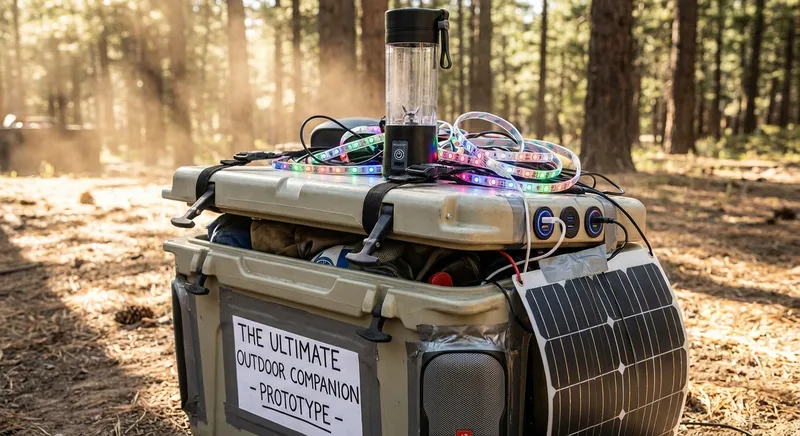
In the summer of 2014, a man from Portland, Oregon named Ryan Grepper asked the internet for $50,000 to build a cooler. Not a normal cooler, mind you. The Coolest Cooler was going to have a built-in blender, a waterproof Bluetooth speaker, a USB charger, a bottle opener, LED lights, and a cutting board. It was a beach party compressed into a box on wheels.
The internet gave him $13,285,226.
Sixty-two thousand people looked at a cooler with a blender in it and said, "Yes. Here is my money. I trust this man from Portland to revolutionize the concept of keeping beverages cold." It became the most-funded Kickstarter campaign of 2014. Time covered it. Forbes covered it. The Today Show covered it.
Five years later, 20,000 of those backers had received nothing — no cooler, no blender, no Bluetooth speaker, no apology that could possibly be adequate. They received, instead, a $20 settlement check and an email blaming the trade war with China. Twenty dollars. For a product they'd paid $185 for. Five years earlier.
Kickstarter's largest failure wasn't a technology company or a video game or a gadget. It was a cooler. A box that keeps things cold. Humanity's oldest portable technology, improved with buzzwords and destroyed by hubris.
The Vision: A Cooler So Cool It Had a Blender
Let's be fair to the Coolest Cooler for a moment, because the concept was genuinely appealing. Picture yourself at a tailgate, a beach party, a backyard barbecue. You want cold drinks. You want music. You want a blended margarita. Normally, this requires a cooler, a Bluetooth speaker, and a blender — three separate things, three separate purchases, three separate things to carry.
Ryan Grepper said: what if one thing?
It was the kind of idea that sounds brilliant after three margaritas and slightly less brilliant after zero margaritas, which may explain why it raised $13 million from people who were, statistically speaking, probably at a barbecue when they backed it.
The first Kickstarter campaign, in November 2013, actually failed. It didn't hit its $125,000 goal. Grepper relaunched in July 2014 — peak summer, peak cooler-desire season — and the timing worked. The campaign exploded. Media coverage drove more backers. More backers drove more media coverage. The cycle fed itself until sixty-two thousand people had pre-ordered a cooler from a man whose primary qualification was that he lived in Portland and owned a previous version of a cooler.
Backers paid $185 each and were promised delivery in February 2015. They did not receive delivery in February 2015.
The Glorious User Experience
Jason from Denver, CO — ★☆☆☆☆
"I backed this in August 2014. I am writing this review in 2019. I have not received a cooler. I have received forty-seven email updates, each one more creatively apologetic than the last. I've been told about manufacturing delays, motor strikes in China, shipping logistics, tariff increases, and at one point, I think Ryan Grepper blamed Mercury being in retrograde. I paid $185 for an email newsletter about failure. One star."
Megan from Austin, TX — ★☆☆☆☆
"After three years of waiting, they emailed me an 'opportunity' to pay an ADDITIONAL $97 for 'expedited delivery' of the cooler I'd already paid for. So let me understand: I gave you $185 three years ago, you haven't delivered my product, and your solution is to ask me for more money? This isn't a cooler company, this is a timeshare presentation."
Brian from Portland, OR — ★☆☆☆☆
"The truly infuriating part was when I discovered you could buy the Coolest Cooler on Amazon for $399 while I, a backer who funded its existence, was still waiting for mine. They were selling coolers to strangers while the people who literally made the company possible sat empty-handed. When backers started leaving one-star reviews on Amazon, Grepper publicly scolded us for hurting his sales. The man who took my money, didn't deliver my product, and sold my product to someone else was angry at ME. Incredible."
“It was a beach party compressed into a box on wheels”
Click to TweetLinda from Seattle, WA — ★☆☆☆☆
"I received my $20 settlement check in late 2019. Twenty dollars. I paid $185 five years ago for a cooler with a blender and a Bluetooth speaker and I received a check that wouldn't cover the cost of a regular cooler from Walmart. I cashed it at a liquor store and bought a bottle of wine, which I drank warm, alone, without music. This felt thematically appropriate."
The Truth: A Masterclass in Crowdfunding Catastrophe
The Coolest Cooler's descent from most-funded to most-failed is a timeline of increasingly desperate pivots and increasingly angry backers.
February 2015 was the promised delivery date. It came and went. Grepper cited "improvements and upgrades" as reasons for the delay, which is the product development equivalent of telling your dinner guests you're late because you were "perfecting the recipe" when you actually forgot to go grocery shopping.
The first coolers shipped in July 2015 — five months late — and by November, tens of thousands of backers had received theirs. But production costs had spiraled beyond what the $185 pledge price covered. Grepper admitted in 2016 that "we didn't set the pledge levels high enough to cover the final quality of the Coolest Cooler." Translation: the math never worked, and they launched anyway.
By March 2016, production had stopped entirely. Grepper announced he needed an additional $15 million to fulfill the remaining 36,000 orders. He'd raised $13 million and needed $15 million more. The cooler that was supposed to cost $185 to produce and ship apparently cost more than $185 to produce and ship, a fact that perhaps should have been discovered before taking sixty-two thousand people's money.
In April 2016, Grepper offered backers the option to pay an additional $97 for expedited shipping — asking people who had already paid and waited two years to pay again for the privilege of receiving what they'd already bought. Over 10,000 backers took the deal, which speaks to either extraordinary optimism or the sunk cost fallacy operating at industrial scale.
Meanwhile, the Coolest Cooler was for sale on Amazon. Retail customers could buy it, receive it within days, and use it at their barbecue while Kickstarter backers refreshed their email hoping for a shipping notification. The Oregon Department of Justice opened an investigation after receiving 315 complaints. A settlement was reached in 2017.
The end came in December 2019, when Grepper emailed backers to announce that tariffs on Chinese imports had killed the company. The remaining 20,000 backers — one-third of the original total — would receive nothing except a $20 check under the Oregon DOJ settlement. Twenty dollars for a $185 pledge. A refund of roughly eleven cents on the dollar. Five years of waiting, culminating in the purchasing power of a sandwich.
The company held a "cyber week" sale days before the shutdown announcement, selling remaining inventory at deep discounts to people who were not Kickstarter backers. The last act of the Coolest Cooler was to sell its remaining products to strangers while its original supporters received a farewell email and a coupon for disappointment.
The Verdict
The Coolest Cooler is Kickstarter's original sin — the project that proved, at massive scale, that crowdfunding a product is not the same as buying a product. It is a $13 million lesson in the difference between a good idea and a viable business. It is proof that putting a blender in a cooler is easy, and manufacturing sixty-two thousand blender-coolers and shipping them worldwide is very, very hard.
Ryan Grepper wasn't a scammer in the traditional sense. He genuinely tried to build the thing. He just couldn't. And in the gap between "I have an idea" and "I have a supply chain," twenty thousand people lost their money and Kickstarter lost a significant portion of its credibility.
The saddest part? The coolers that were actually delivered reportedly worked fine. The blender blended. The speaker played music. The ice stayed cold. Somewhere out there, forty thousand people are having a perfectly good time with their Coolest Coolers, and twenty thousand people are having warm drinks in total silence.
We rate it 1 out of 5 delivered promises.
If you want a cooler that you can buy and then receive — a revolutionary concept — see our alternatives below.
---
✅What to Buy Instead
YETI Tundra 45
Virtually indestructible rotomolded cooler that keeps ice for days. No blender, no Bluetooth, no five-year wait. Just cold drinks when you want them.
Coleman Xtreme 5
Budget-friendly cooler with 5-day ice retention for under $50. It exists. You can buy it. It will arrive. These are its three best features.
RTIC 65 QT Hard Cooler
YETI-quality construction at half the price. If you want a blender and a speaker, buy them separately — they'll arrive faster.
Comments
Sign in or create an account to join the discussion.