
Creepy Crawlers Oven: The Easy-Bake for Boys Except It Burned Children and the Fumes Were Toxic
A 1960s toy that gave children access to a hot plate heated to 300°F and a substance called 'Plastigoop' that nobody should have been allowed to name, let alone inhale
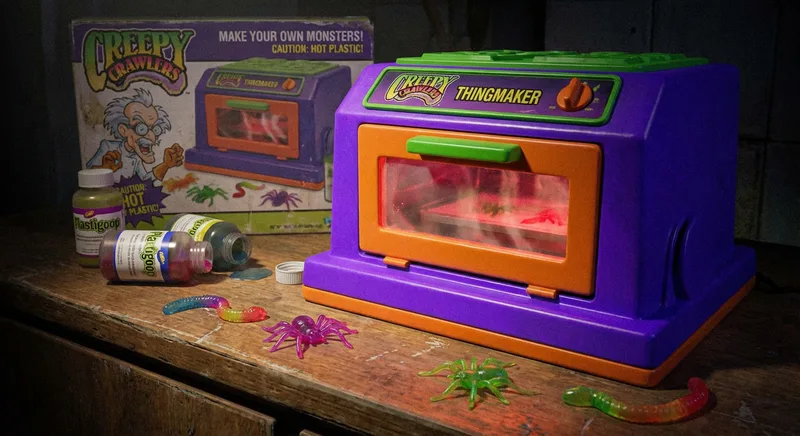
In 1964, Mattel looked at the Easy-Bake Oven — a toy that let girls bake miniature cakes using a lightbulb — and thought: "What if we made the boy version? But instead of cakes, it makes rubber bugs. And instead of a lightbulb, it uses a 300°F hot plate. And instead of cake batter, it uses a liquid polymer that emits fumes when heated."
This product was the Creepy Crawlers Thingmaker, and it was given to children.
The Thingmaker was an open-face electric hot plate — no enclosure, no safety guard, no barrier between the child and a surface heated to approximately 300°F. You poured Plastigoop (this is what they called it — Plastigoop) into metal molds, placed the molds on the hot plate, waited for the Goop to cure into rubbery insect shapes, and then removed the 300°F metal mold with a pair of included tongs that a child's hands were absolutely not large enough or coordinated enough to operate safely.
The result: rubber bugs that were actually pretty cool. Also: burned fingers, burned arms, burned surfaces, and a kitchen filled with the fumes of heating liquid polymer that smelled like a combination of melting plastic and regret.
The 1960s were a different era for children's product safety. The CPSC didn't exist until 1972. The Thingmaker was legal, popular, and sold millions of units to children who were apparently expected to operate industrial heating elements with the dexterity and caution of a jeweler. Millions of these children burned themselves. Their parents shrugged, because it was the 1960s and children were expected to learn from pain.
The Vision: Hot Plate + Liquid Polymer + Child = Toy
The Creepy Crawlers concept was legitimately appealing. Children poured colored goop into bug-shaped molds, heated them until they solidified, and peeled flexible rubber insects from the molds. The bugs were detailed, colorful, and perfect for the purposes that children have always used rubber bugs for: putting them in their sister's bed, hiding them in their teacher's desk, and leaving them on the bathroom counter to alarm their mother.
The problem wasn't the concept. The problem was the implementation: a 300°F open hot plate with no safety mechanism, operated by children aged 6 and up, using a liquid polymer that was not designed for inhalation by developing lungs.
The metal molds conducted heat from the hot plate and retained it. A child removing a mold from the hot plate held, in their hands (via inadequate tongs), a piece of metal at 300°F. The mold needed to cool before the bug could be removed, but children — being children — did not wait. They touched the molds. They touched the hot plate. They spilled the Plastigoop on the hot plate, creating acrid fumes. They dropped the tongs. They learned about thermal physics the hard way.
The Legacy: Scars and Nostalgia
The original Creepy Crawlers Thingmaker is one of those products that adults remember with a combination of genuine fondness and genuine horror. It was fun. It was creative. It also burned virtually every child who used it, because it was a 300°F hot plate for six-year-olds.
The toy was updated multiple times over the decades:
- 1970s-80s: Modified versions with reduced temperatures and improved mold designs
- 1992: Toymax relaunched it with a light-bulb heating mechanism (similar to Easy-Bake), dramatically reducing burn risk
- 2000s: Further safety improvements eliminated the exposed heating element entirely
“And instead of a lightbulb, it uses a 300°F hot plate”
Click to TweetEach generation fixed the previous generation's safety failures, which is the correct trajectory but also an admission that the original product was, by modern standards, astonishingly dangerous. The 1964 Thingmaker would not survive five minutes of modern CPSC review. It would be recalled before the first mold heated up.
The nostalgia for the original Creepy Crawlers is a testament to how dramatically children's safety standards have changed. Adults who used the 1960s Thingmaker describe it with the same mix of affection and disbelief that veterans use for describing hazing rituals: "It was terrible. It hurt me. I loved it. I'm glad it's illegal now."
The Truth: A Product That Predated Its Own Regulation
The Creepy Crawlers Thingmaker was not recalled. It wasn't illegal at the time. The CPSC didn't exist until eight years after the product launched. The safety standards that would have prevented it from ever reaching shelves were written in response to products like it.
This is a pattern in children's product safety: the regulations follow the injuries. The CPSC was created because products like the Thingmaker existed. The safety standards were written because children were burned. The system is reactive — it prevents future harm by studying past harm, which means the first generation of children using a product are the test subjects.
The Creepy Crawlers oven is the founding product of modern toy safety. Not because it was safe, but because it demonstrated, through thousands of burned fingers, why safety standards were needed.
The Verdict
The Creepy Crawlers Thingmaker is a 1960s toy that gave children a 300°F hot plate and told them to make bugs. It was fun. It was creative. It burned everyone. The fumes were toxic. The product predated the regulatory body that would have prevented its existence.
Modern alternatives — the 3Doodler pen, Crayola Model Magic, and other no-heat craft tools — provide the same creative satisfaction without the thermal trauma. The Creepy Crawlers oven is a relic of an era when children's product safety was, essentially, "let them learn."
They learned. It hurt. The CPSC exists now.
We rate it 1 out of 5 unburned fingers.
If your child wants to make creepy crawly things without a 300°F hot plate, see our alternatives below.
---
✅What to Buy Instead
Crayola Model Magic
Air-dry modeling compound. Zero heat. Zero toxicity. Moldable into bugs, monsters, or whatever your child's imagination produces.
National Geographic Bug Catcher Kit
Catch REAL creepy crawlies safely. Bug vacuum, magnifying glass, and habitat. Better bugs than Plastigoop ever produced, and they're alive.
Comments
Sign in or create an account to join the discussion.