
Crystal Pepsi: The Clear Cola That Confused Everyone, Deteriorated in Sunlight, and Was Murdered by Coca-Cola Using a Kamikaze Product
Coca-Cola deliberately launched Tab Clear — a terrible product — specifically to kill Crystal Pepsi. Both died. It was the carbonated equivalent of a murder-suicide.
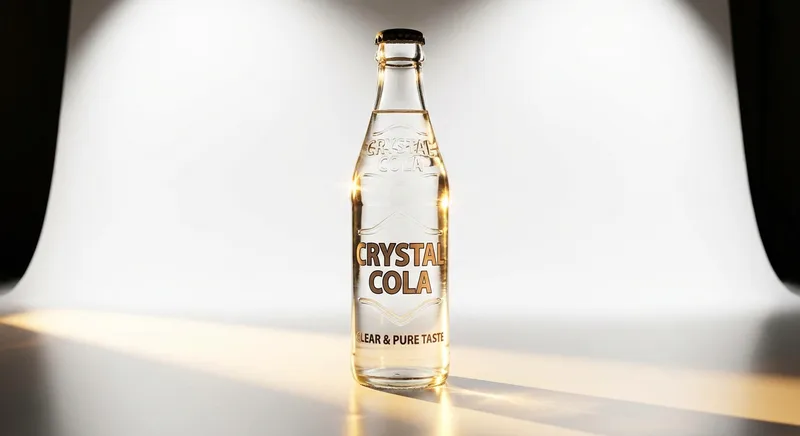
In 1992, PepsiCo asked a question that nobody was asking: "What if cola, but you could see through it?"
The answer to this question was Crystal Pepsi — a clear, caffeine-free cola that tasted approximately like Pepsi that had been left in a glass near an open window where the flavor gradually escaped. It was cola-flavored water. It was Pepsi that had lost its confidence. It was the beverage equivalent of a person who shows up to a costume party without a costume — technically present, visually confusing, fundamentally missing the point.
Crystal Pepsi launched with a Super Bowl commercial set to Van Halen's "Right Now." It was positioned as a pure, natural, clear alternative in an era when "clear" was a marketing virtue — clear deodorant, clear dish soap, clear shampoo. The logic was: clear equals clean equals healthy equals good. The logic did not account for the fact that cola is not supposed to be clear, in the same way that steak is not supposed to be translucent and pizza is not supposed to be invisible.
The product debuted to $474 million in first-year sales, driven by curiosity. Then people tasted it. Then they tasted it again to make sure. Then they didn't buy it again.
Crystal Pepsi was discontinued within a year. But the story doesn't end there. The story ends with Coca-Cola committing a premeditated act of corporate sabotage so elegant and so ruthless that it deserves its own article, but we'll fit it in here because it is the single greatest act of competitive destruction in beverage history.
The Murder: Tab Clear
When Crystal Pepsi launched, Coca-Cola's chief marketing strategist, Sergio Zyman, recognized that the product was vulnerable — not because it was bad (though it was), but because it was a clear cola, and clear colas were confusing to consumers. Zyman's plan was not to compete with Crystal Pepsi. His plan was to kill it. Using a product designed to die.
Coca-Cola launched Tab Clear — a clear version of their Tab diet soda — in December 1992. Tab Clear was not designed to succeed. It was designed to fail in a way that dragged Crystal Pepsi down with it. The strategy: by flooding the market with a second clear cola (one that was explicitly diet and explicitly terrible), Coca-Cola would confuse consumers about what clear colas were. Were they diet? Were they regular? Were they cola? Were they water? Nobody would know. The category would collapse. Both products would die. Crystal Pepsi would die first.
This is exactly what happened. Tab Clear was terrible. Consumers couldn't tell clear colas apart. The category became a joke. Tab Clear was discontinued in six months. Crystal Pepsi was discontinued shortly after. Coca-Cola had sacrificed a product — deliberately created a bad product — to kill a competitor's product. It was the carbonated equivalent of jumping on a grenade, except the grenade also exploded the other guy.
Sergio Zyman later described this strategy openly. He called it a kamikaze mission. The word he used was "kamikaze." A senior Coca-Cola executive used a World War II military term to describe a soda launch. This is the beverage industry.
The Glorious User Experience
Todd from Dallas, TX — ★☆☆☆☆
"Crystal Pepsi tasted like someone described Pepsi to a person who had never tasted Pepsi and then that person made a cola from the description. It was Pepsi-adjacent. Pepsi-approximate. It was in the neighborhood of Pepsi but refused to knock on the door. The flavor existed in a space between 'cola' and 'nothing' that I didn't know existed and wish I could forget. One star."
Amanda from Chicago, IL — ★☆☆☆☆
"I drank Crystal Pepsi in 1993. My brain said 'this looks like water.' My tongue said 'this tastes almost like cola.' The cognitive dissonance between my eyes and my mouth created a confusion that I can only describe as flavor gaslighting. The drink was telling me it was cola while my eyes told me it was not cola and my taste buds sided with my eyes. I was being lied to by a beverage. One star."
“It was Pepsi that had lost its confidence”
Click to TweetMike from Seattle, WA — ★☆☆☆☆
"Crystal Pepsi deteriorated in sunlight. Like a vampire. The clear liquid turned brown when exposed to UV light, which meant if you left it on a table near a window, it slowly transformed back into regular Pepsi, as if the formula was trying to return to its natural state. The cola WANTED to be brown. The clearness was an illusion that sunlight exposed. Your Pepsi had a secret identity and the sun was a whistleblower. One star."
Karen from Denver, CO — ★☆☆☆☆
"I bought Crystal Pepsi once. My husband bought Tab Clear once. We were the clear-cola household for exactly one shopping trip. By the second sip of each, we understood that 'clear cola' was a category that should not exist, and that two different companies had independently arrived at the same wrong answer. One product was terrible on purpose and one was terrible by accident, and we couldn't tell which was which. This was, apparently, Coca-Cola's plan. One star for the brilliance of the sabotage. Zero stars for the beverage."
The Truth: A Product Killed by Its Own Category
Crystal Pepsi's failure was not purely a taste issue — initial sales were strong, and some consumers genuinely liked the flavor. The failure was conceptual: "clear cola" is an inherent contradiction. Cola's identity is brown. The caramel color is as much a part of cola as the carbonation and the sweetness. Removing the color removed the identity, and what remained was a product that didn't know what it was.
The product was revived briefly in 2016 and again in 2022, both times as limited-edition nostalgia runs. These revivals confirmed what the 1990s had already proven: people were curious about Crystal Pepsi, willing to try Crystal Pepsi, and unwilling to drink Crystal Pepsi regularly. The curiosity was the product's ceiling. "I want to try it" does not convert to "I want to drink it every day." It converts to "I tried it. I understand now. I'm good."
Crystal Pepsi's legacy is threefold: (1) it taught the beverage industry that color is identity; (2) it produced one of the great Super Bowl commercials of the '90s; and (3) it was assassinated by Coca-Cola using the most cold-blooded competitive strategy in corporate history, which Coca-Cola openly bragged about afterward.
The Verdict
Crystal Pepsi was a clear cola that answered a question nobody asked, tasted like Pepsi's ghost, deteriorated in sunlight like a vampire, and was deliberately killed by Coca-Cola using a kamikaze product launched for the sole purpose of destroying the clear-cola category.
It is the most murdered beverage in history. It didn't just fail — it was assassinated. By a company that created a product specifically to die alongside it. In the cola wars, Crystal Pepsi wasn't a battle. It was a hit.
If you want a clear, refreshing beverage, water exists. If you want Pepsi, Pepsi exists. If you want both simultaneously, you want something that nature and chemistry agree should not exist, and Crystal Pepsi proved them right.
We rate it 1 out of 5 visible colas.
If you want a refreshing beverage that knows what it is, see our alternatives below.
---
✅What to Buy Instead
LaCroix Sparkling Water
Clear, refreshing, bubbly — without pretending to be cola. Knows what it is. Doesn't deteriorate in sunlight. Doesn't have a secret brown identity.
Olipop Vintage Cola
Prebiotic soda with actual cola taste and gut-health benefits. Brown. As cola should be. A genuine cola upgrade rather than a color experiment.
Regular Pepsi
If you want Pepsi, just drink Pepsi. It works because it's brown. The brownness is the feature. Pepsi figured this out the hard way.
Comments
Sign in or create an account to join the discussion.