
Ed Hardy Clothing: The Official Brand of People Your Mother Warned You About
Tattoo-print bedazzled shirts that made you look like you'd lost a fight with a rhinestone gun in a tattoo parlor — the cultural backlash essentially killed the brand
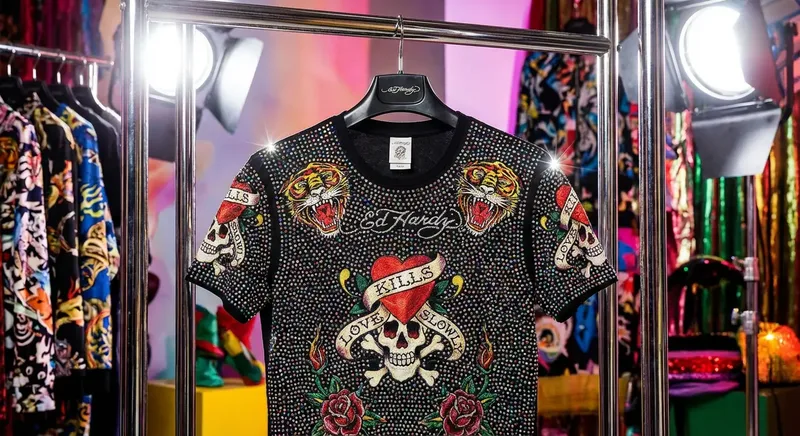
Ed Hardy shirts were what happened when someone looked at a tattoo, looked at a rhinestone, and decided the world needed both on a $90 t-shirt that screamed from across a nightclub with the subtlety of a car alarm.
The shirts featured tattoo-inspired designs — skulls, tigers, eagles, roses, crosses, daggers, and flames — screen-printed in vivid color and then embellished with rhinestones, metallic foil, and embroidery. Each shirt was a small, wearable art museum of aggressive imagery, decorated with enough sparkle to be visible from low Earth orbit. Wearing an Ed Hardy shirt communicated, simultaneously: "I am a person who likes tigers," "I am a person who likes rhinestones," and "I am a person who makes decisions that concern my family."
The brand peaked between 2007 and 2009 — the same cultural moment that produced Affliction, Tapout, and the broader "MMA-adjacent aggressive menswear" category that dressed a generation of men in bedazzled skulls and tribal patterns. Ed Hardy was the most commercially successful of these brands, generating over $700 million in annual revenue at its peak.
Then Jon Gosselin started wearing it.
Jon Gosselin — of Jon & Kate Plus 8, the reality TV show about a couple with eight children and a relationship that deteriorated on camera — became the unofficial face of Ed Hardy after his divorce, when he was photographed repeatedly in Ed Hardy shirts while clubbing in Atlantic City. Jon Gosselin in an Ed Hardy shirt became the image that killed the brand — the personification of everything the cultural backlash was reacting against: a suburban dad trying to rebrand himself as edgy through the purchase of rhinestoned tiger shirts.
The brand did not recover. It could not recover. Once a product is associated with a specific cultural archetype — in this case, "the guy at the club who thinks his shirt makes him interesting" — the association becomes the brand. Ed Hardy was no longer a clothing line. It was a punchline. And the punchline was: "You're wearing Ed Hardy."
The Glorious User Experience
Brett from Scottsdale, AZ — ★☆☆☆☆
"I owned four Ed Hardy shirts. I wore them to clubs. I felt like a KING. I had skulls. I had eagles. I had a tiger with rhinestone eyes that reflected the club lights. I was visible from every angle. I was the brightest object in the room that wasn't a light fixture. Then I saw a photo of myself from that era and experienced a feeling that I can only describe as retroactive shame — shame that travels backward through time and contaminates the memory of every night I wore those shirts. I felt great THEN. I feel attacked NOW. One star in hindsight."
Ashley from Miami, FL — ★☆☆☆☆
"My boyfriend wore Ed Hardy. I should have seen the signs. The rhinestones were the signs. The tattoo of a panther on a t-shirt was a sign. The foil-embossed skull with flaming eyes was a sign. Every element of his wardrobe was a warning label written in rhinestones and I ignored them all because I was 23 and the club was dark and the skulls sparkled differently in low light. One star."
Dave from Las Vegas, NV — ★☆☆☆☆
“Each shirt was a small, wearable art museum of aggressive imagery, decorated with enough sparkle to be visible from low Earth orbit”
Click to Tweet"Ed Hardy in Vegas was EVERYWHERE. Every club. Every pool party. Every man who thought his shirt was a personality. The density of rhinestoned tigers per square foot at Marquee in 2008 would have been visible from space. We weren't men. We were a constellation of bedazzled predatory animals walking upright and ordering bottle service. One star."
Jon Gosselin (Personified by Collective Memory) — ★☆☆☆☆
"I did not kill Ed Hardy. Ed Hardy was already dying. I was simply the last person photographed wearing it before the public decided it was over. I was the pall bearer. The shirt was already in the casket. I just... happened to be wearing it. One star because the shirts were comfortable and the rhinestones caught the light in Atlantic City."
The Truth: From Don Ed Hardy to Death by Association
The irony of Ed Hardy clothing is that Don Ed Hardy — the actual person — is a legitimate American tattoo artist whose work is respected in the art world. His designs are genuine art. Christian Audigier, the fashion entrepreneur who licensed Hardy's name and images, is the person who added the rhinestones, the foil, the embroidery, and the aggressive marketing that turned a tattoo artist's portfolio into a $700 million fashion brand and then into a punchline.
The brand's collapse illustrates the concept of "brand death by cultural association." Ed Hardy didn't fail because the shirts fell apart (they didn't) or because the designs were poorly executed (they were well-made). Ed Hardy failed because the shirts became associated with a specific archetype that the broader culture rejected. The archetype: the aggressively-branded, rhinestone-wearing, bottle-service-ordering, reality-TV-adjacent man who uses his clothing as a substitute for personality.
When a brand becomes a joke, recovery is nearly impossible. The joke is stronger than the product. The association is stronger than the quality. Nobody evaluates an Ed Hardy shirt on its merits anymore. They evaluate it on its cultural meaning, and the meaning is: "This person watched too much VH1 in 2008."
The Verdict
Ed Hardy shirts were $90 tattoo-print bedazzled t-shirts that dressed a generation of men in rhinestoned tigers and foil-embossed skulls during a cultural moment that history has judged harshly, accurately, and repeatedly. The shirts made you visible. The shirts made you memorable. The shirts made you the person your mother warned you about.
Don Ed Hardy deserved better. His art was real. The rhinestones were not his idea. The cultural collapse was not his fault. But the brand that bore his name became the definitive fashion casualty of the late 2000s — killed not by quality but by association, not by design but by the men who wore the designs, and not by Jon Gosselin specifically but by the energy that Jon Gosselin photographed in Ed Hardy at an Atlantic City nightclub embodied so completely.
We rate it 1 out of 5 subtle fashion choices.
If you want bold casual wear that won't haunt your future self, see our alternatives below.
---
✅What to Buy Instead
Faherty Brand
Premium casual wear with subtle prints and quality fabrics — bold without being obnoxious. Your shirt says "good taste" not "I peaked in 2008."
Patagonia
Makes a statement about the environment, not about your relationship with Monster Energy and nightclubs. A shirt that says something worth saying.
Buck Mason Tees
Clean, well-made basics that age gracefully — unlike Ed Hardy shirts, which aged like milk in a nightclub.
Comments
Sign in or create an account to join the discussion.