
Fisher-Price Rock 'n Play Sleeper: The Infant Sleeper So Deadly It Had to Be Recalled Twice
Approximately 100 infant deaths. 4.7 million units recalled. An inclined design that caused suffocation. And a product that had to be re-recalled in 2023 because people were still using it.
This article is different from our others. There are no funny fake reviews. There are no comedic metaphors. Approximately 100 infants died.
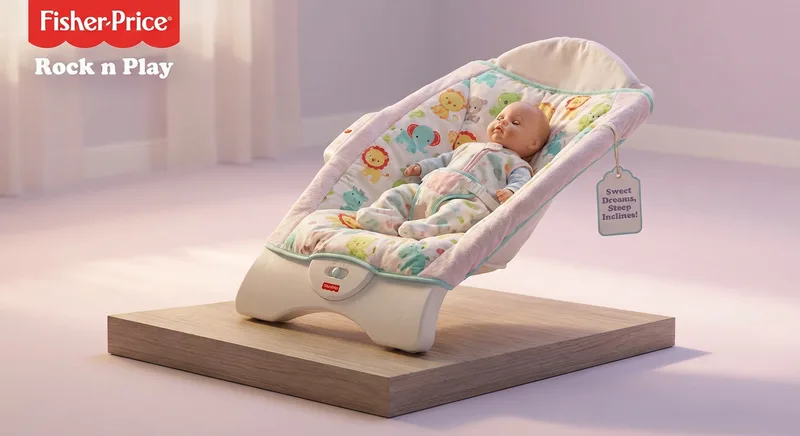
The Fisher-Price Rock 'n Play Sleeper was an inclined infant sleeper — a padded seat angled at approximately 30 degrees that rocked gently and was marketed as a place for babies to sleep. Parents trusted it because it bore the Fisher-Price name, because it was sold at every major retailer in America, and because it appeared to solve one of the most exhausting challenges of new parenthood: getting a baby to sleep.
The inclined angle was the feature. It was also the flaw. Babies placed in the Rock 'n Play could roll or shift in their sleep, and the inclined position combined with the soft padding created conditions where an infant's airway could become obstructed. Infants cannot reposition themselves when their breathing is compromised. The design that was supposed to help babies sleep helped some babies stop breathing.
The Consumer Product Safety Commission (CPSC) and Fisher-Price recalled 4.7 million Rock 'n Play units in April 2019, after reports linking the product to over 30 infant deaths. By the time of the recall, the actual death toll was believed to be significantly higher — subsequent reporting and legal filings brought the estimated total to approximately 100 infant deaths.
In 2023, Fisher-Price issued a second recall — a re-recall — because consumers were still using Rock 'n Play sleepers. Four years after the original recall, families still had the product in their homes, still used it for their babies, either unaware of the recall or unwilling to believe a product they trusted could be dangerous. The re-recall included instructions to destroy the product and send photographic proof of destruction to receive a refund.
A product so dangerous it had to be recalled. Then recalled again. Then photographically destroyed.
The Design Flaw: Incline + Infant = Danger
The American Academy of Pediatrics (AAP) has long recommended that infants sleep on a flat, firm surface — a crib or bassinet with a firm mattress and no soft bedding. This recommendation exists because inclined surfaces, soft surfaces, and surfaces that allow positional movement increase the risk of suffocation, positional asphyxia, and sudden infant death.
The Rock 'n Play violated these guidelines by design. Its 30-degree incline was the product's defining feature — the angle that created the rocking motion that soothed babies to sleep. It was also the angle that allowed babies to slump forward, chin to chest, in a position that restricted their airway.
Positional asphyxia in inclined sleepers occurs when a baby's head falls forward, compressing the trachea. Infants under six months lack the muscle strength to reposition themselves. The inclined, padded design that made the Rock 'n Play comfortable also made it capable of suffocating the infants placed in it.
Fisher-Price marketed the Rock 'n Play for infant sleep. The AAP recommended flat surfaces for infant sleep. These positions were incompatible. Fisher-Price sold 4.7 million units before the incompatibility was resolved through recall rather than through design.
The Regulatory Failure
The Rock 'n Play was sold from 2009 to 2019 — a decade of availability during which approximately 100 infants died. The product met existing safety standards at the time of its sale because, remarkably, there was no federal safety standard specifically governing inclined infant sleepers. The product existed in a regulatory gap.
“The Fisher-Price Rock 'n Play Sleeper was an inclined infant sleeper — a padded seat angled at approximately 30 degrees that rocked gently and was marketed as a place for babies to sleep”
Click to TweetIn 2022, the CPSC finalized the Safe Sleep for Babies Act, which established federal safety standards requiring infant sleep products to have a sleep surface angle of 10 degrees or less. This standard effectively bans inclined sleepers like the Rock 'n Play. The standard exists because of the deaths. It did not exist before the deaths. Approximately 100 infants died in the gap between "this product exists" and "this product is regulated."
The CPSC, investigative journalism (particularly Consumer Reports), and parent advocacy groups spent years pushing for the recall. Fisher-Price and its parent company Mattel initially resisted, noting that deaths occurred when the product was used contrary to instructions (without the restraint harness, with additional bedding, or with babies who had rolled over). This defense — that the product was safe when used exactly as instructed — placed the burden on exhausted new parents to use a product perfectly, every time, in the middle of the night, while sleep-deprived, for a product that was fundamentally designed in a way that contradicted safe sleep guidelines.
What Happened After
In 2024, a former Fisher-Price executive was criminally charged in connection with the Rock 'n Play — one of the first instances of individual criminal accountability for a consumer product safety failure of this magnitude. The charges alleged that the executive was aware of the risks and failed to act.
Fisher-Price has stated that consumer safety is their priority and that they cooperated with the CPSC throughout the recall process. Mattel has faced multiple lawsuits from families of infants who died in the Rock 'n Play.
The inclined sleeper category has been effectively eliminated by the Safe Sleep for Babies Act. Products like the Rock 'n Play can no longer be legally sold in the United States. The standard that would have prevented the product from reaching the market exists now, after the deaths that demonstrated why it was needed.
The Verdict
The Fisher-Price Rock 'n Play Sleeper is the most consequential product failure in the baby products industry. Approximately 100 infants died in a product that was sold for a decade, in a regulatory gap that didn't close until after the deaths occurred, by a company that bore one of the most trusted names in children's products.
The re-recall in 2023 — requiring consumers to photograph the destruction of the product — is an admission of the depth of the failure. The product was so dangerous that its continued existence, even in a closet, even in a garage, was considered a risk worth addressing four years after the original recall.
Parents trusted Fisher-Price. Fisher-Price sold a product that contradicted safe sleep science. Infants died. The regulatory gap closed. The product was banned. And the families who lost children to a product they bought at Target, in a box with the Fisher-Price logo, will carry that loss forever.
We do not rate this product with our usual humor. We rate it with the seriousness it demands.
If you need an infant sleep product, the AAP recommends a flat, firm surface. See our alternatives below.
---
✅What to Buy Instead
Graco Pack 'n Play
Flat, firm sleep surface meeting AAP safe sleep guidelines. The standard recommendation from pediatricians. No incline. No risk.
Halo BassiNest Swivel Sleeper
Bedside bassinet with a firm, flat surface and 360-degree swivel for easy nighttime access. Meets all safe sleep standards.
Newton Baby Crib Mattress
Breathable, washable crib mattress designed specifically for infant safety. Flat. Firm. Breathable. Everything the Rock 'n Play wasn't.
Comments
Sign in or create an account to join the discussion.