
The Flowbee: Someone Attached Razor Blades to a Vacuum Cleaner Hose and Called It a Haircut
Wayne's World parodied it. The internet memed it. Your uncle swears by it. And somewhere, a vacuum is eating someone's hair right now.
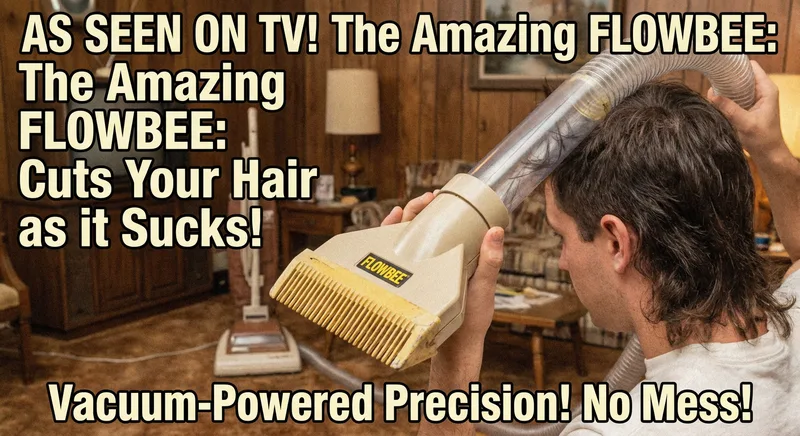
The Flowbee is a haircutting device that attaches to your household vacuum cleaner. The vacuum sucks your hair upward through a plastic spacer, and as the hair enters the spacer at the designated length, rotating blades trim it. Your vacuum cleaner — the appliance that removes dust, pet hair, and Cheerios from your carpet — becomes, with the addition of the Flowbee, the appliance that also cuts your hair.
The sentence "I cut my hair with my vacuum cleaner" should, in any rational society, prompt a wellness check. It should be followed by concerned questions from friends and family. It should result in someone gently suggesting that haircuts cost $20 at Supercuts and that perhaps the vacuum cleaner should return to its original function of cleaning floors rather than being repurposed as a barber.
And yet. The Flowbee has been sold since 1988. SINCE 1988. Thirty-seven years. The vacuum haircut device has been in continuous production for longer than the internet, longer than the iPhone, and longer than many marriages. Someone has been buying the Flowbee for thirty-seven years. Multiple someones. Enough someones to sustain a manufacturing operation for nearly four decades.
Wayne's World parodied it in 1992 with the "Suck Kut" — "It sucks as it cuts!" — and the Flowbee survived the parody. Being mocked in a globally released comedy film did not kill the Flowbee. Being the punchline of a joke watched by millions of people did not reduce sales enough to discontinue the product. The Flowbee is bulletproof. The Flowbee is the cockroach of As-Seen-On-TV. The Flowbee will outlive us all.
The Vision: What If Barber, but Vacuum?
The Flowbee was invented by Rick Hunts, a San Diego carpenter who — and this is real — was cutting wood with a power saw and noticed how the vacuum attachment sucked up sawdust evenly. He thought: "What if that, but hair?" The inventor of the Flowbee was inspired by a power saw and a shop vac. The Flowbee's origin story involves a man looking at industrial woodworking equipment and having a eureka moment about personal grooming.
The device uses interchangeable plastic spacers that set the cutting length — from 1/2 inch to 6 inches. The vacuum suction pulls hair taut and feeds it through the spacer at a consistent length, and the rotating blades trim the hair as it enters. In theory, this produces a uniform cut because each strand is pulled to the same length before being cut. In practice, the results depend on: the suction power of your vacuum, the consistency of your hair thickness, the speed at which you move the device, and your willingness to trust your appearance to an appliance whose primary job is removing crumbs from upholstery.
The Glorious User Experience
Everyone's Uncle, 1988-Present — ★★★★★
"I've used the Flowbee for twenty-three years. TWENTY-THREE YEARS. My hair looks fine. It looks the same every time. It takes seven minutes. I don't make appointments. I don't drive to a salon. I don't make small talk with a barber. I attach a plastic tube to my Dyson, I vacuum my own head, and I'm done. My wife hates it. My kids are embarrassed. My neighbors have seen me through the kitchen window vacuuming my head and have not spoken to me about it. I don't care. TWENTY-THREE YEARS. The Flowbee pays for itself in two haircuts. Everything after that is profit and the freedom of a man who does not need another human to cut his hair. Five stars."
Todd from Portland, OR — ★☆☆☆☆
"I tried the Flowbee. The vacuum sucked my hair up. The blades cut it. The result was a haircut that looked like it had been administered by a vacuum cleaner, because it had been administered by a vacuum cleaner. The cut was even — I'll give it that. It was evenly mediocre. Every strand was the same length, and the same length was the wrong length. I looked like I'd been groomed by an appliance, which I had. One star."
Sarah from Austin, TX — ★☆☆☆☆
"My husband used the Flowbee on our son. Our six-year-old. He vacuumed our child's head. The child screamed — not from pain, but from the experience of having a vacuum cleaner attached to his scalp, which is a sensory experience that no six-year-old is equipped to process calmly. The haircut was fine. The therapy bill may not be. One star."
“Your vacuum cleaner — the appliance that removes dust, pet hair, and Cheerios from your carpet — becomes, with the addition of the Flowbee, the appliance that also cuts your hair”
Click to TweetJason from Chicago, IL — ★★★☆☆
"Three stars because during COVID lockdowns, the Flowbee was VINDICATED. Barbers were closed. Salons were closed. The Flowbee was in my garage, waiting. Patiently. For thirty years. I laughed at the Flowbee. I mocked the Flowbee. And then the world shut down and the Flowbee was the only haircut available. I used it. It worked. It wasn't great. But it was a haircut, and in April 2020, a haircut was a miracle. Three stars for emergency preparedness."
Wayne Campbell (Wayne's World, 1992) — ★★★★★
"It certainly does suck."
The Truth: The Product That Can't Be Killed
The Flowbee's survival defies every law of consumer products. It has been mocked in a major motion picture. It has been the subject of thousands of jokes. It is universally recognized as a punchline. And it has been in continuous production for thirty-seven years because it WORKS — not well, not beautifully, not in a way that a professional hairstylist would endorse — but well enough for a specific demographic that values speed, savings, and independence over aesthetics and social approval.
The Flowbee's core demographic is: men who cut their own hair, don't care about style, and view barber visits as an unnecessary expense and social obligation. This demographic is large, loyal, and immune to mockery. They've heard every joke. They've seen Wayne's World. They don't care. Their hair is cut. Their vacuum is dual-purpose. Their lives are seven minutes more efficient than yours every three weeks.
During the COVID-19 pandemic, Flowbee sales surged. The product that had been a punchline for decades became a necessity when professional haircuts were unavailable. The Flowbee waited thirty years for its moment, and the moment was a global pandemic. This is either the greatest long-game marketing strategy in history or the most patient product ever manufactured.
The Verdict
The Flowbee is razor blades attached to a vacuum cleaner hose, and it has been cutting hair since before most of the products on this website existed. It was parodied by Wayne's World and survived. It was mocked by the entire internet and survived. It was pronounced dead by every trend forecaster and survived. It survived because some things are too weird to die and too functional to fail.
The Flowbee is not a good haircut. It is a haircut that doesn't require another person, a drive, an appointment, or a conversation. For the millions of people who value those four absences more than they value aesthetics, the Flowbee is not a punchline. It's a lifestyle.
Your uncle was right. Don't tell him.
We rate it 1 out of 5 salon-quality experiences (and 5 out of 5 uncles who won't stop talking about it).
If you want a home haircut without vacuuming your own head, see our alternatives below.
---
✅What to Buy Instead
Wahl Color Pro Plus Clippers
Professional-grade home clipper kit with color-coded guards for $25. Cuts hair without a vacuum. Revolutionary non-suction technology.
Remington Virtually Indestructible Haircut Kit
Heavy-duty clipper set designed for home use. Durable enough for decades. Doesn't attach to household appliances.
A Haircut at Supercuts
$20. A trained human cuts your hair with professional tools. No vacuum. No blades attached to hoses. No explaining to your family what you're doing in the kitchen.
Comments
Sign in or create an account to join the discussion.