
Google Glass: The $1,500 Face Computer That Turned Wearers Into Social Pariahs
How Google spent $895 million inventing a new way to get punched in a San Francisco bar
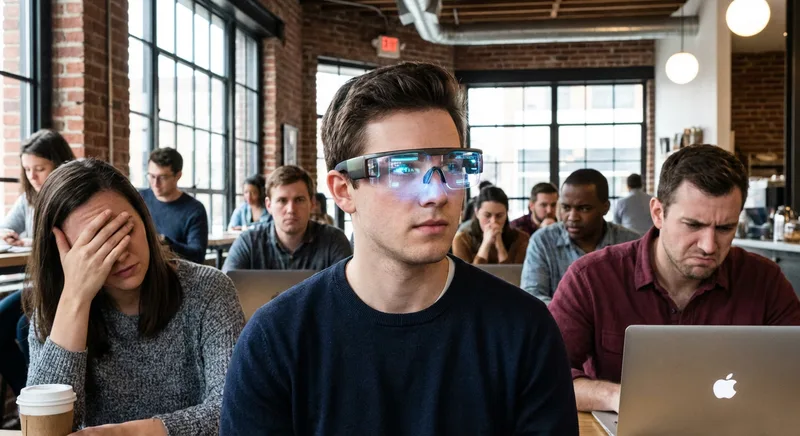
In 2012, Google co-founder Sergey Brin stood on a stage wearing what appeared to be a Bluetooth earpiece that had mated with a picture frame, and announced that the future of computing would live on your face. The audience applauded. Skydivers wearing the device jumped out of a plane and livestreamed their descent. It was the kind of tech demo that makes venture capitalists physically aroused.
Within two years, the device would be banned from bars, restaurants, movie theaters, casinos, strip clubs, hospitals, sports arenas, and college classrooms — making it the most unwelcome piece of technology since the landmine.
The product was Google Glass. It cost $1,500. It recorded everything it saw. And society's response was to invent an entirely new slur for the people who wore it.
The Vision: Augmented Reality for the Socially Unbothered
Google didn't just want to sell you a gadget. They wanted to augment your reality. The promotional video showed a man waking up, putting on Glass, and gliding through his day — getting directions overlaid on his field of vision, video-calling a friend from a bookstore, taking a photo of a sunset with a voice command.
It was gorgeous. It was seamless. It was the technological equivalent of a movie trailer for a film that doesn't exist.
Here's what the video didn't show: the 30 minutes of battery life if you actually tried to record anything. The tiny display that gave people headaches. The voice activation that required you to say "OK, Glass" out loud in public like a person who names their appliances.
The fact that it cost more than a decent used car and performed fewer functions than the $200 smartphone already in your pocket.
But the real problem wasn't the technology. The real problem was that Google Glass turned the wearer into a walking surveillance camera, and it turns out humans have deeply held opinions about being surveilled by strangers wearing cosplay from a Black Mirror episode.
The Glorious User Experience
Craig from Palo Alto, CA — ★★☆☆☆
"I wore Glass to a networking event in Mountain View and three people genuinely asked me if I worked for the NSA. One woman covered her name badge with her hand when I walked by. I kept explaining it was just for email notifications. Nobody believed me. Nobody believes the guy with a camera on his face. I have since moved to a cabin in Montana where there is nobody left to alienate."
Rebecca from Portland, OR — ★☆☆☆☆
"Day one: wore them to a coffee shop. The barista refused to serve me until I took them off. Day two: wore them to a bar. A man offered to remove them from my face 'voluntarily or involuntarily.' Day three: wore them at home. My cat looked at me with what I can only describe as pity. Day four: listed them on eBay. The cat seemed relieved."
Marcus from Austin, TX — ★☆☆☆☆
"You haven't lived until you've said 'OK, Glass, take a picture' in a restaurant and watched an entire table of strangers stop eating simultaneously to stare at you like you just announced you're a registered sex offender. For fifteen hundred dollars, Google sold me the ability to clear a room faster than a fire alarm."
Diane from San Francisco, CA — ★☆☆☆☆
"A woman physically ripped them off my face at a bar on Haight Street. The police report lists the incident under 'assault' but the officer couldn't stop smiling while he wrote it. He asked me what I expected to happen. I said I expected augmented reality. He said I got it."
The Truth: When Your Product Creates Its Own Slur, You've Lost
“It was the kind of tech demo that makes venture capitalists physically aroused”
Click to TweetThe story of Google Glass is not a story about technology failing. The technology, by 2013 standards, was genuinely impressive. It's a story about a company so dazzled by what it could build that it forgot to ask whether anyone should wear it.
Google launched the "Explorer Program" in 2013, inviting select developers and influencers to purchase Glass for $1,500 and serve as unpaid beta testers for a product that made everyone around them profoundly uncomfortable.
Seventy-two percent of Americans reported privacy concerns about Glass, according to Adweek. The camera had no visible recording indicator that could be seen at a distance, meaning anyone wearing Glass could be filming you at any moment, and you'd have no way of knowing.
The social consequences were swift and merciless. The 5 Point bar in Seattle declared itself a "No Google Glass Zone" in 2013, calling the device "an extension of the surveillance state." Casinos banned it. Movie theaters banned it. The Motion Picture Association of America sent alerts to theaters warning about film piracy.
A Las Vegas strip club required patrons to check their Glass at the door, which is how you know a product has truly failed — when a strip club, an establishment with historically flexible moral standards, decides your gadget crosses a line.
The term "Glasshole" entered the cultural lexicon with terrifying speed. Google actually responded to the backlash by publishing an etiquette guide asking Glass users to not be "creepy or rude," which is the corporate equivalent of a parent yelling "be nice!" as their child bites another kid at the playground.
If you have to tell your customers not to be creepy, your product is the problem.
Google lost approximately $895 million on the consumer version of Glass. By January 2015 — less than two years after the Explorer launch — Google pulled it from the market and called it a "learning phase," which is Silicon Valley for "catastrophic humiliation."
They pivoted to enterprise, selling Glass to warehouses and factories where workers needed hands-free displays and, crucially, nobody cared about being filmed because they were surrounded by boxes instead of other humans.
The enterprise version found modest success. DHL reported 15% productivity gains. Surgeons used it to overlay patient data during operations. But this was the equivalent of your failed rock band getting a steady gig playing hotel lobbies — technically employment, spiritually devastating.
Google finally killed Glass entirely in 2023. Product support ended in September. The whole experiment, from hype to obituary, lasted a decade and accomplished exactly one cultural contribution: a new word for someone nobody wants to be around.
The Verdict
Google Glass is the purest example in tech history of building something nobody asked for, selling it to the worst possible ambassadors, and then acting surprised when society reacted with hostility.
It was a $1,500 answer to a question nobody was asking, worn by people who couldn't read a room — literally, since Glass's facial recognition features never materialized because even Google realized that was a bridge too far.
Today, Ray-Ban Meta smart glasses sell millions of units because they look like normal sunglasses and their camera has a visible recording light. They succeed because they learned every lesson Google Glass taught: look normal, be transparent about recording, and for the love of God, don't cost $1,500.
Google Glass didn't fail because it was ahead of its time. It failed because it didn't respect the people who weren't wearing it. And that, it turns out, was almost everyone.
We rate it 1 out of 5 surveillance devices.
If you want smart glasses that won't get you banned from bars, see our alternatives below.
---
✅What to Buy Instead
Ray-Ban Meta Gen 2
Stylish smart glasses with camera and AI that people actually wear — because they look like normal sunglasses. 100+ frame/lens combos.
Meta Ray-Ban Display
First consumer AR glasses with a heads-up display that don't scream "I'm filming you." Same great Ray-Ban styling.
Xreal Air 2 Ultra
Affordable AR display glasses for private movie-watching and spatial computing. No public stigma, just personal giant screens.
Comments
Sign in or create an account to join the discussion.