
The HAPIfork: The $100 Bluetooth Fork That Judged You Harder Than Your Mother-in-Law
How a French company put a gyroscope, a battery, and Bluetooth in a fork, charged $100, and solved exactly zero eating problems
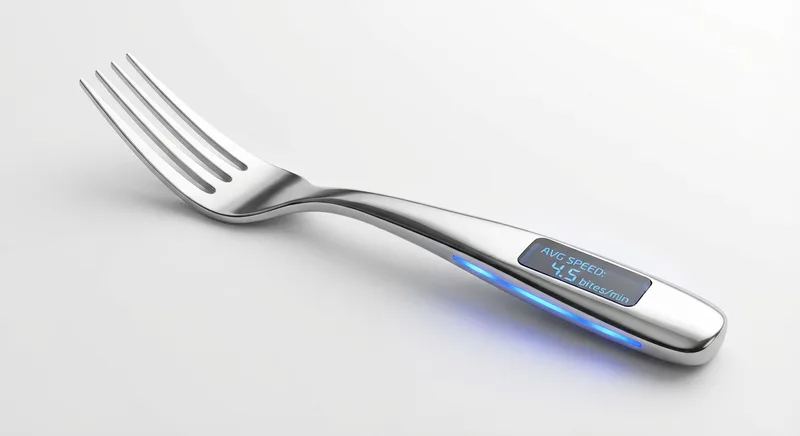
At CES 2013, a French company called Hapilabs walked onto the world's biggest technology stage and, in front of an audience that had just seen 4K televisions, self-driving car prototypes, and bendable displays, presented a fork.
A fork. With Bluetooth. That vibrated when you ate too fast.
The HAPIfork tracked how quickly you brought food to your mouth and, if you exceeded a predetermined pace, buzzed against your fingers like a tiny, judgmental fitness tracker for your eating hand. It synced to an app on your phone that displayed graphs of your "fork servings per minute," which is a data point that no human being has ever needed, wanted, or benefited from.
The fork debuted at $99, which is approximately $96 more than a fork should cost, even one that disapproves of your lifestyle choices.
The HAPIfork was discontinued within a few years, having sold a modest number of units to people who either genuinely believed a fork could change their eating habits or, more likely, received it as a gag gift that the recipient immediately put in a drawer, where it eventually died of battery depletion, alone and unjudging.
The Vision: Quantified Self Meets Tuesday Night Dinner
The early 2010s were the height of the "quantified self" movement — the cultural moment when Silicon Valley decided that everything in your life could be improved by tracking it. Steps? Tracked. Sleep? Tracked. Heart rate? Tracked. How fast you shovel fettuccine into your mouth on a Wednesday evening? Apparently, this also needed tracking.
HAPIfork's thesis was that eating too fast contributes to poor digestion, weight gain, and overeating. This is actually supported by some research. Eating slowly allows your brain to register fullness before you've consumed too much. Where the thesis went spectacularly wrong was the solution: a vibrating fork that cost $100, required USB charging, connected to Bluetooth, synced to an app, and provided data visualizations of your mastication rate.
The fork couldn't tell what you were eating. A forkful of kale and a forkful of cheesecake registered identically. The vibration triggered based purely on the speed of fork-to-mouth motions, which meant eating a salad quickly was punished and eating ice cream slowly was rewarded. The fork's moral compass was exactly backward.
It was also, by all accounts, deeply unpleasant to use. A fork that vibrates in your hand while you're eating creates a sensation that multiple reviewers described as "startling," "annoying," and "the reason I threw a fork across a restaurant." The vibration was not gentle encouragement. It was a tiny electric rebuke, delivered at the speed of each bite, turning every meal into a negotiation between you and a utensil that had opinions.
The Glorious User Experience
Danielle from New York, NY — ★☆☆☆☆
"The fork vibrated while I was eating soup. Soup. A liquid. Being consumed with a fork that I was using as a spoon because the HAPIfork only comes in fork form and sometimes you eat soup with a fork if the fork cost $100 and you feel obligated to use it. The fork detected rapid movements, decided I was eating too fast, and vibrated while I was drinking broth. I was not eating too fast. I was drinking. The fork does not understand liquids. One star."
Robert from Austin, TX — ★☆☆☆☆
"The app showed me a graph of my 'fork servings per minute' over a two-week period. According to the data, I am a moderate-pace eater who spikes to fast eating during pasta and slows during steak. This information cost me $100 and I could have obtained it for free by asking my wife, who has been providing this data verbally, unsolicited, for fifteen years."
“It synced to an app on your phone that displayed graphs of your "fork servings per minute," which is a data point that no human being has ever needed, wanted, or benefited from”
Click to TweetTheresa from Boston, MA — ★☆☆☆☆
"You have to charge it. Via USB. I have charged phones, tablets, laptops, headphones, watches, toothbrushes, and a water bottle. I draw the line at charging a fork. A fork should not have a battery. A fork should not have firmware. A fork should not require a software update. A fork should be a fork. This is the hill I will die on and I will be buried holding an uncharged, non-Bluetooth, fully analog fork."
Kevin from Portland, OR — ★★☆☆☆
"It was a gift. A joke gift. From my brother, who thinks he's funny. I used it once, at Thanksgiving, in front of my family. It vibrated while I was eating mashed potatoes. My grandmother asked what was wrong with my fork. I explained that it was a Bluetooth-connected smart fork that monitors eating speed. She looked at me for approximately four seconds without blinking and then said, 'In my day, we just chewed.' She has never been more correct about anything. Two stars because it was a successful conversation starter, which is not what it was designed to be."
The Truth: Peak Internet of Things Absurdity
The HAPIfork is the most pure expression of a specific era in technology: the moment when Silicon Valley decided that Bluetooth and an app could improve anything, including a tool that humanity perfected approximately four thousand years ago.
CES 2013 gave the HAPIfork significant attention — it won a CES Innovation Award, which sounds impressive until you realize that CES gives out hundreds of innovation awards and many of them go to products that are never heard from again. The media coverage was a mixture of genuine fascination and barely concealed amusement. The fork was featured on The Colbert Report, which should have been a warning sign, since The Colbert Report featured things specifically because they were absurd.
The fork retailed at $99, with additional costs for the charging cradle and app maintenance. The app tracked "fork servings per minute," "duration of meal," and "intervals between forkings" — a phrase that no technology company should ever put in writing. The data was visualized in graphs that looked like they'd been borrowed from a hospital's cardiac monitoring software, lending an air of medical seriousness to the question of how quickly you eat spaghetti.
Reviews were gentle in the way reviews are gentle when a product is too silly to be angry about. Critics noted that the fork was too large, too heavy (it had a battery and a circuit board inside, because it was a fork that contained a battery and a circuit board), and too quick to judge. The vibration penalty was too sensitive for some eaters and not sensitive enough for others, because eating speed is not a universal constant and a one-size-fits-all buzzing fork is not a nuanced intervention.
Hapilabs also produced a smart baby bottle, a smart water bottle, and a connected bathroom scale — a suite of products unified by the thesis that every object in your home should have Bluetooth and an opinion about your habits. The company eventually went quiet, its website reduced to a digital memorial for an era when technology and cutlery briefly, catastrophically intersected.
The Verdict
The HAPIfork is the answer to a question nobody asked, wrapped in technology nobody needed, sold at a price nobody should have paid. It is peak Internet of Things — the belief that embedding a sensor in a fork and connecting it to the cloud would produce an insight more useful than "maybe eat slower," which your mother has been telling you for free since you were four.
The fork that judges you hardest is not the HAPIfork. It's the $2 fork in your drawer that works every time, never needs charging, and has never once connected to Bluetooth. It doesn't track your fork servings per minute. It doesn't sync to an app. It's just a fork. And it's perfect.
We rate it 1 out of 5 courses.
If you want to eat mindfully without being judged by a utensil, see our alternatives below.
---
✅What to Buy Instead
A Regular Fork
Works without batteries, Bluetooth, or an app. Has never vibrated disapprovingly at anyone. $2. Revolutionary technology.
Noom Weight
If you actually want mindful eating, a psychology-based coaching app beats a vibrating fork. Addresses the brain, not the hand.
Portion Control Plates
Simple divided plates that guide portion sizes without requiring USB charging or firmware updates.
Comments
Sign in or create an account to join the discussion.