
HeadOn: Apply Directly to the Forehead! Apply Directly to the Forehead! Apply Directly to the Forehead! (It's Wax. The Product Is Wax.)
The commercial was so annoying it gave you the headache, and the product was homeopathic wax that contained no active ingredients — a self-creating market
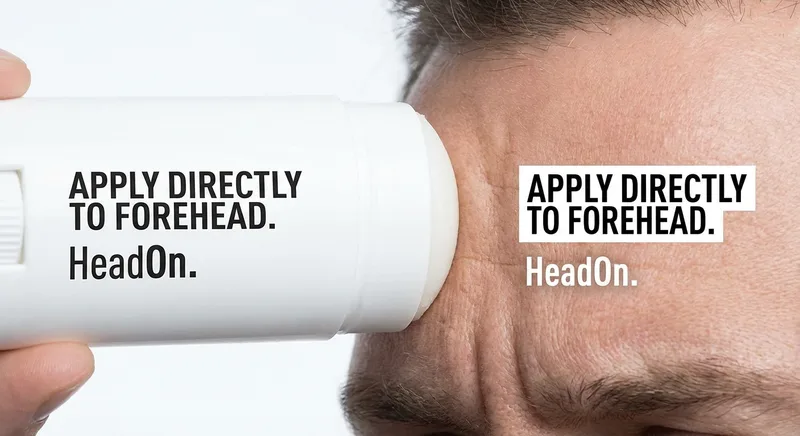
HEADON. APPLY DIRECTLY TO THE FOREHEAD. HEADON. APPLY DIRECTLY TO THE FOREHEAD. HEADON. APPLY DIRECTLY TO THE FOREHEAD.
If you just read those three lines and experienced a visceral reaction — a twitch, a cringe, a phantom headache, a surge of 2006-era television PTSD — congratulations: the commercial worked. Not the product. The commercial. The commercial was the product's greatest achievement and the viewer's greatest punishment. The commercial gave you a headache so efficiently that you almost needed the product it was advertising, which is either marketing genius or psychological warfare, and the line between the two was never clearly drawn.
The HeadOn commercial is the most annoying advertisement in American television history. It consists of a woman rubbing a stick on her forehead while a voiceover repeats "HeadOn! Apply directly to the forehead!" three times. That's it. No explanation of what the product does. No description of ingredients. No claims about efficacy. Just: the name. The instruction. Three times. The commercial was so devoid of information that it looped past "bad commercial" into "performance art" and then back around to "bad commercial" on the other side.
The reason the commercial made no claims about what HeadOn does is that HeadOn does nothing. The product is a homeopathic wax stick — a tube of wax with trace amounts of iris versicolor (blue flag flower), white bryony, and potassium dichromate in homeopathic dilutions so extreme that the product contains no measurable active ingredients. It is wax. You rub wax on your forehead. The wax does not treat headaches, because wax is not medicine. Wax is wax. Wax has never been medicine. Candles are also wax. Candles also do not treat headaches.
The commercial was designed to avoid making health claims — because the product couldn't substantiate any — while still creating the strong implication that HeadOn treats headaches. The repetition of "apply directly to the forehead" combined with the product name "HeadOn" created an association between the product and headache relief without technically stating it. You were supposed to ASSUME it treated headaches. The commercial never said it. The commercial didn't need to. The assumption was the product.
The Vision: Annoy Your Way to Sales
HeadOn's marketing strategy was brilliant in the same way a mosquito is brilliant: it achieved its goal (brand awareness) through a method everyone hated (repetitive annoyance) and nobody could stop (the commercial aired constantly on daytime television during 2006-2007).
The commercial's repetition was intentional. The creators knew it was annoying. They designed it to be annoying. Annoying is memorable. Memorable is profitable. HeadOn became one of the most recognized As-Seen-On-TV brands in America through the sheer force of being impossible to forget, the same way you can't forget a car alarm that went off for an hour outside your apartment at 3 AM.
The company, Miralus Healthcare, eventually released follow-up ads that acknowledged the original commercial's annoyingness — featuring people saying "I hate your commercial, but I love your product!" These ads were even more diabolical: they incorporated the viewer's hatred of the ad INTO the advertising, converting your annoyance into social proof. "Other people hate our ad too, but they bought the product anyway!" Your irritation was a feature, not a bug.
The Glorious User Experience
Everyone Who Watched Daytime TV in 2006 — ★☆☆☆☆
"The commercial played four times during a single episode of Judge Judy. FOUR TIMES. Twelve repetitions of 'apply directly to the forehead' in one hour. By the fourth airing, I had a headache. The commercial for the headache product GAVE ME A HEADACHE. The commercial created the market for the product. The commercial was the disease and the product was the cure and both were owned by the same company. This is either a closed-loop business model or a RICO case. One star."
Jessica from Tampa, FL — ★☆☆☆☆
"I bought HeadOn because the commercial was in my head — literally in my HEAD, playing on repeat like a song I couldn't unlearn. I rubbed it on my forehead. Nothing happened. Because it's wax. I rubbed WAX on my HEAD because a commercial told me to, and the wax did exactly what wax does, which is: sit there. Being wax. On my forehead. I paid $8 for a tube of wax and a lifetime of 'apply directly to the forehead' echoing in my skull. One star."
“The commercial gave you a headache so efficiently that you almost needed the product it was advertising, which is either marketing genius or psychological warfare, and the line between the two was never clearly drawn”
Click to TweetMark from Chicago, IL — ★☆☆☆☆
"I looked up HeadOn's ingredients after using it for a week with zero effect. The active ingredients are listed in homeopathic notation — 'white bryony 12x' means the substance has been diluted twelve times. The math of homeopathic dilution means the final product contains approximately zero molecules of the original ingredient. I was rubbing statistically empty wax on my head. The forehead was receiving nothing. Directly. One star."
Dr. Steven Novella, Neurologist — Professional assessment
"HeadOn contains no active ingredients in any pharmacologically meaningful concentration. The homeopathic dilutions listed on the product render the ingredients effectively absent. The product is a wax stick. There is no mechanism by which rubbing wax on your forehead would treat a headache. Ibuprofen exists."
The Truth: The Ad That Created Its Own Demand
HeadOn is the perfect case study in marketing-over-substance. The product has no active ingredients. It makes no health claims (legally). It does not treat headaches. It is wax. And yet it sold millions of units because the commercial was so memorable, so annoying, and so relentlessly repeated that people bought it through a combination of curiosity, desperation, and the simple inability to get "apply directly to the forehead" out of their heads.
The commercial's avoidance of health claims was legally strategic. Homeopathic products in the U.S. occupy a regulatory gray zone — they don't need FDA approval for efficacy, but they also can't make specific therapeutic claims without evidence. HeadOn's commercial threaded this needle perfectly: it never said "treats headaches." It said "apply directly to the forehead" — an instruction, not a claim. Your brain filled in the rest. Your brain assumed. Your brain was wrong. But your brain also remembered, which was the goal.
The Verdict
HeadOn is wax. You rub it on your forehead. It does nothing. The commercial that told you to rub it on your forehead was so annoying that it may have caused the headache the product claims to — but doesn't — treat. The ad was the headache. The product was the placebo. The cycle was closed. The forehead was waxed. Nothing was healed.
Apply directly to the forehead. Apply directly to the forehead. Apply directly to the forehead.
You're welcome. You hate me now. That's how HeadOn felt.
We rate it 1 out of 5 active ingredients.
If you have a headache, take actual medicine. See our alternatives below.
---
✅What to Buy Instead
Advil (Ibuprofen)
Clinically proven headache relief through actual pharmacology. Contains active ingredients. In measurable quantities. That do things. To headaches.
Excedrin Migraine
Targeted relief combining aspirin, acetaminophen, and caffeine. Three real ingredients doing real work. Not wax.
Tiger Balm
If you want a topical application, Tiger Balm contains menthol and camphor — actual active ingredients with actual effects. Not homeopathic. Not wax. Not nothing.
Comments
Sign in or create an account to join the discussion.