
The Humane Ai Pin: The $700 Lapel Computer That Got Bricked Before It Got Good
It projected a screen on your palm, overheated on your chest, came with a recalled charging case, and was switched off after HP bought the company.
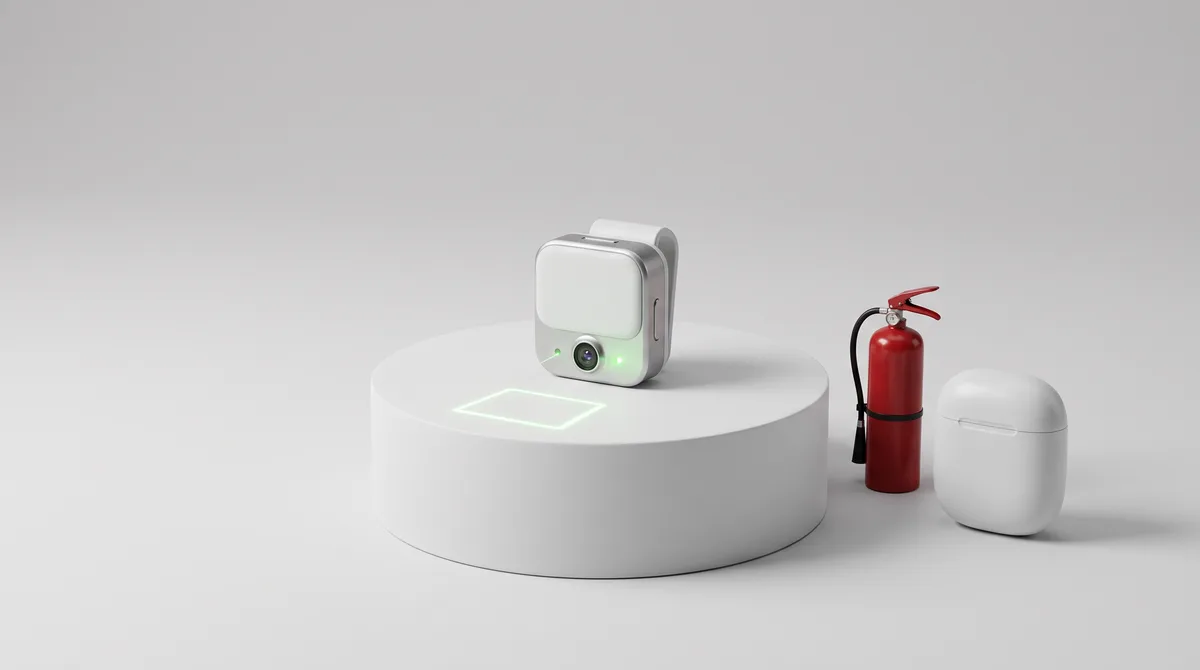
The Humane Ai Pin was a small square computer that clipped to your shirt, listened to you, talked back, and projected a little laser screen onto the palm of your hand. It was built by former Apple directors, backed by some of the biggest names in tech, and sold as the device that would finally free us from staring at our phones. It cost $699, plus $24 a month.
It lasted less than a year on the market. It got reviews so bad they became a genre, it came with a charging case that was recalled for fire risk, and in February 2025 the company sold itself to HP and switched the Pins off. The battery indicator kept working, though. Let's not be unfair.
The Vision: Your Phone, But Worse, On Your Chest
Humane was founded by Imran Chaudhri and Bethany Bongiorno, who had previously led design and software engineering as directors at Apple. The company raised more than $230 million, according to Bloomberg as cited by Entrepreneur, with backing that included Microsoft, Sam Altman and Marc Benioff. The Ai Pin was revealed in November 2023 and reviewed in April 2024.
The pitch was a post-smartphone future. No screen to doomscroll. No apps. You'd just talk to the air and an AI would handle it. When you absolutely needed to see something, a laser would paint it onto your palm, and you would navigate by tilting your hand or pinching your index finger and thumb, like a wizard checking the weather.
This is a beautiful idea if you have never been outside on a sunny day. Or a cloudy one, as it turned out.
The Reviews: A Rare Moment of Industry Consensus
Tech reviewers rarely agree on anything. They agreed on this. As collected by TechRadar's review roundup:
- Marques Brownlee called it "the worst product I've ever reviewed... for now," and said it was "bad at almost everything it does."
- The Verge said it was "not even close" and that its "single biggest problem" is that "it is so, so slow," calling it a "$700 gamble."
- Engadget called it "the solution to none of technology's problems."
- Bloomberg's Mark Gurman concluded its "fundamental design and interface are fatally flawed."
According to Entrepreneur's recap, Engadget's Cherlynn Low found the device overheated and shut down when she took several photos, and she could not read the palm screen on a cloudy, rainy day. The Verge's Victoria Song found the translation feature could not handle simple Japanese and Korean phrases. Brownlee added complaints about slow responses, errors, overheating and a warm puck-like weight on his chest.
So to recap the feature list: a phone replacement that was slower than a phone, a screen you couldn't see outdoors, a translator that couldn't translate, and a built-in hand warmer that nobody ordered. To be generous, Brownlee did call the build "actually impressive." It was a very well-made thing to be disappointed by.
The Charging Case: Now With Fire
Every gadget eventually needs an accessory. The Ai Pin's was an egg-shaped Charge Case, and in June 2024 Humane emailed owners telling them to stop using it immediately, because it "may pose a fire safety risk." The company said it was reaching out "out of an abundance of caution," traced the problem to a battery cell from a third-party supplier, and dropped that supplier.
There was no recall or refund at first, according to MacRumors. Instead, owners got two free months of the Humane subscription, which is a bold way to compensate someone for a fire risk: with more of the product.
“It lasted less than a year on the market”
Click to TweetIn October 2024, on Halloween, the CPSC made it official. About 10,500 Charge Case Accessories were recalled because the battery could overheat and pose a fire hazard. Gizmodo reported one incident of a case overheating and "melting" while plugged in, with no injuries. The remedy this time was a refund or replacement, with Humane estimating replacements would take three to six months.
A wearable AI device whose charging accessory had to be recalled for fire risk is the dark-comedy pitch Silicon Valley never asks for. The whole selling point was that it lived on your chest. Nobody wants the word "melting" anywhere near their chest.
The Numbers: More Returns Than Sales
Here is the part that reads like a business school case study written by a horror novelist. According to Entrepreneur, the Ai Pin brought in about $9 million in lifetime sales, and about $1 million of product came back as returns. From May to August 2024, more Pins were returned than sold. The New York Times reported about 10,000 units sold against a goal of 100,000.
It gets better. Returned Pins could not be resold as refurbished, because each device was tied to one person through a T-Mobile limitation. So every return was not just a lost sale. It was a small, square, very well-built paperweight.
Meanwhile, The Verge reported in spring 2024 that Humane was rumored to be looking for a buyer at around $1 billion. For a company with returns briefly outpacing sales, that's not a valuation. That's a manifestation.
The Ending: HP Buys the Brain, Bricks the Body
In February 2025 the buyer finally appeared. HP agreed to acquire most of Humane for $116 million, picking up its CosmOS software, more than 300 patents and applications, and some employees, according to TechSpot. The founders and team would form a new AI division at HP. The Ai Pin itself was not part of the deal.
Instead, the Pins were scheduled to die. On February 28, 2025, at 12 p.m. Pacific, cellular service ended and the devices stopped connecting to Humane's servers. That meant no AI queries, no calls, no texts and no data, which is to say no Ai Pin. Refunds were only available for devices that shipped on or after November 15, 2024, roughly the last 90 days, with requests due by February 27. Subscribers got prorated refunds for time past the shutdown.
TechSpot noted that the battery indicator would keep working. So if you bought an Ai Pin in its first months, you were left with a $700 device that can no longer do anything except tell you, accurately and with great confidence, how much charge it has for doing nothing. It is the most honest feature it ever had.
The Verdict
The Humane Ai Pin is the purest form of a Silicon Valley flop: a gorgeous object, an enormous funding round, a launch built on the promise of a screenless future, and then reality, in the form of sunlight, latency, a subscription, a fire-risk accessory, and a remote off switch. It wanted to replace the smartphone. It could not replace a flashlight.
The lesson for early adopters is the same one this site keeps relearning: if the product needs the company's servers to work, you don't own the product. You're renting it until someone sells the brain to HP.
We rate it 1 out of 5 laser-projected palms, and the one is for the battery indicator.
About the Author

Nick Irmo
Founder, Chief Reviewer & Professional Disappointment Connoisseur
Nick Irmo is the founder and head reviewer at No Want This, where he reviews the world's worst products with the enthusiasm of a man who has been personally wronged by consumer goods. He believes every terrible product has a story worth telling, every story deserves to be funny, and every reader deserves to know what NOT to buy before they learn the hard way. His work has been described as "Wirecutter if Wirecutter hated everything" — a comparison he considers the highest possible compliment.