
Hypercolor T-Shirts: The Shirt That Publicly Broadcast Exactly Where You Were Sweating, in Neon
Heat-reactive color-changing technology that turned your armpits into spotlights, your back into a Rorschach test, and every handprint into a permanent embarrassment
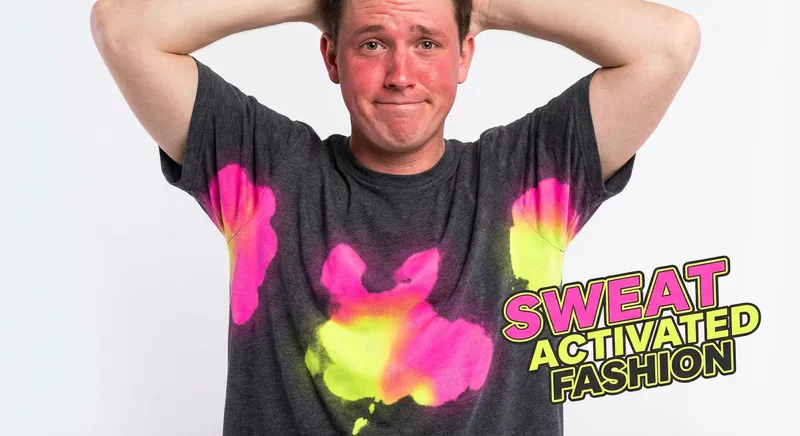
In 1991, Generra Sportswear introduced Hypercolor — a line of t-shirts treated with thermochromic dye that changed color in response to heat. Cold areas stayed one color. Warm areas shifted to another. The concept was futuristic, fun, and visually spectacular in the store.
The concept became considerably less spectacular the moment you put the shirt on a human body that produced heat in specific, unflattering, sweat-related areas.
The armpits went first. Your armpits — the warmest, sweatiest part of your torso — immediately turned a different color from the rest of the shirt, creating two neon spotlights on either side of your body that announced to the world: "THIS PERSON IS SWEATING. THE SWEATING IS HERE. LOOK AT THE SWEATING." The shirt was a wearable heat map of your body's moisture production, and the moisture production was concentrated in the exact areas you'd prefer nobody think about.
Then the back. Your back, pressed against a chair, against a car seat, against a wall you leaned on, produced a heat silhouette — a thermal impression of your spine, your shoulder blades, and whatever posture you'd committed to for the previous thirty seconds. You'd stand up from a chair and your back would display a perfect imprint of the chair, slowly fading as the fabric cooled. You were a human mood ring, except the mood was always "slightly damp."
Then the handprints. This is where Hypercolor transcended embarrassment and entered the territory of genuine social hazard. Any hand placed on the shirt — your hand, a friend's hand, a stranger's hand on the subway — left a glowing thermal print. In a school environment full of adolescents with boundary issues and developing impulse control, this meant that Hypercolor shirts became a canvas for unwanted touching. Someone would slap your chest, and a neon handprint would appear and stay visible for thirty seconds. Someone would poke your shoulder, and a glowing fingerprint would mark you. The shirt documented every instance of physical contact in real-time, in neon, for the whole cafeteria to see.
And then there were the OTHER handprints. The handprints in places that, on an adolescent's body, in a middle school hallway, produced questions that no twelve-year-old wanted to answer and no teacher wanted to investigate. Hypercolor shirts were a forensic evidence kit for inappropriate touching, worn voluntarily, by children, in the most socially volatile environment on Earth: middle school.
The Vision: Fashion Meets Thermodynamics (Nobody Wins)
The thermochromic dye in Hypercolor shirts contained liquid crystals that shifted between two states — absorbing and reflecting different wavelengths of light depending on temperature. At lower temperatures, the shirt displayed its "base" color. At higher temperatures, the dye shifted to a second color, typically lighter. The transition was gradual, creating a spectrum of color change across the temperature gradient of your body.
This was genuinely cool technology. In a laboratory. On a mannequin. On a display table at the store. In every controlled environment where the shirt wasn't being worn by a sweating, chair-sitting, handprint-receiving human, the technology was impressive.
On a human, the technology became an involuntary confession booth. The shirt told everyone: where you were sweating (armpits and lower back, always), what you'd been leaning against (chairs, lockers, other people), and who had touched you (everyone, apparently, because touching the Hypercolor kid was the unofficial pastime of every middle school in America from 1991 to 1993).
The Glorious User Experience
Every Middle School Student, 1991-1993 — ★☆☆☆☆
"I wore Hypercolor to school. By second period, my armpits were neon yellow against a purple shirt. I looked like I had two small suns in my armpits. A kid named Tyler slapped my back between classes and left a perfect handprint that lasted through third period English. Mrs. Henderson asked if I was 'okay' because my shirt displayed a handprint on my chest that I could not explain to a teacher without the explanation being worse than the handprint. One star."
Jamie from Dallas, TX — ★☆☆☆☆
"The shirt died in three washes. THREE. The thermochromic dye degraded with each wash cycle until the shirt no longer changed color — it just looked permanently blotchy, like a tie-dye experiment that someone abandoned halfway through. The shirt's lifecycle was: (1) exciting purchase, (2) embarrassing week of armpit spotlights, (3) dead in the laundry. One star."
“The concept became considerably less spectacular the moment you put the shirt on a human body that produced heat in specific, unflattering, sweat-related areas”
Click to TweetMegan from Chicago, IL — ★☆☆☆☆
"A boy in my seventh-grade class grabbed my Hypercolor shirt from behind and left two handprints on my chest. TWO HANDPRINTS. ON MY CHEST. GLOWING. In neon. In front of the entire hallway. The shirt documented the assault in real-time thermal imaging. I was wearing forensic evidence of unwanted contact and the evidence was FLUORESCENT. The boy got detention. I got a new shirt. The new shirt was a solid color that didn't broadcast where people touched me. One star."
Greg from Portland, OR — ★☆☆☆☆
"I sat on a plastic chair in the cafeteria. I stood up. The back of my shirt displayed a perfect thermal imprint of the chair — including the gap where my lower back didn't contact the seat. I was wearing a topographical map of my seated posture. A kid behind me said, 'Dude, I can see your butt print.' He was not wrong. My butt print was displayed on my shirt like a thermal signature. One star."
The Truth: Cool Technology, Terrible Application
Hypercolor shirts sold over $50 million in their first year — a massive hit driven by novelty, visual spectacle, and the 1991 equivalent of going viral. The shirts were everywhere. Every mall, every school, every kid who wanted the coolest new thing had a Hypercolor shirt.
The decline was as fast as the rise. Three factors killed Hypercolor:
1. The sweat problem: Once the novelty wore off, the reality of walking around with neon armpits outweighed the cool factor. 2. The durability problem: The thermochromic dye degraded rapidly in the wash, rendering the shirts non-functional within a few cycles. 3. The touching problem: Schools became concerned about the shirts' role in facilitating and documenting unwanted physical contact. Some schools banned them.
Generra Sportswear went bankrupt in 1992 — one year after Hypercolor's peak. The company that made the most talked-about fashion item of 1991 was out of business by 1992. The product that sold $50 million in one year couldn't sustain a second year because the technology that made it exciting also made it embarrassing, fragile, and a magnet for the worst impulses of adolescent behavior.
The Verdict
Hypercolor t-shirts were a genuinely innovative use of thermochromic technology applied to the worst possible surface: a garment worn by sweating humans in social environments where physical contact is uncontrollable and body-temperature mapping is involuntary.
The technology was cool. The armpits were not. The handprints were evidence. And the shirts died in three washes, which is honestly merciful, because any garment that broadcasts your sweat pattern in neon should have an expiration date.
We rate it 1 out of 5 dignified shirts.
If you want to hide your sweat rather than broadcast it, see our alternatives below.
---
✅What to Buy Instead
Uniqlo AIRism Crew Neck
Moisture-wicking technology that HIDES sweat rather than broadcasting it in neon. The opposite of Hypercolor. The shirt that keeps your secrets.
lululemon Metal Vent Tech
Anti-stink, quick-dry fabric designed to make sweat invisible. Your armpits remain your business. No thermal imaging.
Any Dark-Colored T-Shirt
Dark shirts hide sweat for free. This technology predates thermochromic dye by approximately all of human history.
Comments
Sign in or create an account to join the discussion.