
Johnson & Johnson Baby Powder: The Product Marketed for Babies That Became One of History's Largest Liability Nightmares
Decades of litigation. Allegations of asbestos contamination. FDA testing finding asbestos in 18% of talc products. A baby on the label.
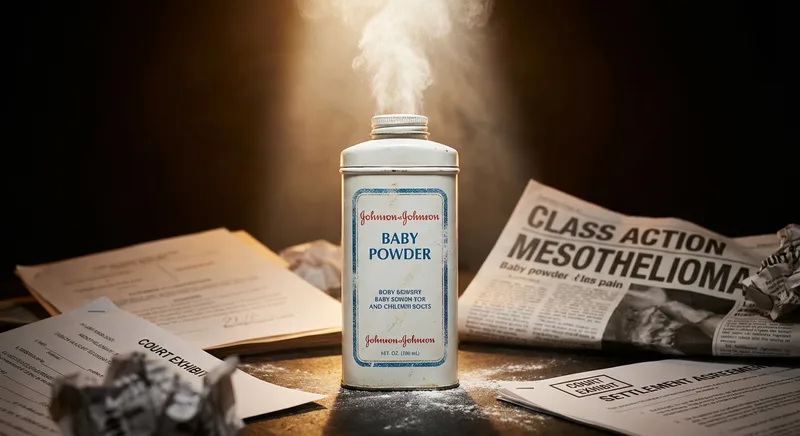
Johnson & Johnson Baby Powder is the most trusted product from the most trusted brand in the most trusted category of consumer goods. It has a baby on the label. The company's tagline is "A Family Company." The powder was used by parents, grandparents, and great-grandparents. It was handed down not as a product recommendation but as a family tradition — the same gentle white powder, the same clean scent, the same faith that a company with a baby on its label wouldn't put anything dangerous in the bottle.
That faith, like the powder, has been shaken.
Johnson & Johnson has faced tens of thousands of lawsuits alleging that their talc-based Baby Powder was contaminated with asbestos — a known carcinogen linked to mesothelioma and ovarian cancer. Internal company documents, surfaced through litigation, allegedly showed that J&J was aware of trace asbestos contamination in their talc as far back as the 1970s. The allegations suggest the company knew for decades, studied the issue internally, and continued selling.
In 2020, Johnson & Johnson discontinued talc-based Baby Powder in the U.S. and Canada — a move the company attributed to "declining demand" rather than safety concerns. The timing, coinciding with thousands of active lawsuits and billions of dollars in proposed settlements, suggested a different narrative than "declining demand."
In 2023, the FDA published research finding asbestos contamination in approximately 18% of cosmetic-grade talc products tested. Eighteen percent. Nearly one in five talc products contained a mineral that causes cancer. The finding validated what plaintiffs had been alleging for years: talc mining and processing did not adequately separate talc from the asbestos that naturally occurs alongside it in the earth.
The product with the baby on the label. The company with "Family" in its identity. The powder that grandmothers used on their grandchildren. Allegedly contaminated with asbestos for decades while the company allegedly knew.
The Vision: Purity as Brand Identity
J&J Baby Powder was introduced in 1894. For over a century, it represented purity, gentleness, and the unshakable trust that parents place in products designed for their children. The white powder. The clean scent. The soft puff of the bottle. Every element of the product's identity communicated safety.
Talc — the mineral in the powder — is mined from the earth. Asbestos is a mineral that naturally occurs in the same geological formations as talc. If the mining and processing don't adequately separate the two, talc products can contain trace amounts of asbestos fibers. Asbestos fibers, when inhaled or applied to body tissues, are carcinogenic.
The litigation alleges that J&J's talc supply chain did not consistently prevent asbestos contamination, and that the company's internal testing detected asbestos on multiple occasions over decades. The company's public position throughout has been that their Baby Powder is safe and does not contain asbestos — a position contradicted by the plaintiffs, by certain internal documents, and by the FDA's broader findings about talc products.
The Glorious User Experience
This section is different from our usual format. The people affected by J&J Baby Powder are not dissatisfied customers leaving one-star reviews. They are cancer patients and families of cancer victims. Their stories are not funny. They are not material for satire. They are devastating.
“" The powder was used by parents, grandparents, and great-grandparents”
Click to TweetWhat we can note is the structural irony: a product marketed as the gentlest, safest, most baby-friendly product in the consumer marketplace became the subject of one of the largest mass tort litigations in American history. The gap between the brand's identity and the litigation's allegations is the widest of any product on this website.
The Truth: Billions in Settlements and a Baby on the Label
The J&J talc litigation is one of the largest and most complex mass torts in legal history. Key facts:
- Tens of thousands of individual lawsuits have been filed alleging that J&J Baby Powder caused ovarian cancer and mesothelioma.
- Multiple jury verdicts have resulted in multibillion-dollar judgments against J&J, though many have been reduced or are on appeal.
- J&J attempted to use a controversial legal strategy called the "Texas Two-Step" — creating a subsidiary, assigning the talc liabilities to it, and then placing that subsidiary in bankruptcy — to cap its exposure. This strategy was rejected by federal courts.
- In 2025, J&J proposed a global settlement fund of approximately $6.5 billion to resolve the talc claims.
- J&J discontinued talc-based Baby Powder in the U.S. and Canada in 2020, switching to a cornstarch-based formula. The company maintained this was due to "misinformation" and declining sales, not safety issues.
- The FDA's 2023 study finding asbestos in approximately 18% of tested talc cosmetic products validated the core allegation of the litigation: that talc mining does not consistently prevent asbestos contamination.
Johnson & Johnson maintains that their Baby Powder was safe, that their talc was tested and did not contain asbestos, and that the science does not support a causal link between their product and cancer. The plaintiffs, the juries that have ruled against J&J, and the FDA's broader findings tell a different story.
The truth will ultimately be resolved through litigation and science. What is already resolved is the brand damage: the product with the baby on the label is now associated with cancer litigation, and the company that built its identity on family trust is fighting to preserve that trust in courtrooms across America.
The Verdict
Johnson & Johnson Baby Powder is the most consequential product failure in consumer goods history — not because of a design flaw or a manufacturing defect, but because of the alleged gap between what a company knew, what a company said, and what happened to the people who trusted both.
The baby on the label trusted the company. The parents trusted the baby on the label. The grandmothers trusted the parents. And the trust was allegedly betrayed by a mineral that occurred naturally in the earth alongside the mineral that made the powder soft, and that the company allegedly knew about for decades.
This is not a product we rate with a number. This is a product that represents a failure of trust so fundamental that no rating captures it.
If you want body powder without talc — the only responsible choice until talc safety is definitively established — see our alternatives below.
---
✅What to Buy Instead
Burt's Bees Baby Dusting Powder
Cornstarch-based powder with no talc. The alternative parents chose when the trust broke. Safe, gentle, and asbestos-free by ingredient design.
Gold Bond Cornstarch Plus
Talc-free body powder with cornstarch and aloe for moisture absorption. Does what Baby Powder did without the mineral that accompanies asbestos.
Native Body Powder
Clean-ingredient, talc-free body powder. Modern formulation from a modern brand that started without the legacy and without the litigation.
Comments
Sign in or create an account to join the discussion.