
Juicy Couture Velour Tracksuits: $200 to Have 'JUICY' Rhinestoned Across Your Backside Like a Bedazzled Surrender Flag
The pinnacle of early-2000s fashion crimes — paying premium prices for velour with your butt as a billboard
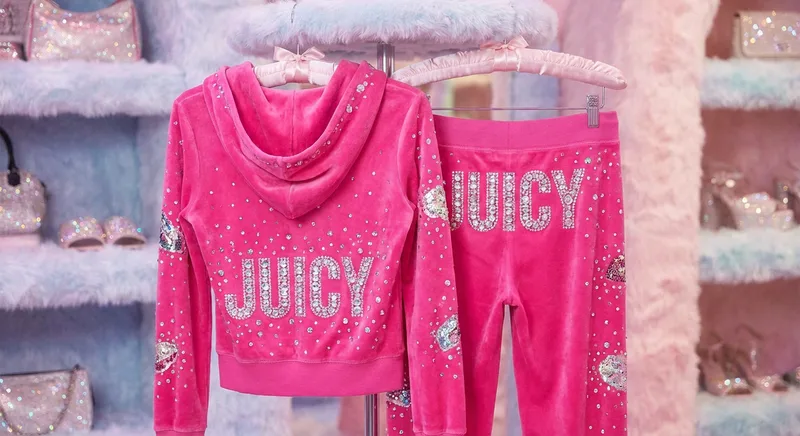
Between approximately 2002 and 2008, millions of American women paid $200+ for the privilege of having the word "JUICY" spelled out in rhinestones across the seat of their velour sweatpants. They did this voluntarily. They did this enthusiastically. They did this while walking through airports, grocery stores, shopping malls, and school pickup lines, with a glittering declaration across their posterior that read like a desperate personal ad written by someone who had given up on subtlety and fonts simultaneously.
The Juicy Couture velour tracksuit was the uniform of early-2000s excess — a matching hoodie-and-pant set made of plush velour in colors ranging from baby pink to hot pink to pink-adjacent pink, with the brand name embroidered, rhinestoned, or printed across the most prominent surface area of the garment: the butt.
Not the chest. Not the sleeve. Not a discreet tag at the collar. The BUTT. The Juicy Couture brand strategy was to turn your posterior into a billboard. The billboard read "JUICY." The intended message was: "I am fashionable and I paid $200 for these sweatpants." The received message was: "I am wearing sweatpants that instruct strangers to read my butt."
Paris Hilton wore them. Lindsay Lohan wore them. Britney Spears wore them. Every celebrity who defined the early-2000s tabloid era wore Juicy Couture velour while being photographed getting out of cars, walking dogs, and holding Starbucks cups the size of their torsos. The tracksuit was aspirational. The aspiration was: "I want people to look at my butt and read a word."
The Vision: Luxury Sweatpants (with Butt Branding)
Juicy Couture was founded in 1997 by Pamela Skaist-Levy and Gela Nash-Taylor, who recognized a gap in the market between "sweatpants you wear on the couch" and "pants you wear in public." The velour tracksuit was the bridge — comfortable enough to lounge in, styled enough to wear out, and branded enough to communicate that you'd paid a premium for the privilege of wearing what was, structurally, a matching sweat suit.
The velour was the texture of the decade. Smooth, plush, slightly sticky on hot skin, and absolutely useless in any temperature above 70°F, which meant that Juicy Couture tracksuits in Miami, Los Angeles, Phoenix, or any warm-climate location were not just a fashion choice but a cardiovascular one. You were committing to a full-body velour embrace in weather that demanded shorts and breathable cotton. The tracksuit was a loyalty test. The price was sweat. The reward was rhinestones.
The brand peaked with annual revenue over $600 million. Six hundred million dollars. For velour. With words on the butt. The early 2000s were a different time, and the time was measured in JUICY butts per square mile at the Beverly Center.
The Glorious User Experience
Lauren from Los Angeles, CA — ★☆☆☆☆
"I owned seven Juicy tracksuits. SEVEN. In pink, baby blue, chocolate brown, forest green, black, white, and a limited edition gold that cost $350. I wore them to Whole Foods, to brunch, to the movies, and once to my ex-boyfriend's apartment because the word JUICY across my butt seemed like a relevant communication at the time. I regret nothing from 2003 and everything from 2003. One star in hindsight. Five stars at the time. Time has not been kind."
Mark from Chicago, IL — ★☆☆☆☆
"My girlfriend wore Juicy Couture. I walked behind her in public. I was a 26-year-old man walking behind a woman whose pants instructed me to read her butt. The word 'JUICY' sparkled at me with every step. I was being given a directive. By pants. In a shopping mall. I looked straight ahead. I looked at the ceiling. I looked at my phone. The rhinestones sparkled in my peripheral vision regardless. One star."
Ashley from Miami, FL — ★☆☆☆☆
“The Juicy Couture brand strategy was to turn your posterior into a billboard”
Click to Tweet"Velour in Miami. VELOUR. IN MIAMI. Where the humidity is 90% and the temperature is 85°F and the air is a wet blanket and I voluntarily added a velour blanket ON TOP of the wet blanket. I was a sweat suit inside a sweat suit. The Juicy tracksuit in Miami was not athleisure. It was a portable sauna with rhinestones. I lost three pounds of water weight walking to the car. One star."
Every Father of a Teenage Girl, 2003-2007 — ★☆☆☆☆
"My daughter wanted Juicy Couture pants. For school. With the word 'JUICY' on her rear end. She was fourteen. I was asked to purchase, with my own money, rhinestoned sweatpants that invited the world to read my fourteen-year-old daughter's backside. The answer was no. The argument lasted three weeks. I prevailed. The argument has been cited in subsequent family disputes as 'The Juicy Incident.' One star."
The Truth: The Rise and Fall of Butt Typography
Juicy Couture's decline mapped exactly to the rise of fashion's minimalist era. As Celine, The Row, and Scandinavian design took over, the maximalism of rhinestoned butt text became a punchline. The tracksuit went from aspirational to ironic to thrift-store in the span of five years.
The brand was acquired by Liz Claiborne (later renamed Fifth & Pacific) for $220 million in 2003, then sold to Authentic Brands Group for a fraction of that in 2013. The tracksuits are still sold — reissued as "heritage" pieces for the Y2K nostalgia market — but their cultural meaning has inverted. In 2003, wearing Juicy was a status signal. In 2025, wearing Juicy is either ironic, nostalgic, or evidence that you bought it at a vintage shop specifically because it's funny.
The early 2000s were the last era when overt branding on clothing was considered aspirational rather than tacky. The Juicy tracksuit, the Von Dutch trucker hat, the Ed Hardy bedazzled tee — all products that announced their brand as loudly as possible — are now understood as the fashion equivalent of shouting in a library. The current era values quiet luxury: unbranded, un-rhinestoned, and unfamiliar to anyone who isn't already in the know.
JUICY across the butt was the opposite of quiet luxury. It was the loudest luxury. The luxury that screamed. The luxury that sparkled at you from across a parking lot and demanded you read a word on a stranger's posterior. Fashion moved on. The velour went to Goodwill. The rhinestones stopped sparkling. The butts went unbranded. And the early 2000s became the decade we look back on and ask: "Why did we put words on our butts?"
The Verdict
Juicy Couture velour tracksuits were $200 sweat suits that turned your butt into a rhinestoned billboard for the word "JUICY" — a word that, when applied to a posterior via sparkly letters, communicates something that no parent wants their daughter to communicate and no adult should want to communicate in a grocery store.
The tracksuits were comfortable. The velour was plush. The brand was status. And the butt typography was a cultural moment that we are all collectively pretending didn't happen, except that the photos exist on Myspace pages that nobody has deleted.
We rate it 1 out of 5 dignified wardrobe choices.
If you want comfortable loungewear without butt-based advertising, see our alternatives below.
---
✅What to Buy Instead
Vuori Performance Joggers
Premium athleisure without rhinestone rear-end advertising. Comfortable, stylish, and your butt remains a private, unbranded surface.
lululemon Align Jogger
Buttery-soft joggers that are genuinely comfortable AND stylish. No words on the butt. No rhinestones. Just fabric being fabric.
Nike Tech Fleece Joggers
Modern tapered joggers that say "I have taste" instead of "I have JUICY across my backside." The evolution of the sweatpant, complete.
Comments
Sign in or create an account to join the discussion.