
Kidde Fire Extinguishers: The Fire Safety Device That Could Do Nothing During a Fire OR Actively Attack You
38 million recalled units spanning 44 years of manufacturing defects — because what's the rush when the only thing at stake is whether your house burns down
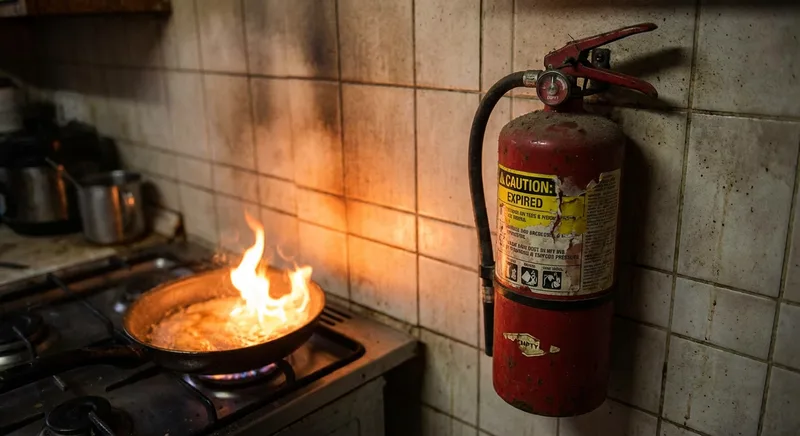
A fire extinguisher has one job. One. You buy it, you mount it on the wall, you pray to God you never need it, and if you do need it, you pull the pin, aim at the base of the fire, and squeeze the handle. The fire goes out. You are alive. The extinguisher has justified its existence.
Kidde fire extinguishers had a different approach. In a recall spanning 38 million units manufactured over a 44-year period (1973 to 2017), the CPSC found that Kidde extinguishers could: (a) fail to discharge when activated, leaving you holding a decorative red cylinder while your kitchen burns, or (b) launch their nozzles across the room like projectiles, turning your fire safety device into a weapon that attacks you while your kitchen also burns.
Option A: Your fire extinguisher doesn't work and you burn. Option B: Your fire extinguisher works, sort of, but also shoots part of itself at your face like a panicked robot having a breakdown.
There is no Option C. Both options involve fire. Neither option involves the fire going out.
One person died. Sixteen people were injured. Thirty-eight million units sat on walls across America like tiny red time bombs with a fifty-fifty chance of either saving your life or making your worst day measurably worse.
The Vision: The Red Can on the Wall That Means Safety
Kidde is one of the most recognized names in fire safety. They make smoke detectors, carbon monoxide alarms, and fire extinguishers for residential and commercial use. When you picture a fire extinguisher — any fire extinguisher — you're probably picturing a Kidde. They are in kitchens, garages, schools, offices, hotels, and dorm rooms. They are the default fire extinguisher of American life.
Which makes the recall especially fun. Thirty-eight million units is not a production run. It's a generation. Kidde extinguishers made between 1973 and 2017 — a period spanning eight presidents, the invention of the internet, and the entire career of most working adults — were all potentially affected. If you bought a fire extinguisher at any point during those 44 years, there was a reasonable chance it was a Kidde, and a reasonable chance it was part of this recall.
The defects were caused by issues with the plastic handles, valves, and nozzle assemblies. Over time — or immediately, depending on your luck — these components could fail in ways that either prevented the extinguisher from discharging or caused the nozzle to eject with force. "Nozzle detachment" is the clinical term. "The fire extinguisher shot its own face at me" is the human term.
The Glorious User Experience
Rich from Milwaukee, WI — ★☆☆☆☆
"Grease fire on the stove. I grab the Kidde off the wall, pull the pin, squeeze the handle, and nothing. Nothing comes out. I'm standing in my kitchen holding a red can of compressed disappointment while bacon grease performs a live recreation of the Great Fire of London on my cooktop. I threw a lid on the pan and put the fire out myself, then spent the next twenty minutes screaming at a fire extinguisher like a man who has completely lost his shit, because I had completely lost my shit."
Jennifer from Scottsdale, AZ — ★☆☆☆☆
"The nozzle rocketed off the top of the extinguisher and hit the ceiling. The ceiling. The fire was on the floor. The extinguisher assessed the situation — fire below, human to the left — and chose to attack the ceiling. It then sprayed its contents in every direction except toward the fire, like a malfunctioning sprinkler at a gender reveal party. My kitchen sustained fire damage AND extinguisher damage. The fire extinguisher caused more property damage than the fire."
Tom from Atlanta, GA — ★☆☆☆☆
“The extinguisher has justified its existence”
Click to Tweet"I tested my Kidde extinguisher in the backyard after reading about the recall. Pulled the pin. Squeezed the handle. The handle broke. Plastic handle. On a fire extinguisher. The device designed to save your life in the most desperate moment of your existence has a plastic handle that snaps like a KitKat bar. I've had sturdier utensils at a birthday party. I've held together IKEA furniture with more confidence. One star."
Fire Marshal Dave — Professional opinion
"I can't tell you how many times I've inspected a building and found a recalled Kidde on the wall. Landlords don't replace them. Businesses don't check the recall list. These things sit there for decades — red, shiny, comforting, and completely useless. A recalled fire extinguisher is worse than no fire extinguisher, because no fire extinguisher at least motivates you to run. A broken one motivates you to stand there squeezing a handle that's about to snap while the room fills with smoke."
The Truth: 44 Years Is Not a Typo
The recall, issued in November 2017, covered 134 models of Kidde fire extinguishers with plastic handles manufactured between January 1, 1973, and August 15, 2017. That's not a batch. That's a lineage. That's nearly half a century of production. Children born the year these extinguishers started being made were in their mid-forties when the recall was announced.
The CPSC reported approximately 391 incidents, including one death and 16 injuries ranging from nozzle-strike injuries to smoke inhalation from fires that weren't extinguished because the extinguisher refused to cooperate. The death and several injuries were linked to extinguishers that failed to activate during actual fires — the precise scenario the product exists to prevent.
The core issue was the plastic valve stems and handles, which could crack, clog, or fail to deliver adequate pressure to discharge the extinguishing agent. Over time, or under stress, or — critically — when you're panicking because your house is on fire and squeezing the handle with slightly more force than normal, the components could break.
Metal-valve extinguishers were not affected. This is worth noting because it means the failure point was a known variable — plastic vs. metal — and Kidde chose plastic for 44 years across 38 million units because plastic is cheaper, which is a perfectly rational business decision when the product isn't supposed to save your life, and an unconscionable one when it is.
Kidde offered free replacements. Whether the millions of people with potentially defective extinguishers actually checked the recall, identified their model, and requested a replacement is a different question — one whose answer is almost certainly "most did not," which means there are still Kidde extinguishers on walls across America right now, waiting patiently to do nothing.
The Verdict
The Kidde fire extinguisher recall is 38 million units of false confidence. Every one of those red cans on every one of those walls told the person who mounted it: "If something goes wrong, I'll be here." And every one of them might have been lying. A fire extinguisher that might not work is not a safety device. It's a decoration. A comforting red cylinder that says "everything is fine" right up until the moment everything is on fire and the nozzle is embedded in your ceiling fan.
Buy a metal-valve extinguisher from a commercial-grade manufacturer. Mount it on your wall. Check it annually. And for the love of God, check whether it's been recalled.
We rate it 1 out of 5 fires survived.
If you want a fire extinguisher that extinguishes fire instead of your confidence in consumer safety, see our alternatives below.
---
✅What to Buy Instead
Amerex B500 5lb ABC
Commercial-grade extinguisher trusted by actual fire departments. Metal valve and handle. Will not shoot its nozzle at your face.
First Alert PRO5
Rechargeable commercial extinguisher with heavy-duty all-metal construction. The word "PRO" is earned here, unlike in most product names.
Buckeye 5 lb ABC
Industrial-standard extinguisher found in hospitals and schools. If it's trusted to protect children and patients, it can probably handle your stovetop.
Comments
Sign in or create an account to join the discussion.