
Kylie Skin Walnut Face Scrub: Kylie Jenner Re-Launched the Most Hated Skincare Product in History and Charged More
St. Ives Apricot Scrub's micro-tear formula, repackaged in pink, tripled in price, and sold to a generation that should have known better
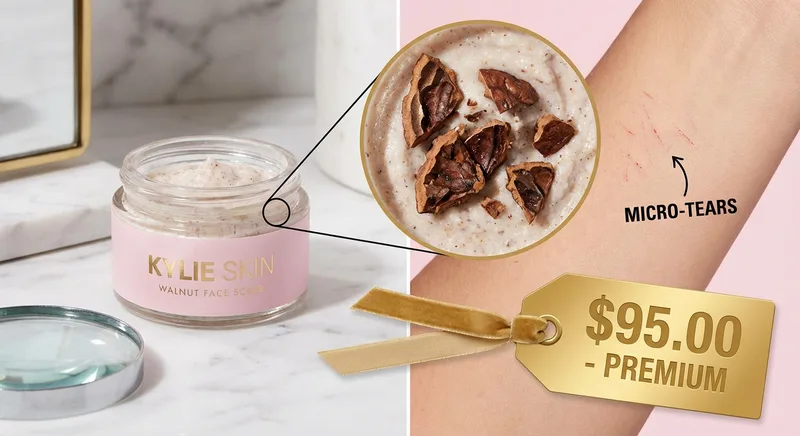
By 2019, the skincare community had reached a nearly universal consensus: walnut shell scrubs are bad for your face. St. Ives Apricot Scrub — the OG walnut shell face scrub — had been dragged through a class-action lawsuit, condemned by every dermatologist with an internet connection, and memed into oblivion on r/SkincareAddiction. The micro-tear discourse was settled. Walnut shells create jagged abrasions. Chemical exfoliants are better. The science was clear. The argument was over.
Then Kylie Jenner launched a walnut shell face scrub. In 2019. For $24.
This is the skincare equivalent of opening a Blockbuster Video in 2019. The market had moved on. The science had spoken. The walnut shell had been dethroned. And a billionaire with a cosmetics empire looked at all of this information and thought: "What if I put it in a pink bottle?"
The Kylie Skin Walnut Face Scrub launched as part of Kylie's skincare line and was immediately roasted by dermatologists, beauty editors, and the entire online skincare community, who could not believe they were having the walnut shell conversation again. It was like watching someone announce a new product made from asbestos — the ingredient had been so thoroughly debunked that its reappearance felt like a prank.
But it wasn't a prank. It was $24 for walnut shell particles in a celebrity-branded tube. St. Ives charged $4 for the same mistake. Kylie charged six times more. The markup on micro-tears is apparently 500%.
The Vision: Celebrity Skincare That Forgot to Check Reddit
Kylie Skin launched with a full product line: cleanser, toner, moisturizer, eye cream, vitamin C serum, and the walnut face scrub. The line was positioned as Kylie's personal skincare routine — the products she used to maintain the skin that millions of Instagram followers admired.
The problem with celebrity skincare is that the celebrity's skin is maintained by a team of dermatologists, aestheticians, and cosmetic procedures that the skincare line does not replicate. Kylie Jenner's skin doesn't look the way it does because of a $24 walnut scrub. It looks the way it does because of professional-grade treatments, expert guidance, and genetics. The walnut scrub is a prop in a narrative, not the cause of the result.
The scrub's ingredient list featured finely ground walnut shell powder — the same category of ingredient that made St. Ives infamous. Kylie Skin argued their walnut particles were "finer" than St. Ives' — a defense that is technically possible but dermatologically insufficient. Finer walnut shell particles are still irregular, still jagged under magnification, and still create micro-abrasions compared to the uniform smoothness of chemical exfoliants.
The skincare community's response was swift and merciless. "She really said 'what if St. Ives but expensive'" became a meme template. Dermatologists posted comparison images of walnut shell particles versus chemical exfoliant molecules. Beauty YouTubers who had spent years educating their audiences about the dangers of physical scrubs suddenly had to explain why a billionaire had just launched one.
The Glorious User Experience
Every Skincare Redditor, Simultaneously — ★☆☆☆☆
"She launched a WALNUT SCRUB. In 2019. For TWENTY-FOUR DOLLARS. We spent five years explaining why walnut scrubs are bad. We linked studies. We cited dermatologists. We built a community consensus. And then Kylie Jenner just... launched one. In pink. I feel like a teacher who taught an entire semester on gravity and then watched a student jump off the roof because a celebrity said flying was possible."
Tara from New York, NY — ★☆☆☆☆
“The micro-tear discourse was settled”
Click to Tweet"I used the Kylie Skin Walnut Scrub because I trust Kylie. My skin turned red and irritated for two days. My dermatologist asked what I'd used. I said 'Kylie Skin.' She said, 'The walnut scrub?' I said yes. She made the same face my St. Ives article says dermatologists make — the mechanic face. Then she prescribed a gentle retinol and told me to use chemical exfoliants only. The $24 Kylie scrub cost me a $60 dermatology copay. One star."
Maya from Los Angeles, CA — ★☆☆☆☆
"I can buy St. Ives Apricot Scrub for $4 at CVS. Same walnut shells. Same micro-tears. Same dermatological condemnation. Kylie charged $24 for the same formula in a prettier tube. I'm not paying a 500% markup on skin damage. If I want to sand my face, I'll use the $4 version. At least St. Ives doesn't pretend it's luxury. One star."
Dermatologist TikTok (collectively) — ★☆☆☆☆
"The Kylie Skin walnut scrub launched and every dermatologist with a social media account immediately posted a response video. It was the dermatological community's most coordinated reaction since sunscreen discourse. We don't agree on everything. We agree on this: walnut shells don't belong on faces. Not at $4. Not at $24. Not in green tubes or pink tubes. The walnut is not the problem. The marketing is the problem. The walnut just works for the marketing."
The Truth: Celebrity Doesn't Override Chemistry
The Kylie Skin Walnut Face Scrub was discontinued relatively quickly — pulled from the line after sustained backlash. The product's brief lifecycle represents one of the clearest cases where the skincare community's collective voice overrode celebrity influence. Kylie Jenner's brand power is enormous. The dermatological evidence against walnut scrubs was more enormous.
The scrub's failure was also a milestone for skincare education. The fact that enough consumers knew to reject a walnut scrub — even one endorsed by one of the most followed people on Earth — demonstrated that the years of dermatologist content, Reddit threads, and beauty YouTuber education had worked. The market had learned. Not completely. Not everyone. But enough to turn a celebrity product launch into a punchline.
The broader lesson is about celebrity skincare as a category. Celebrity-branded skincare lines are marketing exercises, not dermatological innovations. The products are formulated by contract manufacturers, branded by celebrities, and priced by the celebrity's market value rather than the product's ingredient value. A $24 walnut scrub from Kylie Skin contains ingredients worth approximately $2 — the same $2 worth of ingredients in the $4 St. Ives tube.
The Verdict
The Kylie Skin Walnut Face Scrub is St. Ives in a pink tube with a 500% markup. It's the skincare equivalent of a cover song that's worse than the original and costs six times more. The walnut shells are the same. The micro-tears are the same. The dermatological consensus is the same. The only thing different is the name on the label and the price on the shelf.
Kylie Jenner looked at the most debunked skincare ingredient of the decade and said "but make it fashion." The internet said no. The product was discontinued. The walnut shell lost again. And the lesson remains: celebrity endorsement cannot override chemistry, no matter how many Instagram followers you have.
We rate it 1 out of 5 gentle exfoliations.
If you want to exfoliate like a dermatologist instead of a celebrity, see our alternatives below.
---
✅What to Buy Instead
Drunk Elephant T.L.C. Sukari Babyfacial
AHA/BHA resurfacing that chemically exfoliates without physical abrasion. Your face gets resurfaced by acids, not abraded by tree parts.
Dermalogica Daily Microfoliant
Rice-based enzyme powder for gentle daily exfoliation. Smooth, round particles instead of jagged walnut shards.
Tatcha The Rice Polish
Japanese rice bran enzyme exfoliant — centuries of tradition versus walnut scraping. Refined. Gentle. Not condemned by dermatologists.
Comments
Sign in or create an account to join the discussion.