
Leg Magic / Circle Glide: The Leg Machine That Hurt the Elderly and Then Made a Sequel That Was Somehow Worse
An impressive commitment to failure — most companies fix the next version, Leg Magic made it more dangerous
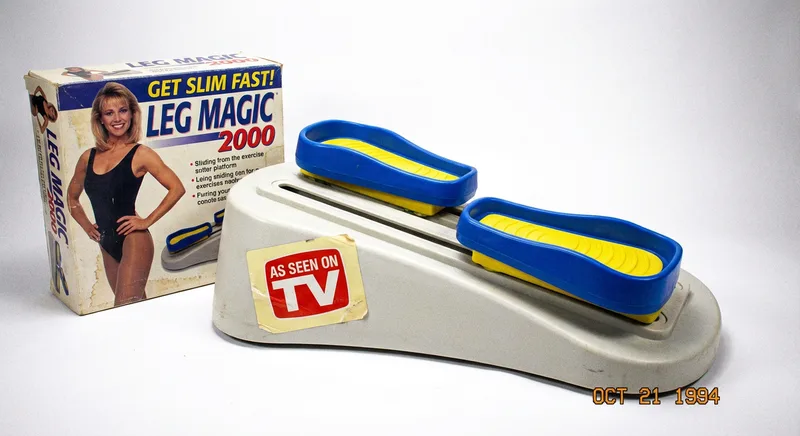
The Leg Magic was a fitness device consisting of two foot plates on rails that slid apart and together, allowing you to perform a standing leg adduction/abduction motion — sliding your legs in and out like a very slow, very deliberate pair of scissors. The infomercial showed fit people gliding effortlessly, their inner and outer thighs presumably transforming with each graceful slide.
What the infomercial did not show was what happened when someone with less-than-perfect balance, reduced lower body strength, or the general physical fragility that accompanies aging attempted to use a device that requires you to stand on two sliding platforms and control their separation using muscles you're trying to strengthen because they're currently weak.
If this sounds like a logical paradox, that's because it is. The Leg Magic asked people with weak legs to stand on a machine that requires strong legs to operate safely. This is like teaching someone to swim by throwing them in the deep end — except the deep end is your living room floor and the water is a fractured hip.
Elderly users — the demographic most targeted by "easy, low-impact leg exercise" marketing — reported falls, injuries, and the specific terror of standing on two platforms that are actively trying to separate your legs in opposite directions while you fight to keep them together using the muscles you don't have yet because you haven't finished the exercise because you just fell.
Then they released the Circle Glide.
The Vision: Glide Your Way to Toned Legs (Without Falling, Theoretically)
The Leg Magic's pitch was simple: slide your legs for a few minutes a day and your inner and outer thighs will tone and slim. The machine provided a guided range of motion that was supposed to be safer and more effective than floor exercises.
"Safer" did a lot of work in that sentence. The platforms slid on rails with minimal friction, which meant they moved quickly and with little resistance. A user with strong legs and good balance could control the motion. A user without those attributes — the exact user the machine was being sold to — could not. The platforms would separate faster than the user could control, resulting in an unplanned split that ranged from "startling" to "requires medical attention."
The Circle Glide was marketed as the next generation of the Leg Magic. It added a circular motion to the linear slide, creating a combination of lateral and rotational movement. This is the equivalent of a car manufacturer responding to complaints about steering problems by adding a second steering wheel that turns independently. The Circle Glide was everything the Leg Magic was — unstable, unpredictable, and poorly suited for its target demographic — but in a circle.
The Glorious User Experience
Doris from Sarasota, FL — ★☆☆☆☆
"I'm 72. I bought the Leg Magic because the commercial showed a woman my age using it easily. She was gliding. She was smiling. She had calves. I stepped on. The platforms began separating. I grabbed the handle. The platforms continued separating. I am now doing an involuntary splits on a machine in my living room at age 72 and the handle is the only thing between me and a hip replacement. I stepped off. I breathed. I called my daughter. My daughter Googled the product and read me the reviews, which were full of women my age describing the same experience with the same terror. One star."
Frank from Tucson, AZ — ★☆☆☆☆
"I used the Leg Magic once. ONCE. My right foot slid forward while my left foot stayed. I did a partial lunge I hadn't intended. My knee popped in a way that knees should not pop. The Leg Magic didn't strengthen my legs. It tested them. It was a diagnostic tool that determined, within three seconds, that my legs were not prepared for a machine designed for people whose legs are already prepared. One star."
“The Leg Magic asked people with weak legs to stand on a machine that requires strong legs to operate safely”
Click to TweetCheryl from Boise, ID — ★☆☆☆☆
"I bought the Circle Glide because I thought they'd fixed the problems with the Leg Magic. The Circle Glide added rotation to the slide, which meant instead of my legs sliding apart in a straight line, they slid apart while also rotating, which is a motion the human hip was not designed for at speed under load while standing on two separate moving platforms. I used the Circle Glide once and my physical therapist used the phrase 'how did this happen' in a tone that suggested he'd heard this story before."
Gary from Denver, CO — ★☆☆☆☆
"The Leg Magic folded up for storage, which was convenient because I needed to store it after one use, and it stayed stored for three years, and then it went to Goodwill, where it was presumably purchased by another person who used it once and stored it, beginning a cycle of single-use ownership that will continue until the machine collapses from the accumulated weight of unused potential."
The Truth: The Sequel Nobody Asked For
The Leg Magic was produced by Thane International, a direct-response marketing company that specialized in As-Seen-On-TV products. The machine sold well initially — the infomercial was effective, the price point was accessible ($80-120), and the promise of "easy leg toning" resonated with exactly the people who should not have been using it.
Consumer complaints about instability and falls accumulated quickly. Rather than redesigning for safety, Thane's response was to release the Circle Glide — a product that added complexity to an already problematic design. The Circle Glide's circular motion required even more balance and coordination than the Leg Magic's linear motion, which is the product development equivalent of a restaurant responding to food poisoning complaints by adding a second course.
Neither product had significant independent research supporting its claims of targeted leg toning. The sliding motion does engage leg muscles — but so does walking, climbing stairs, and every other activity that involves moving your legs, all of which are free and none of which involve standing on sliding platforms designed by people who apparently never tested them on the demographic they were selling them to.
The physical therapy community was not enthusiastic. Multiple PTs have noted that the Leg Magic's combination of low friction, high instability, and minimal user support creates a fall risk that is disproportionate to the exercise benefit. For elderly users — the primary target — the risk-to-reward ratio is upside down. You're more likely to injure yourself using the Leg Magic than to achieve the toned legs it promises.
The Verdict
The Leg Magic is a fitness device that injures the people it's designed to help. The Circle Glide is a sequel that made the original problems worse. Together, they represent the most impressive commitment to failure in fitness product history — a company that had a dangerous product, received complaints about the danger, and responded by releasing a more dangerous product.
Most companies iterate toward improvement. Leg Magic iterated toward the emergency room. The sequel was worse than the original, which is rare in any industry and unprecedented in a product category where the original was already hurting people.
We rate it 1 out of 5 safe landings.
If you want to strengthen your legs without risking a fall or a sequel, see our alternatives below.
---
✅What to Buy Instead
Aerobic Step Platform
Adjustable-height step for leg exercises, step-ups, and cardio. Stable, proven, and used by fitness professionals who know what "safe" means.
Body-Solid Leg Extension Machine
If you want machine-based leg work, a proper leg extension is safer, more effective, and doesn't have a sequel that makes it more dangerous.
Comments
Sign in or create an account to join the discussion.