
Mielle Organics Rosemary Mint Hair Oil: TikTok Made It a Miracle, Then It Allegedly Did the Opposite
The fastest rise-and-fall in hair care history — from viral holy grail to class-action defendant in the time it takes to scroll a For You page
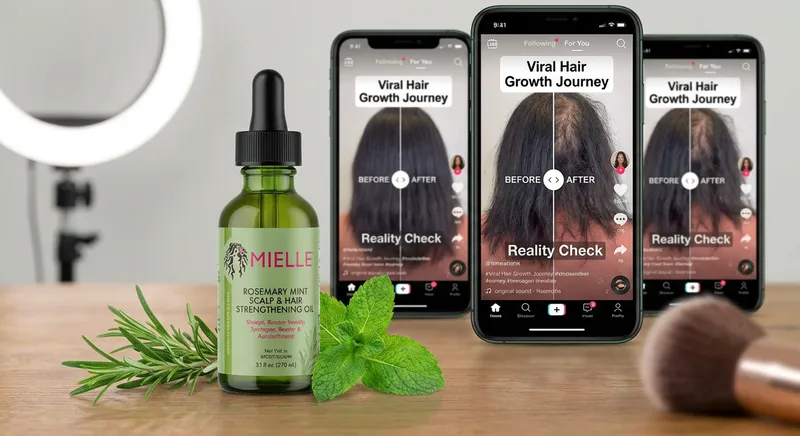
The lifecycle of Mielle Organics Rosemary Mint Scalp & Strengthening Hair Oil is a TikTok parable — a cautionary tale about what happens when an algorithm decides your hair product and a courtroom decides the rest.
Phase 1: The Ascent. Mielle Rosemary Mint Oil goes viral on TikTok. Creators with thick, shiny hair credit the $10 oil for their growth. The hashtag #MielleRosemaryMintOil accumulates hundreds of millions of views. The product sells out everywhere. Ulta can't stock it fast enough. Amazon sellers mark it up 3x. It's the hottest hair product in America, anointed by the algorithm, endorsed by the For You page, canonized in the church of TikTok beauty.
Phase 2: The Acquisition. Procter & Gamble acquires Mielle Organics in 2023 for an undisclosed sum. A Black-owned hair care brand founded by a chemical engineer becomes part of the portfolio that includes Head & Shoulders, Herbal Essences, and Pantene. The TikTok virality made Mielle a target. P&G made it a subsidiary.
Phase 3: The Fall. Class-action lawsuits are filed alleging that Mielle Rosemary Mint Oil causes hair loss, scalp irritation, and hair breakage. The product that TikTok said would grow your hair allegedly did the opposite. The For You page that built it became the comment section that buried it.
The velocity of this arc — from obscure to viral to acquired to sued — is unprecedented in hair care. The entire lifecycle happened in approximately two years, driven by an algorithm's recommendation engine on one end and a legal system's class-action mechanism on the other. TikTok created a miracle. The courts allege it was a mirage.
The Vision: Rosemary Oil + TikTok = Instant Holy Grail
The science behind rosemary oil for hair growth has some legitimate support. A 2015 study published in SKINmed journal found that rosemary oil was comparable to 2% minoxidil (Rogaine) for hair regrowth in patients with androgenetic alopecia over six months. This study — one study, with limitations — became the foundation for an entire TikTok hair growth movement.
Mielle's Rosemary Mint oil was positioned perfectly: rosemary oil as the star ingredient, mint for that tingly "it's working" sensation, affordable at $10, and from a Black-owned brand with a genuine community following. When TikTok's algorithm picked it up, the product hit every viral trigger: affordable, accessible, visually satisfying (the oil application videos), and supported by "science" (the rosemary study, as interpreted by people who read the headline but not the methods section).
The problem with virality as a product endorsement: TikTok is not peer review. The algorithm rewards engagement, not accuracy. A product can go viral because it produces visible results in some people, because the application videos are aesthetically pleasing, because the narrative ("this $10 oil replaced my $100 routine") is satisfying, or simply because the algorithm decided it was your turn to see it. None of these reasons are evidence that the product is safe for everyone, effective for everyone, or free of adverse effects.
The Glorious User Experience
Ashley from Memphis, TN — ★☆☆☆☆
"TikTok told me this would grow my hair. I watched 50 videos of women with gorgeous hair crediting this oil. I bought it immediately. Used it three times a week for two months. My hair started shedding more than before. Not catastrophic shedding — just... more. Enough to notice. Enough to Google. Enough to find the lawsuit. TikTok gave me the recommendation. Google gave me the class action. The internet giveth and the internet taketh away. One star."
Destiny from Houston, TX — ★☆☆☆☆
"I'm part of the community that Mielle was originally made for — Black women with natural hair who've been loyal to the brand since before TikTok discovered it. The viral moment was bittersweet: suddenly everyone wanted our product, then P&G bought the brand, then the lawsuits happened. We went from 'this is our brand' to 'this is P&G's brand' to 'this brand is getting sued' in eighteen months. The whole journey felt like watching your favorite restaurant get famous, get bought by a chain, and then fail a health inspection. One star."
“Creators with thick, shiny hair credit the $10 oil for their growth”
Click to TweetMaya from Los Angeles, CA — ★☆☆☆☆
"My scalp tingled when I applied the oil. The TikTok comments said the tingle meant 'increased blood flow' and 'the rosemary is activating.' My dermatologist said the tingle meant 'irritation.' Two interpretations of the same sensation — one from TikTok, one from medical school. I'm going with medical school. One star."
Jordan from Brooklyn, NY — ★☆☆☆☆
"I bought Mielle Rosemary Mint before the P&G acquisition. The formula was great. I bought it again after the acquisition. Something was different. The consistency. The smell. The way my scalp reacted. I can't prove the formula changed. Plenty of people online believe it did. Whether P&G reformulated or not, the timeline of 'acquired by conglomerate → lawsuits emerge' is a coincidence that the community noticed and has not forgotten. One star."
The Truth: When the Algorithm Replaces the Dermatologist
The Mielle Rosemary Mint Oil class-action lawsuits allege that the product causes hair loss, scalp irritation, and damage — the opposite of its marketed benefits. The lawsuits are ongoing, and Mielle has maintained that its products are safe.
The broader issue is the TikTok-to-consumer pipeline. When a product goes viral, millions of people adopt it simultaneously without the gradual market-testing that traditional retail provides. A product in a store builds its customer base over months and years, allowing adverse effects to surface incrementally. A product on TikTok builds its customer base in days, creating a massive simultaneous user group where adverse effects surface explosively — all at once, documented in real-time in the same comment sections that created the demand.
The rosemary oil study that undergirds the entire TikTok hair growth movement is legitimate but limited. It studied 100 patients with a specific type of hair loss over six months. The leap from "rosemary oil showed promise in one study of 100 people with androgenetic alopecia" to "this $10 rosemary oil product will grow anyone's hair" is the kind of leap that TikTok makes effortlessly and that science would never endorse.
Rosemary oil is a legitimate ingredient with promising research. But a product containing rosemary oil is not the same as the rosemary oil used in the study. Concentration matters. Formulation matters. Other ingredients matter. Scalp sensitivity matters. None of these nuances survive a 60-second TikTok video with trending audio and the text "this changed my life."
The Verdict
Mielle Organics Rosemary Mint Hair Oil is a parable about the difference between virality and evidence. TikTok made it a miracle. Class-action lawyers allege it's a disaster. The truth is probably somewhere between: a product that works for some people, doesn't work for others, and harms a subset — which is true of virtually every beauty product, but most beauty products don't get recommended to 100 million people simultaneously by an algorithm with no quality control.
The product's journey — from independent Black-owned brand to TikTok sensation to P&G acquisition to class-action defendant — is the compressed lifecycle of modern consumer products. The algorithm accelerated everything: the fame, the sales, the adoption, and the fallout. What used to take a decade now takes two years. What used to surface through word-of-mouth now surfaces through viral videos. And what used to be addressed by a quiet reformulation now becomes a class-action lawsuit filed in federal court.
We rate it 1 out of 5 algorithm-endorsed miracles.
If you want hair growth support that's backed by more than TikTok, see our alternatives below.
---
✅What to Buy Instead
The Ordinary Multi-Peptide Serum for Hair Density
Science-backed peptide formula for $18. Clinically studied. Not viral on TikTok, which, at this point, might be a selling point.
Rosemary Essential Oil (DIY)
Pure rosemary oil diluted with a carrier oil — the actual ingredient from the actual study, controlled by you. $8 for a bottle that lasts months.
Vegamour GRO Hair Serum
Clinically tested plant-based hair serum with published study results. Evidence before endorsement. Science before algorithm.
Comments
Sign in or create an account to join the discussion.