
The Nokia N-Gage: The Taco Phone That Failed at Being a Phone AND a Game Console
How Nokia built a device so ergonomically hostile that making a phone call required holding it sideways against your face like a slice of pizza
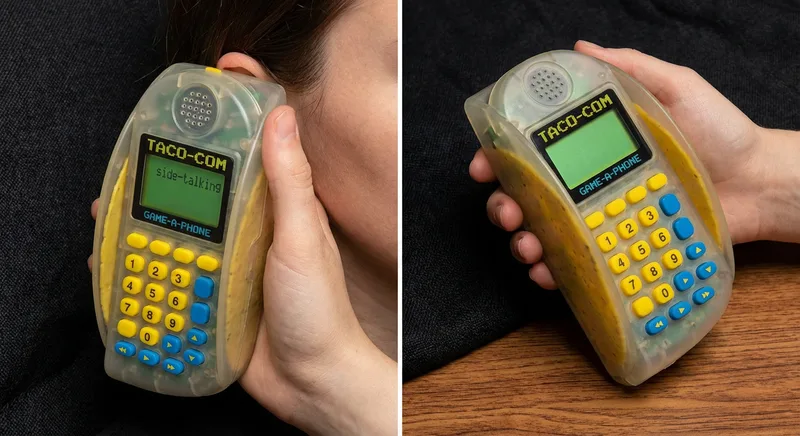
In October 2003, Nokia — then the largest mobile phone manufacturer on Earth — decided to attack Nintendo's dominance in handheld gaming by building a device that was both a phone and a game console. The Nokia N-Gage was born. It was shaped like a taco. It played games. It made phone calls. It did both of these things so badly that it became the most mocked consumer electronics device of the early 2000s, which, in an era that also produced the Segway, is a genuine achievement.
The phone sold approximately three million units, which sounds respectable until you learn that Nokia manufactured six million and the Game Boy Advance — its direct competitor — sold 81 million. Nokia reportedly lost approximately $100 for every N-Gage sold because they'd priced it below manufacturing cost to compete on price with a Nintendo product, which is like trying to out-value Walmart by personally subsidizing each customer's grocery bill from your savings account.
The N-Gage was discontinued in 2005. Nokia's gaming ambitions were discontinued shortly after. The word "sidetalking" entered the cultural vocabulary and never left.
The Vision: What If Your Phone Was Also a Game Boy (but Worse at Both)
Nokia's logic was straightforward: people carry phones everywhere, and people love portable games. Combine the two and you've got a product that does everything. This same logic would later produce the smartphone, which actually worked. In 2003, it produced the N-Gage, which did not.
The device ran Symbian OS, Nokia's mobile operating system, and played games on proprietary MMC cards. It had Bluetooth for multiplayer gaming. It had an FM radio. It had, on paper, everything a young gamer could want.
In practice, it had a screen oriented in portrait mode — vertical, like a phone — for games that were designed for landscape mode, like every other handheld console in existence. Imagine playing a racing game on a screen that's taller than it's wide. Your car takes up approximately 15% of the visible road. The remaining 85% is sky and your rising sense of regret.
The speaker and microphone were located on the thin edge of the device, which meant making a phone call required holding the N-Gage sideways against your face. Not at an angle. Not tilted slightly. Fully sideways, like you're listening for the ocean inside a taco shell. This position was immediately dubbed "sidetalking" by the internet and became one of the earliest technology memes. An entire website — sidetalking.com — was dedicated to photographs of people holding various objects sideways against their faces, because the N-Gage had made this posture iconic for all the wrong reasons.
And then there were the game cartridges. To change a game, you had to power off the device, remove the back cover, remove the battery, swap the MMC card, replace the battery, replace the cover, and power the device back on. This process took approximately ninety seconds and turned every game change into a minor surgery. Nintendo's Game Boy Advance, for comparison, had a cartridge slot on the outside that required precisely zero disassembly and approximately one second to swap.
The Glorious User Experience
Matt from London, UK — ★★☆☆☆
"I was fourteen years old and I wanted the N-Gage more than I had ever wanted anything. I got it for Christmas 2003. My first phone call was to my best friend to tell him about it. I held the device sideways against my face like a taco. My mum watched from the kitchen doorway. She said nothing. Her expression said everything. It said 'I have spent £299 on a device that makes my son look like he's trying to receive satellite transmissions through his cheekbone.' Two stars because Tony Hawk's Pro Skater was genuinely fun on it."
Sarah from Dublin, Ireland — ★☆☆☆☆
"I bought an N-Gage because the salesperson at Carphone Warehouse described it as 'the future of gaming.' The future of gaming, it turns out, involved removing a battery every time you wanted to play a different game. I played Tomb Raider on a vertical screen the width of a playing card. Lara Croft was approximately eight pixels wide. I could not tell if she was raiding tombs or standing in a very narrow corridor. One star."
Kevin from Toronto, ON — ★☆☆☆☆
“The phone sold approximately three million units, which sounds respectable until you learn that Nokia manufactured six million and the Game Boy Advance — its direct competitor — sold 81 million”
Click to Tweet"The sidetalking. I need to talk about the sidetalking. I was on the subway holding this thing against the side of my head and I could see people actively trying not to laugh. A child pointed at me. An older woman leaned over to the person next to her and whispered something. I don't know what she said but I know it wasn't complimentary. I switched to a regular Nokia phone within a month and the N-Gage became a dedicated Sonic game machine that required partial disassembly to play anything else. One star."
Danny from Chicago, IL — ★☆☆☆☆
"Nokia made a redesigned version called the N-Gage QD in 2004 that fixed the sidetalking problem by moving the speaker to the front. They also fixed the battery-removal game-swapping by adding an external card slot. So they knew both problems existed, fixed both problems, and still couldn't sell the device because the fundamental premise — a phone that plays worse games than a Game Boy — was the real issue. They fixed the symptoms and the patient still died."
The Truth: Sidetalking Your Way Into Technology History
The N-Gage launched with a lineup of approximately twenty games, most of which were ports from other platforms that looked and played worse on the N-Gage's vertical screen. The highlight was a version of Tony Hawk's Pro Skater, which was genuinely enjoyable if you could overlook the fact that you were playing a skateboarding game on a screen oriented the wrong way.
Nokia spent an estimated $100 million marketing the N-Gage, including sponsoring gaming events and creating an online multiplayer service called N-Gage Arena. The marketing was aggressive, confident, and targeted directly at the teenage demographic that was already perfectly happy with their Game Boy Advances, thank you very much.
The gaming community was merciless. Reviews were poor. The sidetalking meme spread across early-2000s internet forums with the viral efficiency of a joke that writes itself. Every photo of someone holding the N-Gage to their face was immediately, inherently funny in a way that no amount of marketing budget could counteract.
Nokia tried. The N-Gage QD redesign in 2004 fixed the hardware embarrassments. A later N-Gage software platform launched on other Nokia phones in 2008. But the brand was permanently poisoned. "N-Gage" had become synonymous with failure and public embarrassment, which are not qualities that sell consumer electronics.
The N-Gage's legacy is the lesson that combining two devices only works if the combination is better than either device separately. A phone that plays games worse than a Game Boy and makes calls more awkwardly than a Nokia 3310 is not a compelling combination. It's two mediocre products in one uncomfortable package. The smartphone would later prove that convergence works, but only when every function is executed well. The N-Gage proved that convergence fails when every function is executed like a compromise.
The Verdict
The Nokia N-Gage is the patron saint of devices that tried to do two things and did both of them badly. It was a phone that looked ridiculous when you used it as a phone. It was a game console with a screen oriented the wrong way and a cartridge slot located behind the battery. It was, in the most literal sense, a product designed by a phone company that didn't understand gaming and also, apparently, didn't fully understand phones.
The sidetalking meme has outlived the N-Gage by two decades. That single image — a person holding a taco-shaped device against their face — is more culturally significant than anything the N-Gage ever played, called, or accomplished.
We rate it 1 out of 5 tacos.
If you want portable gaming that doesn't require facial contortions or battery removal, see our alternatives below.
---
✅What to Buy Instead
Steam Deck OLED
Actual portable gaming with thousands of PC games, a gorgeous OLED screen, and a form factor designed by people who have held a game console before.
Nintendo Switch 2
The console that actually succeeded at being both portable and home gaming. Landscape screen. External cartridges. No battery removal required.
Backbone One Controller
Turn your actual phone into a real gaming device with console-quality controls. Your phone already makes calls correctly — just add the games.
Comments
Sign in or create an account to join the discussion.