
Orbeez and Water Beads: Tiny Candy-Colored Beads That Expand 100x Inside Your Toddler's Intestines
They look like candy. They feel like jelly. They expand to marble-size inside a child's digestive tract, causing intestinal blockages, surgery, and at least one death.
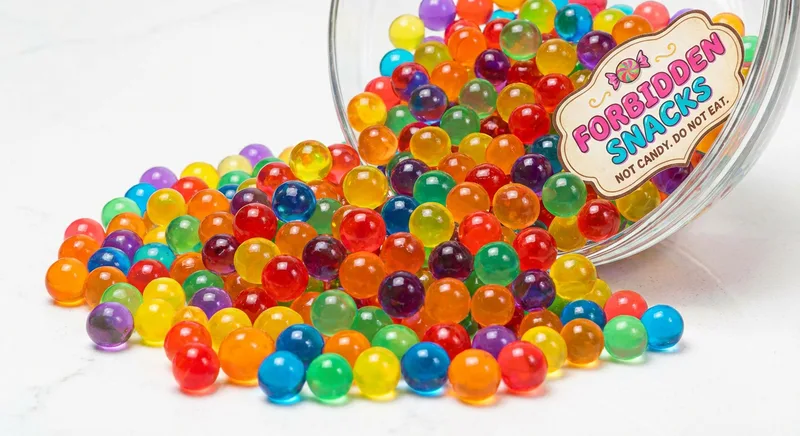
Water beads are superabsorbent polymer spheres that start as tiny, hard pellets — approximately the size of a sprinkle on a cupcake — and expand to the size of marbles when soaked in water. They're colorful. They're squishy. They're translucent and jewel-like. They're marketed as sensory toys for children.
They also look exactly like candy to a toddler. And when a toddler eats them — because toddlers eat everything, and these look specifically like candy — they do inside the child's body what they do in a bowl of water: they expand. A tiny bead that a toddler can easily swallow becomes a marble-sized obstruction in the intestinal tract, blocking the passage of food and liquid, requiring surgery to remove, and — in at least one case — causing death.
The CPSC has received thousands of reports of water bead ingestions. Emergency rooms across the country have treated children who swallowed water beads that expanded inside them. Some children required surgical removal. Some suffered intestinal damage. At least one child died.
The product is still sold. At every major retailer. In the toy section. In colors that look like candy. To an audience that includes children young enough to put everything in their mouths.
How Water Beads Become a Medical Emergency
Water beads are made of sodium polyacrylate — a superabsorbent polymer that can absorb up to 300 times its weight in water. When dry, the beads are small enough to pass through a toddler's throat without choking. This is actually the problem — they're small enough to swallow easily but expand dramatically once inside the body.
In the digestive tract, water beads absorb fluid and swell. A bead that was 2mm when swallowed can expand to 15-20mm within hours. At this size, it can obstruct the intestine — physically blocking the passage and causing symptoms including vomiting, abdominal pain, and constipation that progresses to complete bowel obstruction.
Water beads don't show up on standard X-rays. They're polymer, not metal. This means a child can swallow beads, develop symptoms, go to the emergency room, get X-rayed, and the beads won't be visible. Diagnosis often requires CT scans or ultrasound, and even then the beads can be difficult to distinguish from intestinal contents. The delay in diagnosis can allow the beads to continue expanding, worsening the obstruction.
Surgical removal is frequently necessary because the expanded beads cannot pass through the intestine naturally. The surgery involves opening the abdomen and physically extracting the beads from the bowel — a procedure with inherent risks, performed on a child, because of a sensory toy.
The Scale of the Problem
In October 2022, the CPSC issued a safety alert about water beads specifically aimed at parents, noting serious injury and death risks. The alert was not a recall — water beads as a category remain legal and widely sold. The alert was a warning that the product exists, that children eat it, and that the consequences can be fatal.
“They're marketed as sensory toys for children”
Click to TweetA consumer advocacy group, The Water Bead Safety Coalition, has documented hundreds of cases and advocates for regulation or a ban. Families who have experienced water bead ingestion injuries have testified before Congress. Legislation has been introduced — the Water Bead Safety Act — that would establish safety standards for water beads marketed for children's use.
The challenge is that water beads are sold in multiple contexts: as children's sensory toys (marketed directly to kids), as floral arrangement filler (marketed to adults), and as craft/décor items (marketed broadly). Regulating the children's toy version doesn't address the floral or craft versions that are also accessible to children in homes where they're used for non-toy purposes.
Why They're Still Sold
Water beads remain on shelves because they are popular, because they are not yet subject to a specific safety standard, and because the regulatory process moves slower than the product's distribution. The CPSC can recall specific products but has not banned the category. The proposed Water Bead Safety Act would create federal standards, but legislation takes time.
In the interim, water beads continue to be sold in the toy section alongside products designed for toddlers. The packaging carries warnings about ingestion. The beads continue to look like candy. And toddlers continue to be toddlers — beings whose primary method of investigating the world is putting it in their mouths.
The design challenge is fundamental: a sensory toy designed to be touched and squeezed by small children will inevitably be placed in small children's mouths. A product that is dangerous when mouthed cannot be safely used by the age group most likely to mouth it. The product's target market and the product's danger zone are the same population.
The Verdict
Water beads are tiny when swallowed and enormous when they expand inside a child. They look like candy. They're marketed as toys. They're accessible in homes. And they cause intestinal blockages, surgery, and death in the children who eat them — which is what toddlers do with small, colorful, candy-like objects.
The product that provides sensory stimulation outside the body provides intestinal obstruction inside the body. The same property that makes it a toy — absorption and expansion — makes it a medical emergency. The fun and the danger are the same mechanism.
We rate it 1 out of 5 safe sensory toys.
If your child enjoys sensory play, use products that can't expand inside their body. See our alternatives below.
---
✅What to Buy Instead
Kinetic Sand
Moldable, mess-free sensory play that stays the same size inside and outside a child's body. Cannot expand. Cannot obstruct. Can be mushed endlessly.
Play-Doh
The classic sensory toy, safely mushed since 1956. Non-toxic if eaten (tastes terrible, which is its own safety mechanism). Doesn't expand.
Magna-Tiles
Magnetic building tiles. Too large to swallow. Endlessly creative. Provides sensory satisfaction through building rather than squishing.
Comments
Sign in or create an account to join the discussion.