
Pee Wee Pumps: High Heels for Infants Who Cannot Walk, Stand, or Understand Why You've Done This to Them
Soft-soled high heels for babies aged 0-6 months — an age group whose primary locomotive achievement is rolling over, and whose opinion on footwear has not been solicited
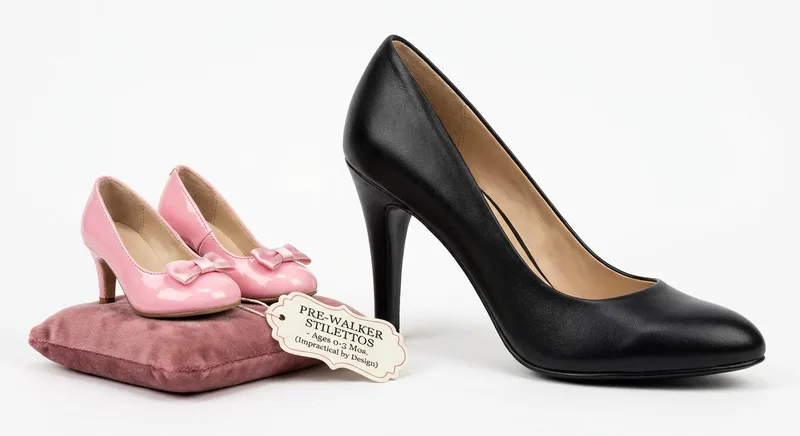
I want to establish a few things about babies aged 0-6 months, the target demographic for Pee Wee Pumps.
They cannot walk. They cannot stand. Most of them cannot sit unassisted. Many of them have not yet discovered their own feet. They do not know what shoes are. They do not know what fashion is. They do not have opinions about footwear. If you put a high heel on a baby's foot and a sock on the other foot, the baby cannot tell you which it prefers because the baby cannot speak, and also because the baby does not care, and also because the baby will attempt to eat both.
Pee Wee Pumps are soft-soled high-heeled shoes designed for infants. They have a raised heel. They have a pointed toe. They are available in colors including leopard print, hot pink, and black patent. They look like the shoes a very small woman would wear to a very small cocktail party. They are for babies. BABIES.
The product exists. It is real. It was funded, manufactured, marketed, and sold. Someone designed a high heel, scaled it to infant proportions, and brought it to market for babies who cannot walk, for a body part that pediatricians recommend keeping bare, in a style that podiatrists have spent decades arguing is damaging to the adult feet that can actually wear them.
Pee Wee Pumps is the answer to a question nobody asked, designed for a customer who can't consent, addressing a need that doesn't exist, in a style that experts recommend against, at every age, for every foot, forever.
The Vision: What If Fashion, but on a Newborn?
The founder of Pee Wee Pumps has stated that the shoes are "fun" and "cute" and designed for photos and special occasions — not for walking, because the babies can't walk, because they're babies. The shoes are a costume. They are dress-up. They are Instagram props for parents who want to photograph their infant in high heels for reasons that survive no scrutiny whatsoever.
The shoes are soft-soled, which means they don't provide the rigid structure of an actual high heel — the baby's foot isn't being forced into an unnatural position because the shoe has no structural integrity. This is Pee Wee Pumps' defense: the shoes are too floppy to cause damage. They are cosmetic heels. Decorative heels. The heel is aesthetic, not functional.
This defense is: "Don't worry, the high heels are fake." Which raises the question: if the heels are fake, the baby can't walk, and the sole purpose is photographs, why not just Photoshop heels onto the baby's feet? Why manufacture a physical product? Why create a shoe-shaped object for a foot that doesn't need shoes, in a style that the foot shouldn't have, for an occasion that requires nothing from the foot except existing?
The answer is Instagram. The answer is always Instagram.
The Glorious User Experience
Crystal from Nashville, TN — ★☆☆☆☆
"I put Pee Wee Pumps on my daughter for a photo shoot. She was four months old. She kicked one off in approximately seven seconds. It landed in a plant. I retrieved it, put it back on, and she kicked it off again. This happened four times. The photo shoot produced zero photos of a baby wearing two heels simultaneously. The photo shoot produced several photos of a baby wearing one heel and one bare foot, which is not the aesthetic anyone was going for. One star."
Diane from Atlanta, GA — ★☆☆☆☆
"I showed the Pee Wee Pumps to my pediatrician. She looked at them. She looked at me. She said, 'Babies don't need shoes.' I said, 'I know, they're just for photos.' She said, 'Babies don't need shoes.' She said the same sentence twice. She was making a point. The point was received. One star."
“Many of them have not yet discovered their own feet”
Click to TweetAmanda from Los Angeles, CA — ★★☆☆☆
"Two stars because they ARE cute. I am acknowledging the cuteness. A tiny leopard-print high heel on a baby foot is, objectively, visually amusing. But 'visually amusing' is the description of a prop, not a shoe. These are props. They are baby foot props. They cost $35 for props that a baby will wear for 30 seconds before launching across the room with the force and accuracy of a tiny pink projectile. Two stars for the aesthetic. Zero stars for the utility. One star average."
Mark from Houston, TX — ★☆☆☆☆
"My wife bought these. I came home from work and my three-month-old son was wearing high heels. I had many questions. The questions were: (1) why, (2) why, (3) what purpose does this serve, (4) can he feel these, (5) does he know these are on his feet, and (6) why. My wife said 'Instagram.' This answered all six questions. One star."
The Truth: Pediatricians Recommend Bare Feet
The American Academy of Pediatrics and virtually every pediatric podiatrist recommends that babies go barefoot as much as possible. Bare feet allow infants to develop foot muscles, balance, and proprioception — the sensory awareness of their body in space. Shoes of any kind are unnecessary for pre-walking babies and can interfere with natural foot development.
High heels, specifically, are the footwear style that podiatrists most consistently recommend AGAINST — for adults. High heels shift body weight forward, compress the toes, shorten the Achilles tendon, and alter spinal alignment. Pee Wee Pumps' soft-sole design means they don't produce these effects on infant feet (because the shoes have no structure), but they introduce the aesthetic of a harmful shoe style to an audience of zero-year-olds, which is a sentence that shouldn't need to be written.
The controversy around Pee Wee Pumps wasn't primarily medical — it was cultural. Critics argued that putting high heels on infant girls projects adult fashion standards onto children who haven't developed the capacity for preferences, self-image, or the concept of shoes. Supporters argued they're just fun photo accessories. Both sides are correct. Both sides are also arguing about a shoe for a person who can't walk.
The Verdict
Pee Wee Pumps are high heels for humans who cannot walk, do not know what fashion is, and will attempt to eat the shoe within seconds of it being placed on their foot. They are soft enough to be harmless and pointless enough to be unnecessary. They solve no problem, serve no developmental purpose, and exist exclusively for photographs that will be shown to the child in eighteen years, at which point the child will ask the same question everyone asks when they see Pee Wee Pumps: "Why?"
The answer is: Instagram. It's always Instagram.
We rate it 1 out of 5 necessary baby shoes.
If your baby needs something on their feet — or if they don't, which is the actual medical recommendation — see our alternatives below.
---
✅ What to Buy Instead
Zutano Baby Booties** | Cozy fleece booties that actually stay on — the real challenge with baby footwear. No heels. No controversy. Just warm feet. | View on Amazon | | ✅ | Bare Feet | Pediatricians recommend barefoot for healthy foot development. Free. Available everywhere. The most evidence-based footwear option for infants. | View on Amazon |
✅What to Buy Instead
Robeez Soft Sole Shoes
Pediatrician-recommended shoes that support natural foot development. Designed for babies who are learning to walk, not babies who are learning to exist.
What to Buy Instead
Tried-and-tested alternatives that actually deliver on their promises. We may earn a small commission on purchases.

Comments
Sign in or create an account to join the discussion.