
Quibi: The $1.75 Billion Streaming Service That Died Faster Than Its 10-Minute Episodes
How two Hollywood legends burned through nearly $2 billion to prove that nobody wants to watch TV shows designed for the bathroom
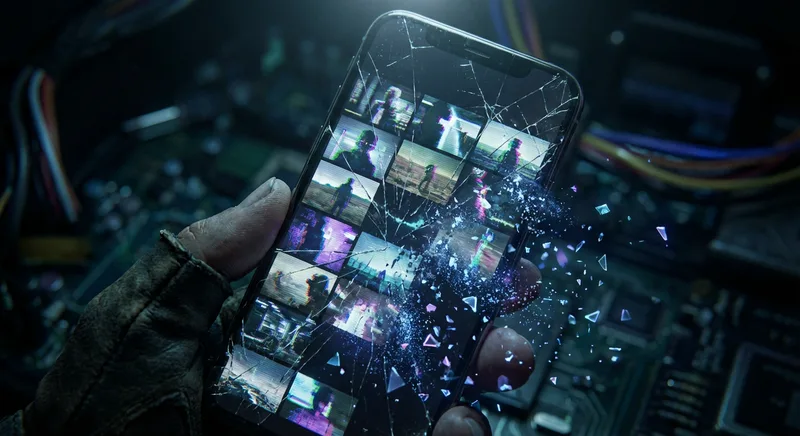
In April 2020, Jeffrey Katzenberg and Meg Whitman launched Quibi, a mobile-only streaming service featuring shows no longer than ten minutes. They had raised $1.75 billion from investors including every major Hollywood studio. They had A-list talent — Chrissy Teigen, Liam Hemsworth, Sophie Turner. They had a proprietary technology called "Turnstyle" that seamlessly switched between portrait and landscape mode when you rotated your phone.
They did not have an audience. They did not have shows people wanted to watch. They did not have the ability to take screenshots, share clips, or cast to a television. They did not, it turned out, have a reason to exist.
Quibi launched on April 6, 2020. It shut down on December 1, 2020. That's 239 days, or roughly $7.3 million burned per day, or approximately $5,000 per minute, or enough money to fund a small country's healthcare system incinerated in the time it takes to watch one of Quibi's forgettable ten-minute episodes.
The service was designed for people to watch during commutes. It launched during a global pandemic when nobody was commuting. This is the business equivalent of opening an umbrella store on the surface of the sun.
The Vision: "Quick Bites" for People Who Are Too Busy for Television but Not Too Busy for Television
The thesis behind Quibi — short for "Quick Bites" — was that there was an untapped market of people who wanted premium, Hollywood-quality content in ten-minute episodes, exclusively on their phones, that they couldn't share with anyone.
Read that sentence again. Each clause makes the business model worse.
Jeffrey Katzenberg, former chairman of Walt Disney Studios and co-founder of DreamWorks, was convinced that mobile-first, short-form premium content was the future of entertainment. His logic went something like: people watch YouTube on their phones, people scroll TikTok on their phones, therefore people want to watch expensive scripted dramas on their phones but shorter.
This logic ignored the fact that YouTube is free and TikTok is free and people watch them because they're free and shareable and community-driven, not because they secretly wished someone would charge them $5/month for professionally produced ten-minute shows starring Liam Hemsworth that they cannot discuss on social media because the app prevents screenshots.
Meg Whitman, former CEO of eBay and HP, was brought in as CEO. The combination of Katzenberg's Hollywood connections and Whitman's corporate gravitas gave the venture an air of inevitability. These were not amateurs. These were industry titans. Surely they knew something the rest of us didn't.
They did not know something the rest of us didn't.
The Glorious User Experience
Rachel from Brooklyn, NY — ★★☆☆☆
"I signed up for the free trial because I was in quarantine and had watched everything else on every other platform. The shows were... fine? Not bad, not memorable, just aggressively fine. Like hotel art. Like elevator music. Like a meal you eat and immediately forget. The problem was I couldn't tell anyone about anything I watched because the app literally blocked screenshots. You cannot discuss a show you cannot share a frame of. Quibi made watching TV a solitary, unshareable experience, which is the opposite of what makes TV cultural. Two stars for Chrissy Teigen's courtroom show, which I cannot prove I watched."
David from Los Angeles, CA — ★☆☆☆☆
"I work in entertainment. I had friends who worked on Quibi shows. The budgets were real — these were not cheap productions. The talent was real. The problem was conceptual. Nobody needed this. The time it took to open the Quibi app, find a show, and start watching was approximately the same as opening Netflix, finding something, and pressing play. Except Netflix let me watch on my TV. And share with my partner. And discuss online. Quibi gave me a ten-minute show on my phone that I watched alone in my bathroom like a secret shame. One star."
“They had A-list talent — Chrissy Teigen, Liam Hemsworth, Sophie Turner”
Click to TweetMike from Austin, TX — ★☆☆☆☆
"The 'Turnstyle' technology — where the show seamlessly switched between landscape and portrait — was genuinely impressive. It was also the most advanced solution to a problem nobody had ever reported having. 'I wish this show would adapt when I rotate my phone' said nobody, ever, in the history of television consumption. They built the world's best technology for rotating a screen and forgot to build a reason to turn it on."
Karen from Denver, CO — ★☆☆☆☆
"I downloaded Quibi in April 2020. I was stuck at home. My commute was from my bed to my couch. The entire service was designed for the commute I no longer had, on a phone screen I no longer needed because I was sitting in front of a 55-inch television with nothing to do for the next eight months. The timing was so bad it almost felt personal."
The Truth: $1.75 Billion for 239 Days
The numbers are staggering in their wastefulness. Quibi spent $1.75 billion and acquired approximately 500,000 paying subscribers — a fraction of what they needed to survive. For context, Netflix adds that many subscribers in a slow week. Disney+ gained ten million subscribers on its launch day alone.
The content strategy was fatally confused. Quibi wanted to be premium but short. HBO-quality but phone-only. Appointment viewing but in ten-minute increments. The shows existed in a no-man's-land between the quick dopamine hits of TikTok and the deep engagement of streaming series, satisfying neither appetite. It was too long to scroll past and too short to care about. A ten-minute drama is just long enough to establish characters you'll never get to know.
The anti-sharing policy was suicidal. In 2020, the currency of entertainment is social media. Shows become hits because people share clips, memes, reactions, and screenshots. Quibi blocked all of this. It built a walled garden and then wondered why nobody could see the flowers. By the time they added screenshot capability in August 2020, the patient was already on life support.
The pandemic accelerated the death but didn't cause it. Katzenberg blamed COVID repeatedly, and while the timing was genuinely terrible, the fundamental problems — no sharing, no TV casting, no compelling exclusive content, a price point competing with free alternatives — existed independently of the virus. Quibi would have struggled in any timeline. COVID just ensured it struggled faster.
After shutting down, Quibi sold its content library to Roku for reportedly less than $100 million — a nickel on the dollar for $1.75 billion in investment. The shows now stream for free on the Roku Channel, which is the entertainment equivalent of your failed restaurant's recipes being published in a pamphlet distributed at a bus station.
The Verdict
Quibi is the most expensive proof of concept in entertainment history for a concept that didn't need proving — because the answer was always "no." Nobody wanted premium content exclusively on their phone, in ten-minute chunks, that they couldn't share or discuss. The market for this product was precisely zero people, and $1.75 billion did not change that number.
The most Quibi thing about Quibi is that nobody remembers any of its shows. Not one. There were over 100 original programs, and the cultural footprint is a perfect circle of nothing. The only thing anyone remembers about Quibi is that it failed, which is the ultimate indictment of a content company: your failure was more memorable than your content.
We rate it 1 out of 5 pivot tables.
If you want to watch something on your phone that's actually good and actually free, see our alternatives below.
---
✅What to Buy Instead
YouTube Premium
Ad-free short and long-form content with offline downloads and background play. The thing Quibi tried to compete with and couldn't.
Netflix Standard with Ads
Massive content library at a budget price with shows people actually remember watching. Castable to your TV. Shareable.
TikTok (Free)
Free short-form video that actually works on phones — what Quibi wished it was. No subscription required. Screenshots encouraged.
Comments
Sign in or create an account to join the discussion.