
The Skarp Laser Razor: The Razor That Might Blind You Before It Shaves You
How a razor with no working prototype raised $4 million on Kickstarter before the platform itself pulled the plug
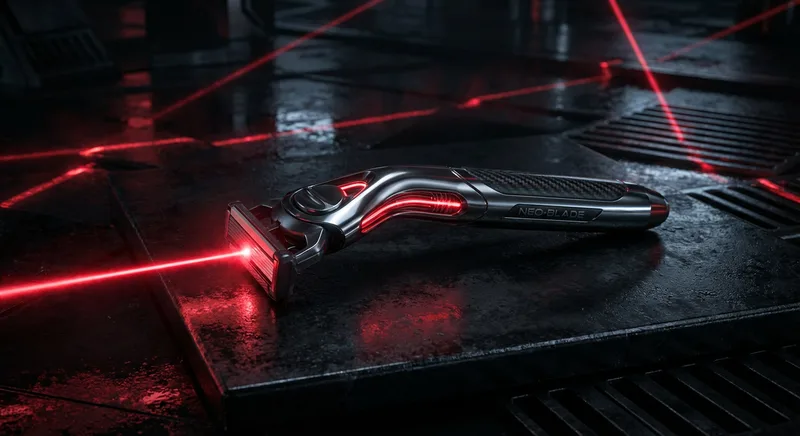
The history of shaving is a history of incremental progress. One blade. Two blades. Three blades. Four blades. Five blades with an aloe strip. A battery that vibrates. A subscription service. Mankind has been adding features to razors for centuries with the grim determination of an arms race where the enemy is facial hair and the casualties are your wallet.
In 2015, a company decided to skip the next fifty years of incremental progress and go straight to lasers. The Skarp Laser Razor would use a focused beam of light to cut hair at the follicle level. No blades. No water. No cream. No irritation. No ingrown hairs. Just a smooth, clean, laser-powered shave that sounded like it came from a science fiction film because, functionally, it did.
The Kickstarter raised over $4 million from people who were ready for the future of grooming. Then Kickstarter suspended the campaign — something it almost never does — because the Skarp team could not demonstrate a working prototype. The razor they showed in the demo video could cut a single hair. Sometimes. When the angle was right. When the laser didn't break. When the planets aligned and the shaving gods smiled upon the tiny, flickering beam of light that was supposed to replace five thousand years of blade technology.
The laser broke on contact with hair. That is the sentence that explains everything. The razor's defining component could not survive contact with the thing it was designed to cut.
The Vision: Light Sabers for Your Face
The pitch was elegant: a small, ergonomic razor handle with a thin laser fiber stretched across its head where blades would normally be. You'd draw it across your skin the same way you'd use a normal razor, but instead of cutting hair mechanically, the laser would sever each strand at a molecular level, leaving skin untouched and hair vanquished.
The founders claimed the laser was tuned to a specific chromophore — a light-absorbing molecule present in all human hair. The light would target hair and pass through skin harmlessly. No nicks. No cuts. No razor burn. The blade would never dull because light doesn't dull. You'd never need to buy replacement cartridges, which alone would save the average man approximately $200 per year and deprive Gillette of its reason for existing.
If this sounds too good to be true, it's because the laser fiber they were using was so fragile that it snapped when it encountered resistance — which, given that its job was to encounter resistance from hair, was a significant design limitation.
The Glorious User Experience
Nobody (Product Was Never Shipped) — ★★☆☆☆
"I backed this for $159 and received a full refund after Kickstarter pulled the campaign. I consider myself lucky. The people who followed the campaign to Indiegogo, where it continued after the Kickstarter suspension, were less fortunate. I'm giving it two stars instead of one because the concept was genuinely cool and the refund was prompt. But a razor that breaks when it touches hair is like a boat that sinks when it touches water — the concept needs additional development."
Dave from r/wicked_edge — Professional skeptic
"The shaving community called this immediately. When the demo video showed the laser cutting a single strand of hair in slow motion, we all noticed three things: one, it took several seconds to cut one hair; two, the face has approximately thirty thousand hairs; three, at that rate, a full shave would take approximately twenty-five hours. The math didn't work. The physics didn't work. The laser didn't work. But the Kickstarter page was very well designed."
Mike from Chicago, IL — ★☆☆☆☆
“In 2015, a company decided to skip the next fifty years of incremental progress and go straight to lasers”
Click to Tweet"I followed this to Indiegogo after Kickstarter pulled it, because I am a person who sees a red flag and interprets it as a festive banner. The Indiegogo campaign raised additional money. I contributed. The razor never shipped. I now use a $30 Merkur safety razor that has worked flawlessly for three years. The blades cost eight cents each. I have spent less on shaving in three years than I pledged for the Skarp. The future of shaving, it turns out, was invented in 1904."
Caroline from London, UK — ★☆☆☆☆
"I backed this for my husband's birthday. He unwrapped... nothing, because it never arrived. Instead of a laser razor, I gave him an IOU for a product that doesn't exist, from a company that had been suspended from the platform where I found it. For his next birthday, I gave him a gift card. Our marriage survived both decisions."
The Truth: Kickstarter Said No, Which Is Like Being Rejected by a Platform That Funded the Potato Salad Guy
Kickstarter's decision to suspend the Skarp campaign was extraordinary. This is a platform that has funded a project to make potato salad ($55,000), a guy who promised to eat a ghost pepper ($255), and the Coolest Cooler ($13 million). The bar for Kickstarter suspension is located somewhere beneath the Earth's crust. Skarp didn't just fail to clear it — Skarp was excavating toward the bar when Kickstarter intervened.
The suspension cited Kickstarter's requirement that hardware projects demonstrate a working prototype. The Skarp team's prototype video showed the laser cutting one hair under controlled conditions. Kickstarter's evaluation determined this did not constitute a working prototype of a razor — a device whose fundamental requirement is cutting more than one hair.
The team moved to Indiegogo, which has historically lower standards for prototype verification. The Indiegogo campaign raised additional funds. As of this writing, the Skarp Laser Razor has not shipped to backers. The company has posted sporadic updates over the years, each one promising progress and none of them including the words "we've shipped the product."
The core problem was always the laser fiber. Cutting hair with light requires either enormous power (dangerous near eyes and skin) or an incredibly specialized wavelength that targets hair chromophores without heating surrounding tissue. The Skarp team's fiber was too fragile to survive repeated use. It was a razor built around a component that broke when asked to do its job, which is an engineering challenge roughly equivalent to building a car around an engine that explodes when you turn the key.
The hair removal industry does use lasers successfully — in clinical settings, with devices the size of a desk lamp, operated by licensed professionals, at costs ranging from hundreds to thousands of dollars per session. The idea of shrinking that technology into a handheld consumer razor at a $159 price point wasn't just ambitious. It was aspirational in the way that building a time machine in your garage is aspirational — technically not impossible, but practically, you're going to need a bigger garage.
The Verdict
The Skarp Laser Razor is the rare crowdfunding project that was suspended not because it was a scam, but because the product simply didn't work and the team couldn't prove otherwise. It occupies the uncomfortable space between fraud and delusion — a company that genuinely believed it could revolutionize shaving with lasers but couldn't build a prototype that survived contact with a single human hair.
The shaving industry has since continued its reliable, unglamorous march of incremental improvement. Safety razors, double-edge razors, and high-quality electric shavers remain the most cost-effective and reliable ways to remove hair from your face. None of them use lasers. None of them risk blinding you. All of them can cut more than one hair at a time.
We rate it 2 out of 5 safety hazards. One extra star for the audacity of the concept and the promptness of the Kickstarter refunds.
If you want a shave that's effective, affordable, and won't require safety goggles, see our alternatives below.
---
✅What to Buy Instead
Henson AL13 Safety Razor
Precision-machined aluminum razor that lasts a lifetime. Blades cost pennies. Cuts hair on contact, which is the minimum requirement for a razor.
Philips Norelco 9000 Prestige
Premium electric shaver with AI-powered sensors that adapt to your face. Uses electricity, not lasers. Your eyes remain unharmed.
Merkur 34C
Classic double-edge safety razor beloved by r/wicked_edge for over 50 years. Under $40. The future of shaving was invented in 1904 and it still works.
Comments
Sign in or create an account to join the discussion.