
St. Ives Apricot Scrub: The Skincare Holy Grail That Turned Out to Be Sandpaper for Your Face
How walnut shell fragments went from 'exfoliating' to 'creating micro-tears that accelerate aging' — the most dramatic fall from grace in drugstore skincare history
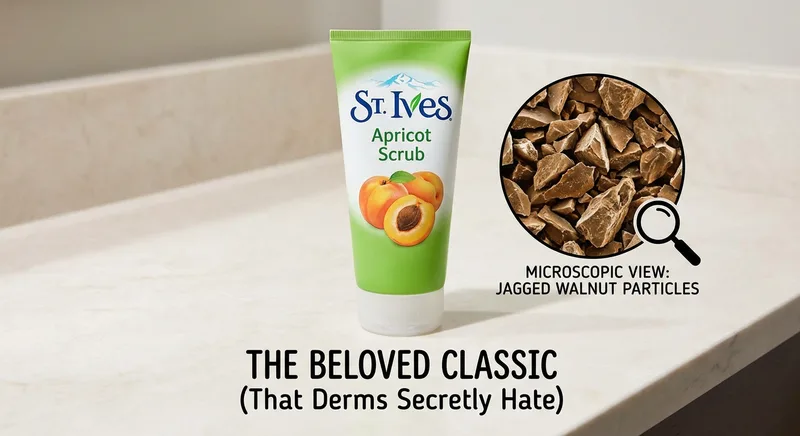
Every person who went through puberty in America between 1985 and 2015 used St. Ives Apricot Scrub. This is not an exaggeration. It is a statistical near-certainty. The green tube with the apricot on the label was in every bathroom, every shower caddy, every dorm room, every teenager's acne-fighting arsenal. It cost $4. It smelled like fruit. It felt like rubbing gravel on your face, which, at the time, we interpreted as "working."
It was not working. It was sanding.
St. Ives Apricot Scrub contained crushed walnut shell fragments as its primary exfoliating agent. Walnut shells are irregular, jagged, and sharp — microscopic shards that, when rubbed vigorously across facial skin, create micro-tears in the epidermis. These tears are invisible to the naked eye but visible under magnification, and they do the opposite of what exfoliation is supposed to do: instead of smoothing the skin, they damage the skin barrier, increase sensitivity, promote inflammation, and — according to dermatologists — actually accelerate the aging process the scrub was supposed to prevent.
For decades, we were rubbing tiny knives on our faces and calling it skincare.
The product was the subject of a class-action lawsuit in 2016, alleging that St. Ives' parent company (Unilever) marketed the scrub as beneficial for skin when it actually caused damage. The lawsuit alleged the walnut shell particles were "too rough and too large" for facial exfoliation and that the product's marketing misrepresented its effects.
The fall from grace was swift and total. St. Ives Apricot Scrub went from America's most beloved drugstore skincare product to the example dermatologists use when explaining what NOT to do to your face, in approximately the time it took for r/SkincareAddiction to reach critical mass.
The Vision: Exfoliation Through Violence
Physical exfoliation — using a rough substance to scrub dead skin cells off the surface of your face — is a real skincare technique. The problem isn't the concept. The problem is the execution: walnut shells are an irresponsibly aggressive exfoliant for facial skin.
Facial skin is thinner and more delicate than the skin on the rest of your body. The stratum corneum — the outermost layer — is approximately 10-20 micrometers thick on the face, compared to 20-30 micrometers on the body and up to 600 micrometers on the palms and soles. Walnut shell fragments, with their irregular jagged edges, don't distinguish between dead skin cells that should be removed and living skin cells that should not.
Chemical exfoliants — products containing AHAs (glycolic acid, lactic acid) or BHAs (salicylic acid) — dissolve the bonds between dead skin cells without physical contact, removing them evenly and without creating tears. This distinction — chemical precision versus physical brutality — is the difference between modern skincare and what St. Ives was selling.
St. Ives was selling the skincare equivalent of cleaning your teeth with sandpaper. It removed stuff. It also removed things you needed.
The Glorious User Experience
Every Teenager in America, 1990-2010 — ★★★★★ at the time, ★☆☆☆☆ in retrospect
"I used St. Ives Apricot Scrub every single day because the burning meant it was working. The redness meant it was exfoliating. The tightness meant my pores were clean. None of this was true. The burning meant my skin barrier was compromised. The redness was inflammation. The tightness was dehydration from stripping my natural oils. But it was $4 and it smelled like apricots and I was 15 and nobody told me I was sanding my face. One star in hindsight."
Rachel from r/SkincareAddiction — ★☆☆☆☆
"The moment I replaced St. Ives with Paula's Choice 2% BHA, my skin transformed. Not because the BHA was magic. Because I'd stopped attacking my face with walnut fragments every morning. The 'improvement' I saw was my skin recovering from years of micro-trauma. The bar was underground and I was celebrating that my skin cleared up after I stopped hurting it. One star."
“The green tube with the apricot on the label was in every bathroom, every shower caddy, every dorm room, every teenager's acne-fighting arsenal”
Click to TweetDr. Ranella Hirsch, Dermatologist — Professional opinion
"Crushed walnut shell is an extremely aggressive physical exfoliant that creates micro-tears in the skin's surface. These tears compromise the skin barrier, increase transepidermal water loss, and create entry points for bacteria and irritants. For patients with sensitive, acne-prone, or aging skin, this type of exfoliation can worsen every condition it claims to treat."
Sarah from Austin, TX — ★☆☆☆☆
"I was loyal to St. Ives for twenty years. TWENTY. YEARS. Two decades of rubbing crushed walnut shells on my face three times a week. My dermatologist looked at my skin under magnification and asked what I'd been using. I said St. Ives. She made a noise. Not a word. A noise. The kind of noise a mechanic makes when you say you've been putting diesel in your gasoline car for twenty years. One star."
The Truth: The Scrub Heard 'Round r/SkincareAddiction
St. Ives Apricot Scrub's fall from grace is a case study in how internet skincare communities changed the beauty industry. For decades, the scrub was unchallenged — recommended by magazines, stocked in every drugstore, and endorsed by the universal logic of "it feels like it's doing something, so it must be doing something."
Reddit's r/SkincareAddiction subreddit, which grew to over 2 million members, became the primary platform where the scrub's reputation was dismantled. Dermatologists, cosmetic chemists, and informed consumers shared the science of micro-tears, explained the difference between physical and chemical exfoliation, and recommended alternatives. The scrub became the subreddit's go-to example of bad skincare — the "before" photo of everyone's skincare journey.
The 2016 class-action lawsuit, filed in the U.S. District Court for the Southern District of New York, alleged that Unilever marketed the scrub as safe for daily use when dermatological science contradicted this claim. The lawsuit was eventually dismissed on procedural grounds, but the public discourse it generated cemented St. Ives' fall from grace in the broader culture.
The scrub is still sold. It still costs about $4. The label now reads "dermatologist tested," a phrase that means a dermatologist was involved in testing the product, not that a dermatologist recommends it. The phrase is a shield, not an endorsement.
The skincare revolution that dethroned St. Ives ushered in the era of chemical exfoliation — products like Paula's Choice BHA, The Ordinary's AHA/BHA peeling solution, and CeraVe's salicylic acid cleanser replaced walnut shells with acids that exfoliate without tearing. This was not progress. This was correction. The industry had been selling face-sandpaper for three decades and calling it skincare.
The Verdict
St. Ives Apricot Scrub is the most popular bad skincare product in American history. It was in every bathroom. It was recommended by every magazine. It felt like it worked because it was aggressive enough to be felt, and for decades, that feeling was mistaken for efficacy.
It was sandpaper. Fancy, apricot-scented, $4 sandpaper. And the generation that grew up rubbing it on their faces is now the generation explaining to their dermatologists why their skin barrier has been compromised since the Clinton administration.
We rate it 1 out of 5 gentle exfoliations.
If you want to exfoliate without creating micro-tears in your skin, see our alternatives below.
---
✅What to Buy Instead
Paula's Choice 2% BHA Liquid Exfoliant
The gold standard of chemical exfoliation. Dissolves dead skin cells without physical damage. The product that replaced St. Ives in millions of medicine cabinets.
The Ordinary AHA 30% + BHA 2% Peeling Solution
At-home chemical peel for $7.50. No walnut shells. No micro-tears. Just chemistry doing what scrubbing couldn't.
CeraVe SA Smoothing Cleanser
Gentle salicylic acid cleanser that exfoliates while supporting the skin barrier. The opposite of everything St. Ives did.
Comments
Sign in or create an account to join the discussion.