
Steel Supplements Shredded-AF: Every Product Ends in '-AF' and They Keep Getting Caught by the FDA
A company whose naming convention screams 'gym bro energy' and whose ingredient list screams 'unapproved stimulants the FDA warned us about'
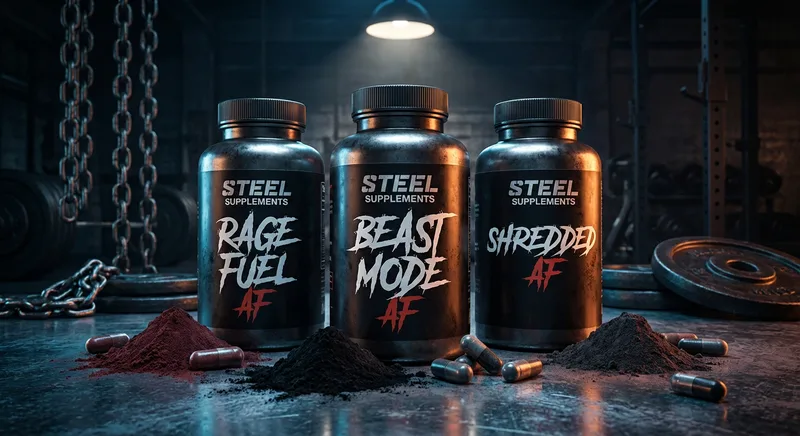
Let me introduce you to Steel Supplements, a company whose product naming strategy consists of taking a fitness adjective and appending "-AF" to it. Shredded-AF. Pumped-AF. Focused-AF. Rested-AF. Charged-AF. It's like a 22-year-old gym bro achieved sentience and became a corporation.
The "-AF" stands for what you think it stands for. It's the kind of branding that says "we are not a company that employs a compliance department." It's the supplement-label equivalent of arriving at a job interview in a tank top. It communicates a certain... approach to professionalism.
And the ingredients match the naming convention: aggressive, unverified, and occasionally illegal.
The FDA has issued multiple warnings to Steel Supplements for products containing deterenol — an unapproved synthetic stimulant that the FDA specifically warned was not a legitimate dietary ingredient. Deterenol is structurally related to banned stimulants and has no established safety profile in humans. It has never been approved for use in dietary supplements. Steel Supplements put it in their products. The FDA told them to stop. They kept selling.
This is a company that received federal warnings about unapproved stimulants in their products and responded with the supplement-industry equivalent of "I'll do it again." The FDA said stop. Steel said "-AF."
The Vision: Aggressive Branding for Aggressive Ingredients
Steel Supplements markets itself to a specific audience: young men who want to be shredded, pumped, focused, charged, and rested — all of these states achieved through capsules and powders with names that sound like Call of Duty perks.
The marketing is heavily Instagram-influenced — sponsored athletes with visible abs posting workout videos tagged with #SteelArmy, alongside links to products that the FDA has specifically flagged as potentially dangerous. The disconnect between the aspirational fitness imagery and the regulatory reality is staggering: the people endorsing these products may not know that the products contain unapproved stimulants, and the people buying them almost certainly don't.
Deterenol, the ingredient the FDA flagged in multiple Steel products, is a beta-agonist — a compound that stimulates the sympathetic nervous system, increasing heart rate and blood pressure. Beta-agonists have legitimate pharmaceutical uses under medical supervision. They do not have legitimate dietary supplement uses, which is why the FDA told Steel to remove deterenol from their products.
The Glorious User Experience
Tyler from Las Vegas, NV — ★☆☆☆☆
"I took Shredded-AF for two weeks. My resting heart rate went from 62 to 89. RESTING. While sitting on my couch watching Netflix, my heart was beating like I was being chased by something. My Apple Watch started sending me heart rate alerts. My Apple Watch was more concerned about my health than the company that made the supplement I was taking. When your smartwatch is a better health advisor than your supplement brand, reconsider your supplement brand. One star."
Cody from Dallas, TX — ★☆☆☆☆
"I bought Focused-AF because I wanted better gym focus. What I got was jittery hands, a jaw that wouldn't unclench, and the kind of wired anxiety that makes you clean your apartment at 1 AM because your body has too much synthetic stimulant in it to sit still. I wasn't focused. I was vibrating. One star."
Jake from Miami, FL — ★☆☆☆☆
“The "-AF" stands for what you think it stands for”
Click to Tweet"I looked up Steel Supplements on the FDA website after a friend mentioned they'd been warned. Multiple products flagged. Warning letters. Unapproved ingredients. I'd been taking their products for three months. Three months of consuming ingredients that a federal agency had specifically said shouldn't be in dietary supplements. Nobody told me. Not the website. Not the Instagram athletes. Not the store that sold it to me. The FDA told Steel. Steel didn't tell me. One star."
Brooke from Phoenix, AZ — ★☆☆☆☆
"My boyfriend's supplement shelf looks like a Steel Supplements shrine. Shredded-AF. Pumped-AF. Focused-AF. Every tub ends in '-AF.' I Googled the company. FDA warnings. Unapproved stimulants. I showed him. He said, 'But look at my gains.' His gains don't know about the deterenol. His heart does. One star."
The Truth: Warning Letters Are Not Suggestions
The FDA's warning letter process is not casual. Warning letters are issued after investigation, analysis, and regulatory review. They represent the FDA formally stating: "This product contains ingredients that are not legal in dietary supplements. Stop selling it." The FDA's resources are limited. The fact that they allocated those resources to Steel Supplements means the concern was significant.
Steel Supplements' response to FDA scrutiny has been, generously, ambiguous. Products have been reformulated — some flagged ingredients have been removed, others appear to have been replaced with different novel stimulants that haven't yet attracted regulatory attention. This is the supplement-industry version of whack-a-mole: remove one unapproved ingredient, add another, and hope the FDA takes longer to notice the new one than it took to flag the old one.
The "-AF" branding is not incidental. It's strategic. The aggressive, in-your-face naming signals to the target audience that these products are intense, edgy, and uncompromising. What it doesn't signal is that "intense" and "edgy" sometimes means "contains synthetic stimulants that a federal regulatory agency has specifically told us to remove."
The supplement industry's regulatory framework creates a landscape where companies can receive FDA warnings and continue operating without meaningful consequence. Warning letters are public. Consumers can look them up. But consumers don't look them up, because the Instagram athletes look healthy and the tub says "-AF" and the assumption is that if something is sold in a store, it must be safe.
This assumption is wrong. It is demonstrably, repeatedly, sometimes fatally wrong.
The Verdict
Steel Supplements is a company that names its products like a gym bro texts and formulates them like a pharma company that lost its license. The FDA has warned them. They have reformulated. The names remain aggressive. The compliance remains questionable. And the target audience — young men who trust sponsored athletes more than regulatory databases — continues to buy products that a federal agency has publicly flagged.
The "-AF" suffix is the most honest thing about these products. They are indeed "-AF." Just not in the way the marketing intends.
We rate it 1 out of 5 clean labels.
If you want a pre-workout that won't earn FDA warning letters, see our alternatives below.
---
✅What to Buy Instead
Legion Pulse Pre-Workout
Clean label, research-backed, third-party tested. Every ingredient published with its dose. No "-AF" suffix needed when the science is actual.
Kaged Pre-Kaged
Informed Sport certified with patented ingredient forms. The kind of label that survives FDA scrutiny because it was designed to.
Nutricost Caffeine Capsules
Pure caffeine. Measured doses. $0.05 per serving. Works. Is legal. Has never received an FDA warning letter. A low bar that Steel couldn't clear.
Comments
Sign in or create an account to join the discussion.