
The Tiko 3D Printer: A 3D Printer That Couldn't Even Print Its Own Obituary
How three college kids raised $3 million, shipped 4,000 broken printers, and wrote the saddest Kickstarter farewell letter in crowdfunding history
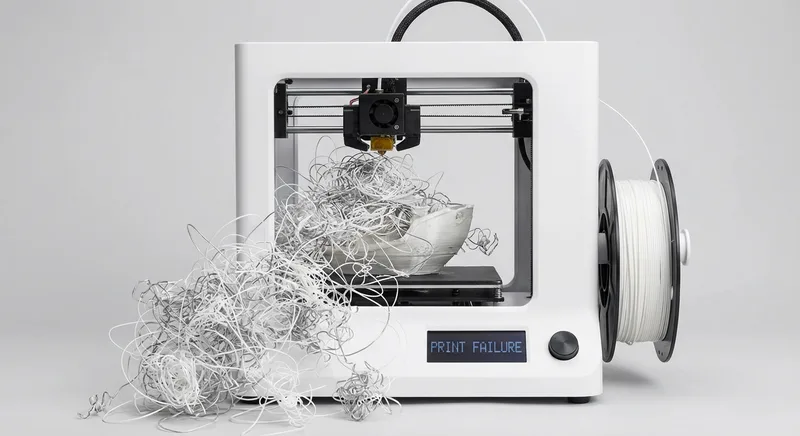
In March 2015, three students from Dalhousie University in Nova Scotia launched a Kickstarter for a $179 3D printer called the Tiko. It was beautiful — a sleek, triangular, enclosed delta printer with a unibody frame that looked like it belonged in a design museum. At that price, it was the cheapest 3D printer anyone had ever attempted to mass-produce. The campaign raised $2,950,874 from 16,538 backers who wanted to believe that the future of desktop manufacturing could be had for less than the cost of a nice dinner for two.
Sixteen thousand people gave money to college students to build a precision manufacturing device for $179. This is the crowdfunding equivalent of hiring a teenager to rewire your house because he offered to do it for forty dollars.
Two years, $55 in shipping fees per backer, and approximately four thousand broken printers later, the Tiko team posted a Kickstarter update that read like a suicide note written by a startup: "We climbed to the top, then fell off and hit every branch on the way down. We're sorry we disappointed you."
Twelve thousand backers received no printer and no refund. The branches, apparently, did not break the fall.
The Vision: A Unibody Masterpiece (That Couldn't Be Repaired)
The Tiko's defining innovation was its unibody frame — a single injection-molded plastic shell that served as both the printer's enclosure and its structural support. This was, in theory, brilliant. One part instead of dozens. No alignment issues. No assembly required. Lower manufacturing costs.
In practice, it meant that when something went wrong — and things went wrong constantly — the printer was essentially unrepairable. You can't replace a part when the part is the entire machine. The unibody that was supposed to make the Tiko affordable and precise instead made it disposable, in the same way that a car with no hood is technically aerodynamic but practically useless if the engine needs service.
The team also made a fateful decision to use cheaper, lower-torque stepper motors instead of the industry-standard NEMA 17 motors. This saved approximately $15 per unit and caused approximately $3 million worth of problems. Reports of layer shifting, missed steps, and catastrophic mid-print failures poured in from the four thousand backers who actually received units. The prints looked less like precision manufacturing and more like a candle that had melted in a warm car.
Instead of active cooling fans, they designed a "passive cooled liquefier" — engineering language for "we didn't put a fan on it." The result was extruded filament that blobbed and sagged like warm cheese on a pizza that's been delivered from too far away.
The Glorious User Experience
Trevor from Toronto, ON — ★☆☆☆☆
"I received my Tiko after paying $179 plus $55 shipping — $234 total for a printer that produced objects resembling modern art created by someone who is deeply angry. Every print had layer shifts. The first thing I tried to print was a test cube, which came out as a parallelogram. Not a parallelogram by design. A parallelogram by failure. The Tiko turned my cube into a geometry lesson about what happens when motors skip steps."
Sarah from Portland, OR — ★☆☆☆☆
"The demo prints that came pre-loaded looked fine, which I now realize is like a restaurant having one good dish that the health inspector eats while everything else gives people food poisoning. The moment I tried to print anything that wasn't a demo file, the results were catastrophic. Spaghetti. Blobs. A vase that looked like it had been to war. I contacted support. Support told me to try the demo files again. I did not find this helpful."
Marcus from London, UK — ★☆☆☆☆
“At that price, it was the cheapest 3D printer anyone had ever attempted to mass-produce”
Click to Tweet"I am one of the twelve thousand people who paid $234 and received nothing. Not a printer. Not a refund. Not even a functional apology — just a Kickstarter update where three college students described their business failure using military metaphors. 'No battle plan survives first contact with the enemy,' they wrote, quoting a Prussian general. My brother, you were building a plastic box that squirts melted filament. You are not storming Normandy. You are failing to deliver a product people paid for. One star."
Nina from Vancouver, BC — ★★☆☆☆
"One of those rare cases where I'm giving two stars to something I never received, because the Tiko was genuinely beautiful. As an industrial design object, it was stunning. As a 3D printer, it was a failure. As a business, it was a catastrophe. As an expensive LED lamp — which is what one owner said he tells people it is — it's honestly not bad. Two stars for the lamp."
The Truth: We Climbed to the Top, Then Fell Off and Hit Every Branch
The Tiko story is a masterclass in what Hackaday memorably called "out-innovating yourself." The team had one genuinely clever idea — the unibody frame — and then, intoxicated by their own innovation, decided to reinvent every other component of the printer as well. Custom motors. Custom drive systems. Custom cooling. Custom electronics. Every standard, proven, affordable component used by the 3D printing community was replaced with something novel, untested, and ultimately broken.
During a Reddit AMA, when a user rationally pointed out that Tiko couldn't possibly know their cost of goods sold before finalizing manufacturing, the team responded: "We understand your skepticism but are not incompetent." This sentence aged like milk left in the Tiko's unibody frame.
The money ran out fast. The team ordered components in bulk before finalizing the design — the manufacturing equivalent of buying furniture before the house is built. When the design changed, the components were useless. When the components were useless, the budget evaporated. When the budget evaporated, twelve thousand backers started writing increasingly desperate comments on the Kickstarter page.
The team charged backers $55 in shipping fees separately from Kickstarter — money paid directly to Tiko for shipping a product that, for 75% of backers, never shipped. Those shipping fees were never refunded. Backers paid $234 total for a printer that either arrived broken or didn't arrive at all. M3D, a competitor, offered Tiko backers a working printer for $199 — which, while a kind gesture, also underscored the absurdity of having paid $234 for a printer and then needing to buy a different, cheaper printer to actually print things.
The farewell update on Kickstarter is genuinely sad to read. These weren't scammers — they were young people who had an idea they couldn't execute, in an industry they didn't fully understand, at a price point that defied mathematics. Their parting message included the line "this isn't over yet," promising a potential investor could revive the project. No investor appeared. The project remained over.
The Verdict
The Tiko 3D printer is a cautionary tale about the difference between design and engineering. The Tiko was designed beautifully. It was engineered tragically. The unibody frame that made it photogenic also made it unrepairable. The low price that made it irresistible also made it unmanufacturable. The college-kid ambition that made it charming also made it doomed.
Today, the Bambu Lab A1 Mini costs roughly the same as a Tiko and actually works — auto-calibrating, fast-printing, producing objects that look like the things they're supposed to be. The 3D printing revolution that the Tiko promised is happening. It just didn't need the Tiko to get there.
We rate it 1 out of 5 successfully printed layers.
If you want a 3D printer that prints objects instead of regrets, see our alternatives below.
---
✅What to Buy Instead
Bambu Lab A1 Mini
Best entry-level 3D printer with auto-calibration, fast printing, and great quality for ~$200. The Tiko's dream, built by adults with manufacturing experience.
Creality Ender-3 V3
Reliable workhorse with a massive community, endless upgrades, and prints that look like what they're supposed to be.
Prusa MK4S
Gold standard of consumer 3D printing with legendary customer support. Costs more, but you'll actually receive it and it'll actually work.
Comments
Sign in or create an account to join the discussion.