
The WhyCry Baby Crying Analyzer: A $100 Device That Tells You Your Baby Is Crying, Which You Already Knew
A gadget that claims to analyze cry sounds and tell you WHY your baby is crying, but actually just cycles through 5 generic reasons with the diagnostic accuracy of a Magic 8-Ball
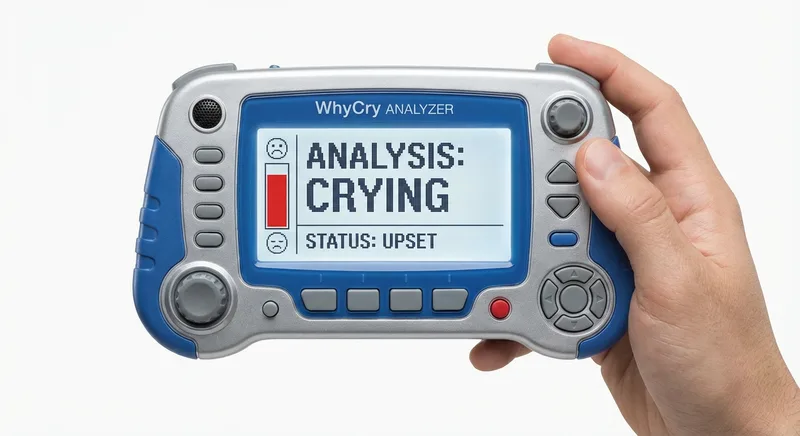
The WhyCry is a $100 handheld device that you hold near a crying baby. The device "analyzes" the cry pattern and displays one of five icons representing the alleged reason for crying: hungry, bored, annoyed, sleepy, or stressed.
That's the product. For $100. Five possible answers. Displayed on a screen. Based on "cry analysis."
There are five reasons a baby cries, according to the WhyCry. There are also five sides to a pentagon, five fingers on a hand, and five possible answers on a Magic 8-Ball if you remove the novelty phrasing. The WhyCry is a $100 multiple-choice test with five answers, administered to an infant, with diagnostic accuracy that independent reviews have described as "random," "no better than guessing," and "worse than a parent's intuition."
The device's premise — that different types of cries have acoustically distinct patterns that a handheld consumer device can reliably identify — is not entirely unsupported by research. Studies have shown that infant cries do contain acoustic features that correlate with different states (pain cries are acoustically different from hunger cries, for example). What the research does NOT show is that a $100 consumer gadget with a microphone and basic processing can reliably distinguish these patterns in real-time, in a home environment, with background noise, while the baby is actively screaming.
What parents discovered: the WhyCry cycles through its five icons with apparent randomness, occasionally landing on the correct reason by chance (20% of the time, which is exactly what you'd expect from a random five-option generator). The device doesn't analyze. It guesses. And it guesses with the confidence of a product that costs $100 and the accuracy of a product that shouldn't cost $5.
The Vision: What If Technology Could Decode Baby Cries (It Can't, at This Price Point)
The concept of cry analysis is legitimate. Neonatal research has used sophisticated acoustic analysis software — running on laboratory-grade equipment — to identify patterns in infant cries that correlate with neurological conditions, pain levels, and developmental states. This research uses controlled environments, calibrated microphones, and machine learning algorithms trained on thousands of cry samples.
The WhyCry is a handheld consumer device with a basic microphone, minimal processing power, and five output options. The gap between neonatal cry research and the WhyCry is approximately the same gap between NASA's Mars rover and a toy remote-control car. Both have wheels. The similarity ends there.
The real "crying analyzer" that every parent already possesses: their own brain, their own experience, and the process of elimination that has been the primary diagnostic tool for infant care since the beginning of humanity. Is the baby hungry? When did they last eat? Are they wet? Check the diaper. Are they tired? When did they last sleep? Are they in pain? Check for obvious causes. Are they overstimulated? Reduce stimulation.
This process takes approximately 30 seconds, costs $0, and is correct significantly more than 20% of the time. The WhyCry costs $100, takes longer, and provides a random icon that the parent then has to evaluate anyway, which means the parent is doing the actual diagnostic work and the WhyCry is providing decoration.
The Glorious User Experience
Sarah from Minneapolis, MN — ★☆☆☆☆
"The baby was screaming. I held the WhyCry near the baby. The WhyCry displayed the 'hungry' icon. I fed the baby. The baby continued screaming. I held the WhyCry near the baby again. It displayed 'sleepy.' I tried to put the baby down for a nap. The baby continued screaming. I held the WhyCry near the baby a third time. It displayed 'bored.' My baby was not bored. My baby was experiencing gas pain, which is not one of the WhyCry's five options, because the WhyCry only has five options, and 'gas' is not one of them. I spent $100 on a device that doesn't include 'gas' as a diagnostic option for a baby. One star."
Mike from Portland, OR — ★☆☆☆☆
“"There are five reasons a baby cries, according to the WhyCry”
Click to Tweet"I used the WhyCry and my wife used her instinct. My wife was right every time. The WhyCry was right approximately one out of five times. My wife is free. The WhyCry cost $100. I paid $100 to be outperformed by the person standing next to me. One star."
Lisa from Dallas, TX — ★☆☆☆☆
"The WhyCry told me my three-week-old was 'bored.' BORED. A three-week-old. A human being whose entire cognitive world consists of eating, sleeping, and being startled by their own hands. The WhyCry diagnosed my infant with ennui. I paid $100 for a device to tell me my newborn has existential torpor. One star."
James from Chicago, IL — ★☆☆☆☆
"I bought this during sleep deprivation week two. I would have bought anything that promised to explain why the baby was crying. I would have bought a fortune cookie. I would have consulted a ouija board. The WhyCry is approximately as accurate as both of those options and significantly more expensive. One star."
The Truth: Desperation Is a Market
The WhyCry exploits the most vulnerable moment in parenting: the first weeks with a newborn, when sleep deprivation is acute, confidence is low, and a screaming baby feels like an unsolvable problem. New parents are desperate for answers. The WhyCry offers answers. The answers are wrong, but they're offered with the authority of a device that has a screen, a microphone, and a $100 price tag.
The parenting gadget market is full of products like the WhyCry — devices that promise to decode, analyze, or translate the baby experience for anxious parents. Some, like smart baby monitors with breathing tracking, provide genuinely useful data. Others, like the WhyCry, provide the illusion of data while delivering random outputs.
The difference between a useful parenting gadget and a useless one is whether the technology behind it can actually do what it claims. A breathing monitor uses a sensor to detect respiration — a measurable, physical event. A cry analyzer claims to interpret acoustic patterns into emotional states — a complex, contextual, subjective determination that laboratory-grade equipment struggles with and a $100 consumer device cannot do.
The Verdict
The WhyCry is a $100 Magic 8-Ball for exhausted parents. It provides five possible answers to the question "why is my baby crying" with the accuracy of random chance and the confidence of a product that costs more than most baby monitors.
Your baby is crying. You don't need a device to tell you why. You need to check the diaper, offer food, try sleep, reduce stimulation, and check for pain — the same process every parent has used since before the concept of consumer electronics existed. This process is free. It works. And it doesn't diagnose your three-week-old with boredom.
We rate it 1 out of 5 accurate diagnoses.
If you want actual tools to understand your baby, see our alternatives below.
---
✅What to Buy Instead
Huckleberry App (Free)
Baby tracking app that logs feeding, sleep, and diapers — revealing patterns over time that explain fussy periods. Data-driven, not guess-driven. Free.
Wonder Weeks App
Science-based developmental leap tracker that explains WHY babies are fussy during specific weeks. Backed by decades of research. More accurate than five icons.
Harvey Karp's Happiest Baby on the Block
The 5 S's: swaddle, side/stomach, shush, swing, suck. Proven soothing techniques that work for $15. The book version of what the WhyCry pretends to be.
Comments
Sign in or create an account to join the discussion.