
Juicero: Silicon Valley's $699 Monument to Solving Problems That Don't Exist, Then Solving Them Wrong
$120 million in venture capital. A Wi-Fi-connected juice press. A Bloomberg reporter squeezed the bag by hand and got juice faster. The founder now sells $40 'raw water.'
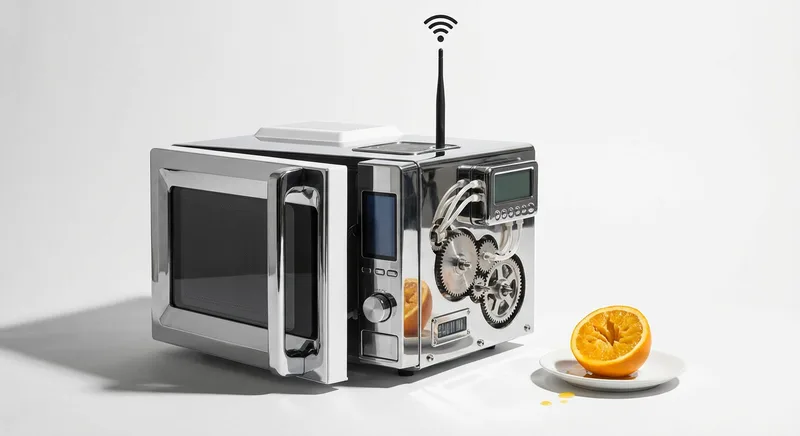
In 2016, a startup called Juicero raised $120 million in venture capital funding from investors including Google Ventures, Kleiner Perkins, and Campbell Soup Company. One hundred and twenty million dollars. For a juice press.
The Juicero was a countertop machine that pressed proprietary juice packs — pre-filled bags of chopped fruits and vegetables — into a glass. You inserted the bag, pressed a button, and four tons of force squeezed the bag into juice. The machine cost $699 at launch (later reduced to $399). The juice packs cost $5-8 each and were available only through a subscription. The machine required Wi-Fi to operate because it scanned a QR code on each pack to verify freshness — and would refuse to press packs past their expiration date.
The juice press had DRM. Digital rights management. For juice. The machine wouldn't press a bag that had expired, which means Juicero built a juice press that could refuse to make juice. It was a juice press with veto power. It was an appliance that had opinions about your produce.
In April 2017, Bloomberg News published the article that killed Juicero. Reporters discovered that you could squeeze the juice packs by hand — with your human hands — and get the same amount of juice, at the same speed or faster, as the $699 machine. The machine that applied four tons of force to a bag of pre-chopped produce was outperformed by a reporter's grip strength.
Four tons. Of force. To squeeze a bag. That a person could squeeze with their hands. In the same amount of time. The $120 million machine was a $120 million pair of hands.
Juicero shut down in September 2017, sixteen months after launch. One hundred and twenty million dollars. Sixteen months. Wi-Fi juice press. Hand-squeezable bags. This is Silicon Valley's masterpiece.
The Vision: What If Juice, but with a Subscription and Wi-Fi?
Juicero's founder, Doug Evans, pitched the company as "the Keurig of juice" — a comparison that was accurate in one specific way: like Keurig, Juicero locked consumers into proprietary pods that only worked with the machine. Unlike Keurig, the pods could be squeezed by hand, which is like discovering your Keurig coffee pods can be opened and poured into a cup of hot water to produce the same coffee.
The machine was beautifully engineered. Seriously. It was a genuine feat of mechanical engineering — CNC-milled aluminum, custom geartrains, a precision press mechanism that applied consistent, measured force. Teardowns revealed a machine with the build quality of medical equipment. The engineering was extraordinary. The problem was that the engineering was applied to a task that didn't require engineering. Or electricity. Or Wi-Fi. Or four tons of force. Or $120 million.
The juice packs were the business model. Juicero sold machines at a loss (or near-loss) and planned to profit from recurring pack sales — the razor-and-blade model. The packs contained pre-washed, pre-chopped fruits and vegetables in a sealed bag. You could not see inside the bag. You could not add your own produce. You could not use the machine without the proprietary bags. The $699 machine was, functionally, a bag squeezer that only worked on Juicero-brand bags.
Evans described the Juicero as a revolution in nutrition. He compared himself to Steve Jobs. He said the machine applied "four tons of force" with the reverence that other people reserve for describing the Apollo program. Four tons of force. On a bag of carrots. Like the carrots were fighting back.
The Glorious User Experience
Jason from San Francisco, CA — ★☆☆☆☆
"I bought the Juicero at launch. $699. I set it up on my counter. I connected it to Wi-Fi — my juice press REQUIRED WI-FI — and I pressed my first pack. Green juice came out. It tasted like juice. Like the juice I could buy at the grocery store for $4. But this juice cost $7 for the pack plus the amortized cost of a $699 machine plus the electricity plus the Wi-Fi it used to verify I was authorized to drink juice. I was paying $12 per glass for the privilege of having a machine squeeze a bag that I could have squeezed myself. I have a degree from Stanford. One star."
Elena from Palo Alto, CA — ★☆☆☆☆
"The Bloomberg article killed me. Not the machine. The article. I read that reporters had squeezed the bags BY HAND and gotten the same juice in the same time. I walked to my kitchen. I looked at my Juicero — this beautiful, $699, aluminum monolith sitting on my counter. I took a juice pack. I squeezed it by hand. Juice came out. The same amount. In the same time. I stood in my kitchen, holding a bag of juice in one hand and $699 of regret in the other. The juice tasted the same. The realization tasted different. One star."
“The Juicero was a countertop machine that pressed proprietary juice packs — pre-filled bags of chopped fruits and vegetables — into a glass”
Click to TweetMike from Austin, TX — ★☆☆☆☆
"The machine once REFUSED to press a pack because its QR code indicated it was one day past expiration. My juice press told me no. I was denied juice by a machine. I was standing in my kitchen being rejected by an appliance. I have been rejected by humans with more grace. The Juicero looked at my produce and said 'I don't think so.' My $699 juice press had more authority over my diet than I did. One star."
Sarah from Brooklyn, NY — ★☆☆☆☆
"I tried to explain the Juicero to my grandmother. I said, 'It's a machine that squeezes juice from a bag.' She said, 'Why don't you squeeze the bag?' I said, 'The machine uses four tons of force.' She said, 'How hard is the bag?' She was 84 years old. She identified the fundamental flaw in a $120 million startup in two questions. One star."
Anonymous VC Partner — ★☆☆☆☆
"We invested in Juicero because Doug Evans was compelling and the TAM for cold-pressed juice was significant and the technology was genuinely innovative and none of us tried squeezing the bag by hand. In retrospect, this seems like a significant oversight. One star."
The Truth: The Bag Was the Product and the Machine Was the Problem
The Bloomberg exposé revealed what should have been obvious from the beginning: the value in the Juicero system was the juice packs, not the machine. The packs contained pre-washed, pre-cut, organic produce, portioned and sealed for freshness. This is genuinely convenient. This is a product people might pay for.
What they didn't need was a $699 machine to open the bags. The bags were squeezable. The produce inside was already processed. The four tons of force was applied to bags that yielded to human hand pressure. The entire machine was a solution to a problem the bags didn't have.
Doug Evans' post-Juicero career provides an elegant epilogue: he became an advocate for "raw water" — unfiltered, untreated spring water sold for $40+ per jug. He went from selling a $699 machine that squeezed bags you could squeeze by hand to selling unfiltered water that your faucet already provides for free. The common thread: charging enormous premiums for things that already exist in simpler, cheaper forms.
Juicero is the founding myth of Silicon Valley's overengineering era — the product that proved venture capital can fund, build, and ship a $699 solution to a problem that doesn't exist, and that the market will eventually notice. The machine worked. The bags worked. The human hand also worked. And the human hand was free.
The Verdict
Juicero is a $699 Wi-Fi-connected juice press that was outperformed by a person's hands. It received $120 million in venture capital from investors who never tried squeezing the bag. It lasted sixteen months. Its founder now sells unfiltered water for $40.
The machine applied four tons of force to a bag of carrots. The carrots were not fighting back. The bag was squeezable. The juice was available at the grocery store. The Wi-Fi was unnecessary. The DRM was insulting. And the grandmother who asked "why don't you squeeze the bag?" was worth more than $120 million in venture capital.
We rate it 1 out of 5 hand-squeezable bags.
If you want juice without a subscription, a Wi-Fi connection, or $120 million in venture funding, see our alternatives below.
---
✅What to Buy Instead
Breville Juice Fountain Cold
Actual cold-press juicer that takes real fruits and vegetables — not proprietary bags. You choose the produce. The machine doesn't have opinions.
NutriBullet Pro
Powerful personal blender for smoothies at $80. Keeps the fiber that juicing removes. No Wi-Fi required. No bags. No DRM. No venture capital.
Buying Juice from a Store
Pre-made juice exists. Cold-pressed if you want. Costs $4-8. Doesn't require a countertop appliance, a subscription, or an internet connection. Revolutionary concept.
Comments
Sign in or create an account to join the discussion.