
Lay's WOW Chips: The Fat-Free Chips Whose Side Effects Included 'Anal Leakage,' Which Is a Phrase That Should Never Appear on a Snack Label
America wanted guilt-free chips. Olestra delivered guilt-free chips with cramping, diarrhea, and a side effect so memorable it entered the cultural lexicon as a warning about hubris
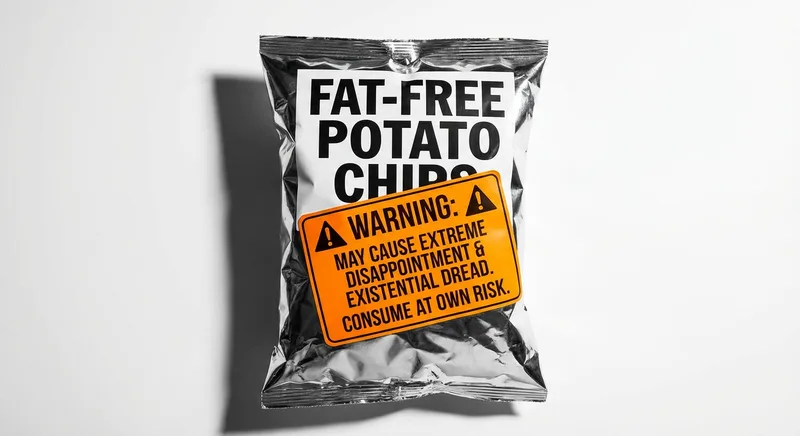
In the late 1990s, Procter & Gamble invented Olestra — a synthetic fat substitute that tasted like fat, cooked like fat, and had zero calories because the human digestive system could not absorb it. The molecule was too large to be broken down by digestive enzymes, which meant it passed through the body completely undigested, carrying fat-soluble vitamins with it and producing gastrointestinal side effects that the FDA, in its most heroically understated moment, described as "abdominal cramping and loose stools."
The consumer translation of "loose stools" was less clinical. The phrase that entered the American vocabulary — the phrase that will be forever associated with Olestra, with Lay's WOW chips, and with the hubris of the fat-free era — was "anal leakage."
Anal. Leakage. On a snack.
This phrase appeared on the packaging of Lay's WOW chips, required by the FDA as part of a mandatory warning label. You were in the grocery store. You picked up a bag of chips. The bag said "FAT FREE!" on the front. You turned it over. The back said "Olestra may cause abdominal cramping and loose stools." In some versions, the language was more specific. In all versions, the message was: these chips may cause your body to do things it should not do in your pants, at a party, in a movie theater, or anywhere you are wearing clothes.
Lay's WOW chips launched in 1998 and sold $400 million in the first year. Four hundred million dollars of chips that could cause anal leakage. Americans read the warning, looked at the fat-free claim, weighed the risk of public humiliation against the benefit of guilt-free Doritos, and four hundred million dollars' worth of them chose the chips.
Then their bodies chose differently.
The Vision: What If Fat, but Without Consequences? (There Were Consequences)
Olestra was the holy grail of the fat-free era — a period in American nutrition roughly spanning 1985-2005 when dietary fat was treated as the primary enemy and any product that eliminated fat was automatically considered healthy. Fat-free cookies. Fat-free ice cream. Fat-free salad dressing that tasted like sweetened sadness. The fat-free era was American food science's longest psychotic episode, and Olestra was its crowning achievement.
P&G spent over $500 million developing Olestra. The molecule — sucrose polyester — was a sugar molecule bonded with fatty acids in a structure too large for digestive enzymes to cleave. It provided the mouthfeel and cooking properties of fat while contributing zero digestible calories. On paper, it was perfect. On a chip, it was delicious. In a colon, it was a disaster.
Because Olestra passed through the digestive system unabsorbed, it carried fat-soluble vitamins (A, D, E, K) with it — literally flushing nutrients out of the body. More memorably, its passage through the intestines produced effects ranging from mild cramping to full gastrointestinal rebellion. The severity depended on how many chips you ate, which, given that the target audience was people who wanted to eat unlimited chips without guilt, was: a lot of chips.
"Nobody can eat just one" — Lay's slogan — became, in the context of WOW chips, less a marketing tagline and more a threat.
The Glorious User Experience
Kevin from Cincinnati, OH — ★☆☆☆☆
"I ate half a bag of WOW chips during a Bengals game. Halftime arrived. Something else also arrived. I spent the third quarter in the bathroom experiencing what I can only describe as my digestive system filing for divorce from my decision-making. My body was leaving me and taking the chips with it. I missed a 42-yard field goal. The chips missed nothing — they departed my body with a completeness that was almost admirable. One star."
Diane from Atlanta, GA — ★☆☆☆☆
"I brought WOW chips to a dinner party. I PUT THEM IN A BOWL. I offered them to my guests. Multiple guests ate them. By 9 PM, there was a line for the bathroom. A LINE. At a DINNER PARTY. Three people left early citing 'not feeling well.' Two others stayed but looked haunted. I poisoned a dinner party with Lay's. I am a domestic terrorist of snacking. One star."
Marcus from Denver, CO — ★☆☆☆☆
“The phrase that entered the American vocabulary — the phrase that will be forever associated with Olestra, with Lay's WOW chips, and with the hubris of the fat-free era — was "anal leakage”
Click to Tweet"The FDA warning said 'abdominal cramping and loose stools.' This is like describing a hurricane as 'wind and rain.' Technically accurate. Catastrophically insufficient. What happened to me after eating WOW chips was not 'loose stools.' What happened to me was an emergency. What happened to me was a spiritual experience. What happened to me cannot be described in a family publication. One star."
Jenny from Portland, OR — ★☆☆☆☆
"I was on a first date. I ordered a salad. He ordered wings with WOW chips on the side because he said he was 'being healthy.' He ate the chips. Twenty minutes later he excused himself to the restroom. He was gone for eleven minutes. When he returned, his face had the expression of a man who has seen something he cannot unsee. There was no second date. Olestra killed the romance. One star."
Brian from r/FoodHistory — ★☆☆☆☆
"Olestra is now primarily used as an industrial lubricant and paint additive. The fat substitute that was too slippery for your intestines found its true calling as a lubricant for machinery. The molecule that couldn't be a food became a chemical product. Everything Olestra did to your digestive system — the slipperiness, the uncontrollable passage — is exactly what makes it an effective industrial lubricant. Your intestines were the beta test. One star."
The Truth: $500 Million to Invent Industrial Lubricant
P&G spent over $500 million and 25 years developing Olestra. The FDA approved it in 1996 with a mandatory warning label — one of the few times in history the FDA approved a food additive while simultaneously requiring the manufacturer to warn consumers about the additive's gastrointestinal effects.
TIME magazine named Olestra one of the 50 Worst Inventions of all time. The Center for Science in the Public Interest received over 20,000 consumer complaints about Olestra-containing products — the most complaints the organization had ever received about a food ingredient. Reports included severe cramping, uncontrollable diarrhea, fecal urgency (the polite term for "sprinting to the bathroom"), and the side effect that shall not be named but which I have already named three times in this article.
The FDA eventually removed the mandatory warning label in 2003, not because Olestra's side effects had diminished but because the FDA determined that the warning label was discouraging consumption to an extent that prevented consumers from making their own choices. The government decided that people had the right to eat chips that might cause anal leakage without being warned about the anal leakage. This is either a triumph of personal freedom or a failure of common sense, depending on your relationship with snack-related intestinal emergencies.
Lay's WOW chips were rebranded as "Lay's Light" and still contain Olestra. The product exists today, quietly, on shelves, the warning label removed, the historical trauma suppressed, waiting for a new generation to discover what happens when you eat half a bag of fat-free chips and trust your body to handle a molecule it cannot digest.
Olestra's primary commercial use today: industrial lubricant and paint additive. The molecule that was too slippery for human intestines found its calling in manufacturing. P&G spent $500 million developing a food ingredient that turned out to be a better chemical product. The chips were the prototype. Your colon was the testing facility.
The Verdict
Lay's WOW chips are fat-free chips whose primary achievement is making the phrase "anal leakage" part of the American vocabulary. They represent the zenith of the fat-free era — the moment when the quest to remove fat from food reached its logical, catastrophic conclusion: a chip that tasted great, had no fat, and required you to remain within sprinting distance of a bathroom.
The chips worked. The body didn't cooperate. And the molecule that P&G spent $500 million developing is now used to lubricate machines, because machines don't have digestive systems and therefore cannot experience what Kevin from Cincinnati experienced during the third quarter of a Bengals game.
We rate it 1 out of 5 intact pairs of pants.
If you want chips that don't require emergency bathroom planning, see our alternatives below.
---
✅What to Buy Instead
Beanitos Black Bean Chips
High-fiber, high-protein chips that are genuinely healthy without gastrointestinal side effects. Your body can digest them. This is a feature.
Siete Grain-Free Tortilla Chips
Clean ingredients, great taste, zero industrial lubricant byproducts. Made from cassava and coconut. Your colon will not file a complaint.
Popcorn (Air-Popped)
Whole grain. High fiber. Low calorie. No emergency bathroom planning required. The fat-free snack that nature already made.
Comments
Sign in or create an account to join the discussion.