
Neutrogena Rapid Wrinkle Repair: The Brand Whose Slogan Was 'Safety Is Paramount' While Allegedly Selling Carcinogens
Benzophenone in the retinol. Benzene in the sunscreen. Neutrogena collected carcinogen concerns like loyalty points.
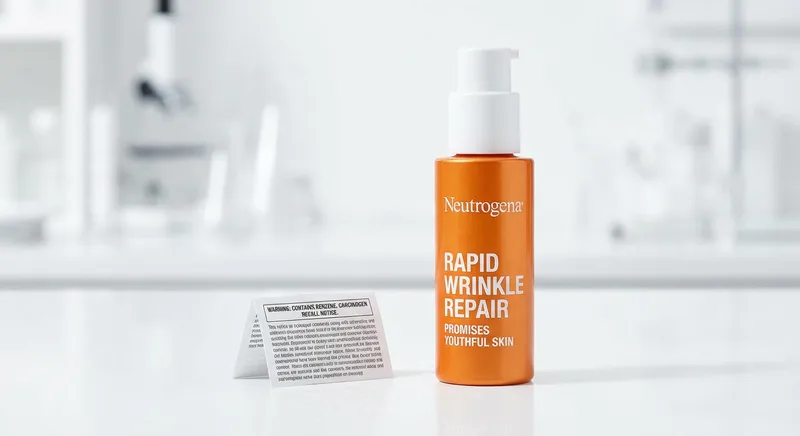
Neutrogena's corporate messaging includes the phrase "Safety Is Paramount." This phrase appeared on their website, in their materials, and as part of their brand identity. Safety. Is. Paramount. Three words. Clear. Definitive. The kind of statement that leaves no room for interpretation.
Now here's what was allegedly in their products.
Benzophenone — classified by the International Agency for Research on Cancer as a possible human carcinogen and identified as a potential endocrine disruptor — was allegedly present in Neutrogena Rapid Wrinkle Repair products. Lawsuits filed against Johnson & Johnson (Neutrogena's parent company) alleged that benzophenone was a degradation product or contaminant in the retinyl palmitate used in the formula. The lawsuits alleged that J&J knew or should have known about the presence of benzophenone and failed to disclose it.
Separately, in 2021, independent laboratory Valisure detected benzene — a known human carcinogen — in multiple Neutrogena sunscreen products, leading to a voluntary recall of certain aerosol sunscreens. Benzene causes leukemia. It was found in products people sprayed on their skin before going to the beach.
Two different carcinogenic concerns. Two different product lines. One brand. One slogan: "Safety Is Paramount."
The distance between the slogan and the product contents is the kind of distance that generates class-action lawsuits, which it did.
The Vision: Anti-Aging Through Retinol (and Allegedly Carcinogens)
Neutrogena Rapid Wrinkle Repair is a retinol-based anti-aging line — one of the most popular drugstore retinol products in America. Retinol (vitamin A) is a legitimate, well-studied anti-aging ingredient. It promotes cell turnover, stimulates collagen production, and reduces the appearance of fine lines and wrinkles. Dermatologists recommend retinol. The ingredient works.
The concern is not the retinol itself but what allegedly came with it. Retinyl palmitate — the form of retinol used in Rapid Wrinkle Repair — can degrade into benzophenone under certain conditions, including exposure to UV light and heat. Lawsuits alleged that J&J's formulation and packaging did not adequately prevent this degradation, resulting in consumers applying a potential carcinogen to their faces as part of their anti-aging routine.
The irony writes itself: a product designed to fight the signs of aging allegedly contained an ingredient linked to cancer, which is the ultimate accelerator of aging. The wrinkle repair was allegedly accompanied by a carcinogenic risk. The anti-aging product allegedly contained a substance associated with the worst possible outcome of aging.
The Glorious User Experience
Melissa from San Diego, CA — ★☆☆☆☆
"I used Neutrogena Rapid Wrinkle Repair every night for three years. Every. Night. I applied it to my face, my neck, my hands. I was diligent. I was consistent. I was, according to the lawsuits, consistently applying a potential carcinogen to the parts of my body I was trying to keep young. I wanted to fight wrinkles. The product allegedly came with a side of cancer risk. These are not the same anti-aging strategy. One star."
David from Houston, TX — ★☆☆☆☆
"I used their sunscreen at the beach. Their retinol at night. I was allegedly exposing myself to benzene and benzophenone from the same brand in the same 24-hour period. Morning carcinogen, evening carcinogen. A comprehensive schedule. 'Safety Is Paramount' should have an asterisk. One star."
“The kind of statement that leaves no room for interpretation”
Click to TweetKaren from Phoenix, AZ — ★☆☆☆☆
"I chose Neutrogena specifically because they were the '#1 Dermatologist Recommended' brand. That recommendation meant safety to me. It meant that doctors I trusted had evaluated this brand and found it worthy. When the benzene recall happened and the benzophenone lawsuits followed, I didn't just lose trust in Neutrogena. I lost trust in the recommendation. If the #1 dermatologist-recommended brand has carcinogen concerns, what does that recommendation even mean? One star."
Janet from Chicago, IL — ★☆☆☆☆
"I keep the recall notice and the product in a drawer together. Not because I plan to use it. Because I want to remember what 'Safety Is Paramount' looks like when it's sitting next to a product that was recalled for containing a known carcinogen. It's an art installation about corporate messaging. One star."
The Truth: When '#1 Dermatologist Recommended' Meets Carcinogen Concerns
The Neutrogena brand carries enormous consumer trust. "#1 Dermatologist Recommended" is not just a tagline — it's a clinically earned designation based on surveys of dermatologists. The brand has built decades of credibility on the premise that its products are safe, effective, and doctor-approved.
The benzene sunscreen recall in 2021 and the benzophenone lawsuits created a credibility crisis not just for Neutrogena but for the "#1 Recommended" category itself. Consumers who chose Neutrogena specifically because of the dermatologist recommendation felt that the recommendation had failed them. The recommendation is based on the product's intended formulation — not on contamination or degradation that occurs after manufacturing.
J&J's response to the benzene contamination was to recall affected products and reformulate. The benzophenone lawsuits are separate and ongoing, with J&J maintaining that their products are safe.
The broader industry issue is quality control and stability testing. Retinyl palmitate's potential to degrade into benzophenone under UV exposure is known in cosmetic chemistry. Formulations should include stabilizers and packaging should minimize light and heat exposure. Whether Neutrogena's formulation adequately addressed these degradation pathways is a central question in the litigation.
"Safety Is Paramount" is a brand promise. The lawsuits allege the brand didn't keep it. The truth, as always, will be determined by courts. But the gap between the slogan and the allegations is wide enough to fit a class-action lawsuit, which is exactly what happened.
The Verdict
Neutrogena Rapid Wrinkle Repair is a mainstream retinol product from a trusted brand that is now defending itself against allegations of carcinogenic contamination. The retinol works. The brand's reputation worked. What allegedly didn't work was the formulation's ability to remain free of carcinogenic byproducts.
"Safety Is Paramount" is a statement of corporate values. When the products allegedly don't reflect those values, the statement becomes evidence — not of safety, but of the gap between what a corporation says and what its products contain.
We rate it 1 out of 5 paramount safeties.
If you want effective retinol without carcinogen concerns, see our alternatives below.
---
✅What to Buy Instead
La Roche-Posay Retinol B3 Serum
Dermatologist-developed retinol stabilized with vitamin B3. French pharmaceutical skincare — they take formulation stability seriously.
CeraVe Skin Renewing Retinol Serum
Affordable retinol with ceramides to support the skin barrier. Encapsulated retinol for stability. No degradation drama.
The Ordinary Retinol 0.5% in Squalane
Clinical-strength retinol for $6.50 with transparent, minimal ingredients. You can read the ingredient list without a chemistry degree or a lawyer.
Comments
Sign in or create an account to join the discussion.