
The Ouya: The $99 Console That Proved You Get Exactly What You Pay For
How 63,000 Kickstarter backers funded the gaming equivalent of a Rubik's cube that plays phone games on your TV
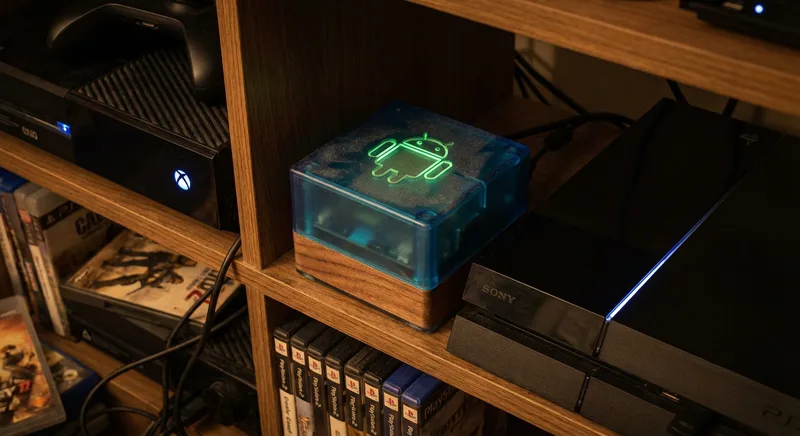
"What if you could press a button and reset the entire video game industry?"
That was the tagline. The actual Ouya experience was closer to: "What if you pressed a button and nothing happened because the button was stuck under the aluminum faceplate of the worst controller ever manufactured?"
In July 2012, Julie Uhrman launched a Kickstarter for a tiny Android-based gaming console the size of a Rubik's cube. It would cost $99. Every game would be free to try. Every console would double as a developer kit. It would democratize gaming. It would topple Sony, Microsoft, and Nintendo. It would, in Uhrman's words, "open the last closed platform: television."
The Kickstarter raised $8.5 million from 63,416 backers — nearly nine times its goal and the fastest first-day fundraise in Kickstarter history. The gaming press swooned. Investors circled. The revolution was coming.
Then they shipped the thing, and the revolution was postponed indefinitely due to the controller not working.
The Vision: A Cube That Would Destroy PlayStation
The promise of the Ouya was intoxicating to anyone who'd ever dreamed of making a video game. For $99, you got a console. Every console was also a development kit. No licensing fees. No corporate gatekeepers. Just you, your game, and a direct pipeline to millions of living rooms.
Indie developers would finally be free from the tyranny of publishers. Gamers would access hundreds of titles for free. The gaming industry would be disrupted, democratized, and reborn.
The hardware specs told a slightly different story. The Ouya ran on an Nvidia Tegra 3 chip — the same processor found in mid-range Android tablets from 2012. It had 1 GB of RAM and 8 GB of storage, which is enough space for roughly seven photographs of the console you'll soon wish you hadn't bought.
It ran a forked version of Android Jelly Bean, which, for context, was already outdated when the console launched. It connected to your TV via HDMI and to the internet via Wi-Fi, when the Wi-Fi worked, which was not a given.
But that was fine, supposedly, because the Ouya wasn't competing with the PlayStation 4 and Xbox One. It was creating a new category. It was the "microconsole." It was going to do for gaming what the Kindle did for books.
This comparison conveniently ignored the fact that the Kindle was good.
The Glorious User Experience
Tyler from Portland, OR — ★☆☆☆☆
"The controller arrived with a broken right shoulder button. Out of the box. I hadn't even finished the setup process and the controller was already broken. The face buttons would stick under the aluminum faceplate, which you had to physically pry off with your fingernails to change the batteries, which were housed in two separate compartments on either side of the controller, making the entire thing feel like it was about to disassemble in your hands like a stress toy from a dollar store. Also there was no rumble. Also there was no Start button. This is not a game controller. This is a prank."
Heather from Columbus, OH — ★☆☆☆☆
"I was a Kickstarter backer. I pledged my $99 in 2012 with genuine excitement. When did I receive my console? After it was already on sale at Best Buy for everyone else to buy. I funded this thing's existence and I was the last person to receive it. The card inside my box said 'Thank you for believing.' Retail purchasers got a card that said 'And so begins the revolution.' So the retail customers got the revolution and the people who made it possible got a thank-you note and a broken controller. Revolutionary indeed."
Derek from Austin, TX — ★★☆☆☆
"I opened the Ouya store expecting the promised 600+ games and found approximately 600 games I would not play under any circumstances. The 'killer exclusive' was TowerFall, which is genuinely great, and which sold exactly 7,000 copies in its first year because 7,000 is approximately how many Ouya owners wanted to play anything at all. Seventy-three percent of Ouya owners never purchased a single game. Not one. The free-to-play requirement meant every game had a free version, and seventy-three percent of the customer base collectively decided the free version was sufficient and the paid version was a moral hazard."
“"In July 2012, Julie Uhrman launched a Kickstarter for a tiny Android-based gaming console the size of a Rubik's cube”
Click to TweetRick from Minneapolis, MN — ★☆☆☆☆
"I unboxed the Ouya at an angle other than face-up and the console and controller fell out of the packaging and onto the floor. This is the first impression. You open the box and the product falls on the ground. The packaging did not secure the console in any way. There was no insert, no clip, no friction — just gravity and vibes. The console hit my hardwood floor, I said a word I can't repeat here, and then I spent forty-five minutes trying to connect to Wi-Fi because the Wi-Fi didn't work properly. One star. The console hit the floor harder than it hit the market."
The Truth: 73% of Owners Never Bought a Single Game
The Ouya launched on June 25, 2013 — three months after Kickstarter backers were supposed to receive theirs, and several weeks after many of them still hadn't. Retail units hit Best Buy shelves before backers got their boxes, a sin in the crowdfunding world roughly equivalent to a restaurant seating walk-ins before the people with reservations.
Reviews were polished with the kind of carefully chosen language critics use when they're trying to be fair to something that doesn't deserve it. ExtremeTech found "a number of serious faults," including the controller, the connectivity, and the fact that games running flawlessly on smartphones stuttered on the Ouya.
The Verge noted the controller's "mushy D-pad and stiff face buttons." Nearly every reviewer circled back to the same fundamental question: why would anyone play phone games on their TV using a broken controller when they could play those same games on their phone using their fingers?
The game library was the critical failure. The Ouya store was a graveyard of half-finished mobile ports, bizarre indie projects that existed because the barriers to entry were nonexistent, and emulators for classic consoles that worked better than anything the Ouya actually sold.
Its most popular game, TowerFall, sold 7,000 copies — and its developer promptly ported it to PlayStation, where it became a genuine hit. The message was clear: the Ouya was a stepping stone that developers used to reach better platforms, not a destination anyone wanted to stay on.
Then there was the "Free the Games Fund," a scheme where Ouya would match Kickstarter campaigns for exclusive games dollar-for-dollar. This was immediately exploited by scammers who created fake campaigns, collected Ouya's matching funds, and produced nothing. The initiative designed to build the Ouya's game library instead became a cautionary tale about why you shouldn't hand money to strangers on the internet — a lesson the Ouya's original Kickstarter backers were also learning in real time.
Four months after launch, Ouya announced plans for a completely new version of the console. Four months. They hadn't finished selling the first one and they were already publicly admitting it needed to be replaced. This is the hardware equivalent of a restaurant opening night featuring the chef personally apologizing and promising the menu will be better next time.
The Ouya sold approximately 200,000 units total. For context, the PlayStation 4 sold one million units in its first 24 hours. In 2015, Ouya was acquired by Razer, which integrated the software into its own Forge TV platform before quietly pulling the plug entirely. Ouya's servers were shut down in June 2019.
The console that was going to reset the entire video game industry ended up being reset by the company that makes gaming mice.
The Verdict
The Ouya is the purest distillation of Kickstarter optimism colliding with physical reality. On paper, it was beautiful: affordable, open, democratic, revolutionary. In your hands, it was a tiny cube with a broken controller, a barren game store, and Wi-Fi that worked when it felt like it.
Seventy-three percent of its owners never paid for a single game, which is either an indictment of the game library or the most honest consumer review in gaming history.
The tagline asked: "What if you could press a button and reset the entire video game industry?"
The answer, it turns out, is that the button gets stuck, the reset fails, and the video game industry continues exactly as before, only now 63,000 people are out $99 and have a very small paperweight.
We rate it 1 out of 5 functional buttons.
If you want to play actual games on an actual console that actually works, see our alternatives below.
---
✅What to Buy Instead
Nintendo Switch 2
Portable and home console hybrid with the best exclusive game library in gaming. People actually buy these games. Millions of them.
Xbox Series S
Affordable next-gen console at $299 with Game Pass access to hundreds of quality titles on day one. The Ouya's promise, delivered by a company that knows how.
Steam Deck OLED
Portable PC gaming with access to your entire Steam library and a gorgeous OLED screen. The Ouya's dream, realized by adults.
Comments
Sign in or create an account to join the discussion.