
The USB Desktop Vacuum Cleaner: A Vacuum So Small and Weak It Lost a Fight with a Single Crumb
$15 for a device that's too small for your desk, too big for your keyboard, and too weak for the concept of suction
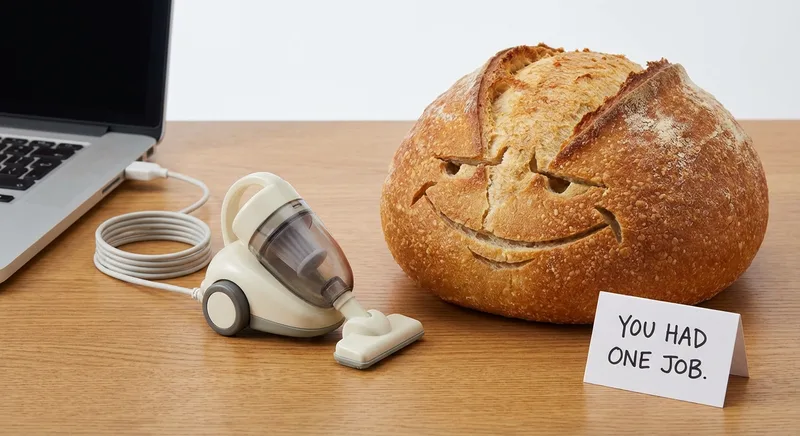
Somewhere in a factory in Shenzhen, someone looked at a USB port and thought: "What if vacuum, but pathetic?"
The USB Desktop Vacuum Cleaner is a miniature vacuum approximately the size of a coffee mug that plugs into your computer's USB port and produces a suction force so weak that describing it as "suction" feels legally actionable. It is marketed as a desktop cleaning solution for crumbs, dust, and keyboard debris. In practice, it cannot pick up a crumb unless the crumb is actively trying to be picked up. It cannot clean a keyboard because it's too fat to fit between the keys. It cannot clean a desk because the nozzle is the width of a drinking straw and the suction is the strength of a polite exhale.
This product has the suction power of someone blowing on a birthday candle from across the room. It has the cleaning ability of a Roomba that died and was reincarnated as a USB stick with an inferiority complex. It is, in every measurable way, worse than picking crumbs up with your fingers — a technology that is free, universally available, and has been beta-tested by every human who has ever eaten a sandwich at their desk.
You can buy a $5 can of compressed air that blasts debris off your keyboard with the focused fury of a tiny hurricane. Or you can buy a $15 USB vacuum that approaches your keyboard debris with the energy of a grandparent trying to pick up a piece of rice with chopsticks. These are your options. The market has decided. The can of air outsells the USB vacuum by approximately one thousand to one, because the market is occasionally rational.
The Vision: Clean Desk, Clean Conscience, Clean Nothing
USB desktop vacuums exist in a product category I call "desk fidgets for people who think they're being productive." They're bought by the same people who buy desk fountains, USB-heated coasters, and mousepad wrist rests that claim to prevent carpal tunnel through the power of gel. They are accessories for the accessory-minded — products that make your desk look like you care about your workspace while your workspace remains exactly as dirty as it was before.
The marketing shows a tiny vacuum gliding across a desk surface, picking up crumbs and dust with elegant efficiency. The reality is a tiny vacuum being pushed across a desk surface, failing to pick up crumbs and dust, and being placed in a drawer where it will remain until you move offices or die, whichever comes first.
The Glorious User Experience
Tyler from San Jose, CA — ★☆☆☆☆
"I pressed this thing against a Cheez-It crumb. A single Cheez-It crumb. The vacuum's motor whirred. The crumb didn't move. I pressed harder. The crumb rolled slightly to the left, not because of suction, but because I was pressing a physical object against it. I was not vacuuming. I was pushing. The USB vacuum had become a $15 crumb-pushing stick. I then picked up the Cheez-It crumb with my fingers, ate it, and unplugged the vacuum forever."
Rebecca from Denver, CO — ★☆☆☆☆
"The nozzle attachment is too wide to fit between keyboard keys, which is the ONE PLACE desk debris actually accumulates. It can't clean the surface of the desk because the suction can't handle anything heavier than a piece of lint the size of an eyelash. It exists in a dimensional no-man's-land — too big for precision, too small for coverage, too weak for anything. It is a vacuum designed for a surface that doesn't exist, powered by a USB port that wasn't asking for this responsibility."
Dan from Chicago, IL — ★☆☆☆☆
“In practice, it cannot pick up a crumb unless the crumb is actively trying to be picked up”
Click to Tweet"I timed it. I timed how long it took to 'vacuum' my desk with this versus how long it took to wipe my desk with my hand. The USB vacuum: four minutes of pushing crumbs around in circles while the motor made a noise like a mosquito having a panic attack. My hand: eight seconds, crumbs in the trash, done. The USB vacuum is slower, louder, less effective, and cost $15. My hand was free and came pre-installed at birth. One star."
Lisa from Portland, OR — ★★☆☆☆
"Two stars because it's cute. That's it. That's the entire review. It's cute sitting on my desk. It's a decorative object that happens to contain a motor. It's the desk equivalent of a decorative throw pillow — present, ornamental, useless. If you want a tiny desk ornament that makes a noise, two stars. If you want a vacuum, zero stars, because this is not a vacuum."
The Truth: $15 for a Device Outperformed by Lungs
The USB desktop vacuum's fundamental problem is physics. USB 2.0 ports provide 2.5 watts of power. USB 3.0 provides 4.5 watts. A handheld vacuum — the smallest functional vacuum you can buy — uses 20-50 watts. A $5 can of compressed air uses zero watts but stores approximately 500 PSI of pressure that it unleashes in a focused stream.
The USB vacuum is trying to create meaningful suction with the power budget of a phone charger. This is like trying to tow a car with a bicycle chain. The chain exists. The connection exists. The force does not.
The motor in a typical USB desk vacuum produces approximately 0.1-0.3 watts of actual suction power — enough to pick up very fine dust, individual hairs, and crumbs that are small enough to be lifted by a force roughly equivalent to someone whispering at them. Anything heavier than a grain of sand requires the user to physically press the nozzle against the debris and drag it toward the vacuum's opening, at which point you are not vacuuming. You are sweeping with extra steps.
The DataVac Electric Duster — an actual compressed-air replacement that plugs into a wall outlet — delivers 500 watts and can blast debris off a keyboard, out of a computer case, and across a room with the authority of a device that understands what "clean" means. It costs $60-80 and lasts for years, replacing hundreds of compressed air cans. It is the nuclear option for desk cleaning, and it makes the USB vacuum look like what it is: a toy.
The Verdict
The USB Desktop Vacuum Cleaner is a product that fails at the fundamental requirement of being a vacuum, which is suction. Without suction, a vacuum is a motor in a shell. Without a motor strong enough to create suction, a vacuum is a noise-making desk ornament. Without a nozzle the right size for the surfaces it's meant to clean, even good suction would be useless. The USB desktop vacuum fails on all three counts and costs $15 for the privilege.
Your fingers are free. A can of compressed air is $5. A DataVac is $70 and lasts forever. The USB desktop vacuum is $15 for something that can't pick up a Cheez-It. The math is clear. The crumb is still on your desk.
We rate it 1 out of 5 sucked crumbs.
If you want your desk clean — actually clean, not "tiny motor whirring while crumbs remain" clean — see our alternatives below.
---
✅What to Buy Instead
DataVac Electric Duster
500 watts of focused air that blasts dust off keyboards, out of computers, and into the next room. Does what the USB vacuum pretends to do.
Metro DataVac Pro
Professional-grade electric duster used by IT departments worldwide. Replaces hundreds of compressed air cans. The USB vacuum's disappointed father.
Compressed Air Can
A $5 can of air that outperforms the $15 USB vacuum by several orders of magnitude. Point, spray, clean. No USB port required. No dignity surrendered.
Comments
Sign in or create an account to join the discussion.